
Trimethoprim-Sulfamethoxazole and Warfarin: Why INR Rises and How to Stay Safe
 Feb, 7 2026
INR Risk Calculator for Warfarin and TMP-SMX
This calculator estimates how trimethoprim-sulfamethoxazole (TMP-SMX) might affect your INR while taking warfarin. Based on clinical evidence, TMP-SMX can increase INR by 1.5 to 2.5 points within 36-72 hours.
Note: This is a general estimation tool. Your actual INR response may vary based on individual factors like age, liver function, and other medications. Always consult your healthcare provider for personalized medical advice.
Estimated INR After TMP-SMX
Based on 2023 clinical data showing TMP-SMX increases INR by an average of 1.8 units. This calculator uses the average increase (2.0 points) for estimation.
When you're on warfarin, even a simple antibiotic can turn dangerous. Take trimethoprim-sulfamethoxazole-commonly sold as Bactrim or Septra. It’s often prescribed for urinary tract infections, sinus infections, or pneumonia. But if you're taking warfarin to prevent blood clots, mixing these two can spike your INR fast-and put you at serious risk of internal bleeding.
INR, or International Normalized Ratio, measures how long it takes your blood to clot. A normal range for someone on warfarin is usually between 2.0 and 3.0. But when TMP-SMX enters the picture, that number can jump by 1.5 to 2.5 points in just a couple of days. That’s not a small change. An INR over 4.0 means your blood is taking much longer to clot. Above 5.0? You’re in danger zone. And if it hits 8 or higher? That’s a medical emergency.
Why This Interaction Happens
This isn’t just a coincidence. It’s science. Warfarin works by blocking vitamin K, which your body needs to make clotting factors. But it doesn’t just float around freely. About 97% to 99% of it sticks tightly to proteins in your blood-mostly albumin. When another drug like sulfamethoxazole (part of TMP-SMX) comes along, it pushes warfarin off those protein sites. Suddenly, more warfarin is floating around in your bloodstream, active and unbound. That’s one reason your INR rises.
The second reason hits harder. Warfarin comes in two forms: S-warfarin and R-warfarin. S-warfarin is three to five times more powerful at thinning your blood. And guess what? Your liver uses an enzyme called CYP2C9 to break it down. Trimethoprim? It’s a moderate inhibitor of CYP2C9. So when you take TMP-SMX, your body can’t clear S-warfarin as quickly. It builds up. And that’s why your INR climbs-sometimes dramatically.
There’s a third factor: your gut. Sulfamethoxazole doesn’t just affect your blood. It kills off some of the good bacteria in your intestines that make vitamin K. Less vitamin K means even less ability to counteract warfarin’s effect. It’s a triple hit-displacement, enzyme block, and reduced vitamin K production.
How Fast Does It Happen?
Timing matters. You won’t see a spike right away. Most patients start seeing their INR rise within 36 to 72 hours after taking the first dose of TMP-SMX. That’s why waiting until your next scheduled INR check is a bad idea. If you’re on warfarin and your doctor prescribes Bactrim for a UTI, don’t wait. Get your INR tested within 48 hours-no exceptions.
Real-world data backs this up. A 2023 study tracking over 70,000 patients found that those who took TMP-SMX while on warfarin had an average INR increase of 1.8 units. Compare that to amoxicillin, which only raised INR by 0.4 units. Even ciprofloxacin, another common antibiotic, only pushed it up by 0.9. TMP-SMX isn’t just a mild interaction-it’s one of the strongest out there.
Who’s at Highest Risk?
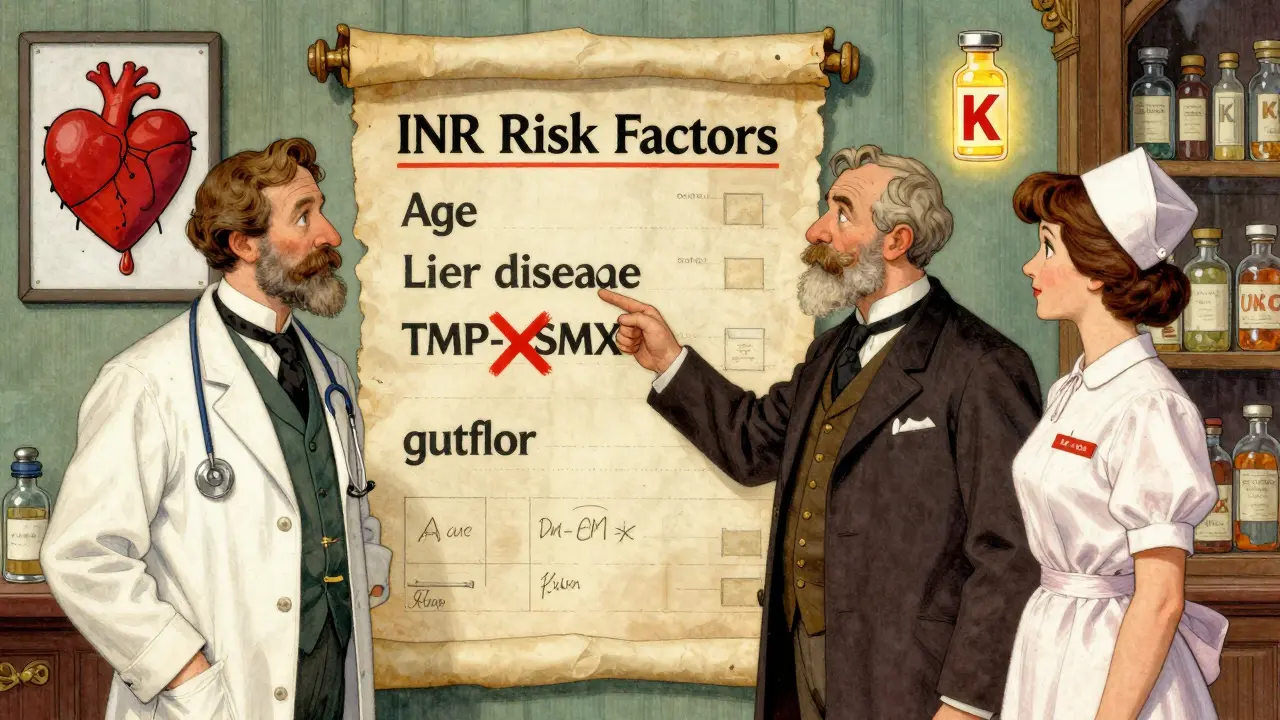
Not everyone reacts the same way. Some people take TMP-SMX and their INR barely budges. Others go from 2.5 to 6.0 in three days. Why? Several factors make the risk worse:
- Age over 75-slower metabolism, less liver function, more sensitivity.
- Liver disease-your liver can’t process warfarin properly even without antibiotics.
- Heart failure-poor circulation means drugs stick around longer.
- Poor nutrition-low vitamin K intake from greens, dairy, or eggs makes your body even more vulnerable.
- Male gender-studies show men are 9% more likely than women to have dangerous INR spikes.
One nurse practitioner in a Midwest clinic told of five elderly patients in six months-all on warfarin for atrial fibrillation-who got Bactrim for a UTI. All five had INRs jump above 6.0. Two needed vitamin K. One ended up in the ICU with a brain bleed.
What to Do If You’re Prescribed TMP-SMX
If you’re on warfarin and your doctor says you need TMP-SMX, here’s what you must do:
- Ask if there’s an alternative. Nitrofurantoin is often a safe choice for UTIs. Amoxicillin is safer than TMP-SMX for most infections. Don’t assume Bactrim is the only option.
- Get your INR tested before starting. Know your baseline. If it’s already near 3.0, you’re already on the edge.
- Test again within 48 hours. Don’t wait for your next routine check. This isn’t optional.
- Reduce your warfarin dose preemptively. In high-risk patients, experts recommend cutting your weekly dose by 20-30% before starting the antibiotic. This isn’t guesswork-it’s standard protocol at major hospitals.
- Watch for bleeding signs. Unexplained bruising, nosebleeds, blood in urine or stool, headaches, dizziness, or vomiting blood? Go to the ER immediately.
What If Your INR Already Spiked?
Here’s what doctors do based on how high your INR goes:
- INR 4.0-5.0, no bleeding: Skip 1-2 doses of warfarin. Resume at a lower dose. Recheck in 2-3 days.
- INR 5.0-10.0, minor bleeding (bruising, nosebleeds): Take 1-2.5 mg of oral vitamin K. Recheck INR in 24 hours.
- INR over 10.0 or severe bleeding (vomiting blood, brain bleed): IV vitamin K (5-10 mg) + 4-factor prothrombin complex concentrate (PCC). This reverses the effect within hours. Emergency hospitalization required.
One 78-year-old man with a mechanical heart valve had an INR of 8.2 after three days of TMP-SMX. He was vomiting blood. He got IV vitamin K and PCC. He survived. But he spent 11 days in the hospital. His family said they never knew antibiotics could do this.

Why This Still Matters in 2026
You might think, "But everyone’s on DOACs now-apixaban, rivaroxaban, dabigatran." That’s true. Direct oral anticoagulants (DOACs) have replaced warfarin for many people. But over 2.6 million Americans still take warfarin in 2026. Why? Because DOACs aren’t safe for everyone. People with mechanical heart valves, certain types of clotting disorders, or severe kidney disease still need warfarin. And for them? TMP-SMX remains a ticking time bomb.
Even more alarming: a 2022 study in JAMA Internal Medicine found that nearly 19% of warfarin patients got an antibiotic within 30 days-and nearly 3 out of every 10 of those were TMP-SMX. That’s not rare. That’s routine. And it’s still happening in clinics across the country.
What Patients Should Remember
There’s no magic bullet. But there are simple rules:
- Always tell every doctor you see that you’re on warfarin-even your dentist.
- Never take a new antibiotic without checking with your anticoagulation clinic or pharmacist.
- Keep a log of your INR numbers and when you took antibiotics.
- Know the signs of bleeding. Don’t wait for "something bad" to happen.
- If you’re told "it’s just a short course," ask: "Is this the safest option?"
One patient in Perth told his pharmacist he’d taken Bactrim before without issues. The pharmacist replied, "That doesn’t mean it’s safe now. Your liver changes. Your diet changes. Your INR target might’ve changed. This isn’t about history-it’s about now."
Final Thought
Antibiotics save lives. But some of them can kill you if you’re on warfarin. TMP-SMX isn’t the only offender-but it’s one of the most dangerous. The good news? You can prevent this. You don’t need to be a doctor. You just need to ask questions, get tested, and speak up. Your life depends on it.
Can I take Bactrim if I’m on warfarin?
Bactrim (trimethoprim-sulfamethoxazole) should be avoided if possible when taking warfarin. It significantly raises INR and increases bleeding risk. If no other antibiotic works, use it only under close medical supervision-with INR checks within 48 hours of starting and a possible warfarin dose reduction.
How long does the INR elevation last after stopping Bactrim?
The effect can last 5 to 10 days after stopping Bactrim, since warfarin’s effects linger and the body needs time to restore gut bacteria and enzyme function. INR should be monitored daily or every other day during this period until it returns to target range.
Are there antibiotics that are safe with warfarin?
Yes. Amoxicillin, cephalexin, and nitrofurantoin generally have minimal effect on INR. Azithromycin and clindamycin are also low-risk. Always confirm with your pharmacist or anticoagulation clinic before taking any new antibiotic.
What should I do if my INR is over 5.0?
If your INR is over 5.0 and you have any bleeding (bruising, nosebleed, blood in stool), contact your doctor immediately. For INR 5.0-10.0 without bleeding, you may be advised to skip warfarin doses and take oral vitamin K. Always follow medical guidance-do not self-treat.
Can I take vitamin K to prevent INR spikes?
No. Taking vitamin K daily to "prevent" spikes is dangerous and can make your warfarin ineffective. Vitamin K should only be used under medical supervision to reverse dangerously high INR. Do not self-administer.
Why do some people have no reaction to TMP-SMX?
Genetics play a role. People with certain CYP2C9 gene variants metabolize warfarin differently. Some have faster enzyme activity, so even with inhibition, their warfarin levels don’t rise as much. Others have more stable gut flora or higher vitamin K intake. But you can’t predict your response-so testing is essential.
Mary Carroll Allen
February 7, 2026 AT 10:03OMG I just had this happen to me last month-was on Bactrim for a UTI and didn’t think twice because I’d taken it before. My INR jumped from 2.8 to 7.1 in 72 hours. I was dizzy, bruising everywhere, and had a nosebleed that wouldn’t stop. ER visit. Vitamin K. Now I keep a list of every med I’m on and show it to every doc. Don’t be like me-ask questions before you swallow that pill.
Sarah B
February 8, 2026 AT 03:18Warfarin users need to stop being lazy. If you’re on this drug you’re already high risk. Don’t wait for a doctor to warn you. Read the damn label. Bactrim = danger. Period. No excuses.
Tola Adedipe
February 8, 2026 AT 21:25I’m a pharmacist in Toronto and I’ve seen this too many times. A 79-year-old man came in last week with INR 8.5 after a 3-day course of Bactrim. He thought "it’s just a little infection." We gave him IV vitamin K and PCC. He’s home now. But here’s the kicker-he’d been on warfarin for 12 years and never had a single INR check outside his scheduled window. That’s not negligence. That’s a systemic failure. Pharmacies need to flag these interactions automatically. And patients? You have to be your own advocate. Don’t assume your doctor knows every interaction.
Mark Harris
February 10, 2026 AT 17:59Bro this is wild but also so important. I’m on warfarin for AFib and I never knew antibiotics could do this. I thought it was just about food or alcohol. Now I’m telling everyone I know. My grandma’s on it too. I just texted her the whole article. She’s 81 and still drives herself to the clinic. She’s gonna start checking her INR every 48 hours if she gets any script. We’re all gonna be better now.
Marcus Jackson
February 11, 2026 AT 09:02Look. The science here is solid. But let’s be real. Most docs don’t know this. I’ve had three primary care docs prescribe Bactrim to warfarin patients without even blinking. One even said "it’s fine if they’re careful." Careful? Your INR can go from 2.5 to 6.0 in 48 hours. That’s not careful. That’s a ticking time bomb. This isn’t a "maybe". It’s a hard stop. If you’re prescribing this combo, you’re not just careless-you’re dangerous.
Natasha Bhala
February 12, 2026 AT 01:56Just got back from my INR check. 2.9. Felt good. But now I’m scared. I took Bactrim last year for a sinus infection. No symptoms. No warning. I didn’t even know to check. I’m gonna start keeping a log. Like, a little notebook. INR. Antibiotics. Dates. Maybe I’ll even print out this article and stick it on my fridge. Just in case I forget. Thanks for the heads up. I needed this.
Paula Sa
February 12, 2026 AT 20:52There’s something deeply human here. We think of medicine as this cold, mechanical system. But it’s not. It’s a web of fragile biology-liver enzymes, gut bacteria, protein binding, gene variants. And we’re all just trying to survive it. The fact that one antibiotic can unravel months of careful dosing… it’s terrifying. But also beautiful. It shows how interconnected we are. We’re not just patients. We’re ecosystems. And when we stop seeing ourselves that way, we stop caring. This post reminds us: your body is listening. Always.
Jesse Lord
February 13, 2026 AT 16:48I’m a nurse and I’ve seen this too. Last month, a guy came in with a GI bleed. INR 11. He’d been on Bactrim for a UTI. Said his doctor told him "it’s fine." I pulled his chart. He’d had three INR checks in the last 6 months. All within range. But he didn’t know to check after the antibiotic. We’re failing people because we assume they know. They don’t. We need better systems. Like automated alerts in EHRs. Or mandatory counseling when Bactrim is prescribed to a warfarin patient. Not just a pamphlet.
Ashley Hutchins
February 14, 2026 AT 18:41People who take warfarin are basically asking for trouble. You think you’re safe because you check your INR? Nope. You’re just delaying the inevitable. You’re a walking time bomb. And now you want to blame the antibiotic? The real problem is you’re on warfarin at all. DOACs exist for a reason. Stop being stubborn. Get off it. Or at least stop being so careless. This isn’t rocket science. It’s basic biology. And you’re failing it.
Lakisha Sarbah
February 15, 2026 AT 13:24My mom’s on warfarin. She’s 77. Had a stroke 5 years ago. She’s super careful. Always checks her INR. Never misses a dose. But she took Bactrim last year for a bladder infection. Didn’t tell anyone. Said it was "just a little thing." INR went to 6.3. She was fine. But she didn’t know. That’s the scary part. Not the medicine. The silence. I’m making her a little card. "If you take ANY new med, call me first." I’m putting it on her fridge. Right next to her meds.