
Specialty Pharmacy and Generics: Key Practice Challenges and Strategies
 Dec, 5 2025
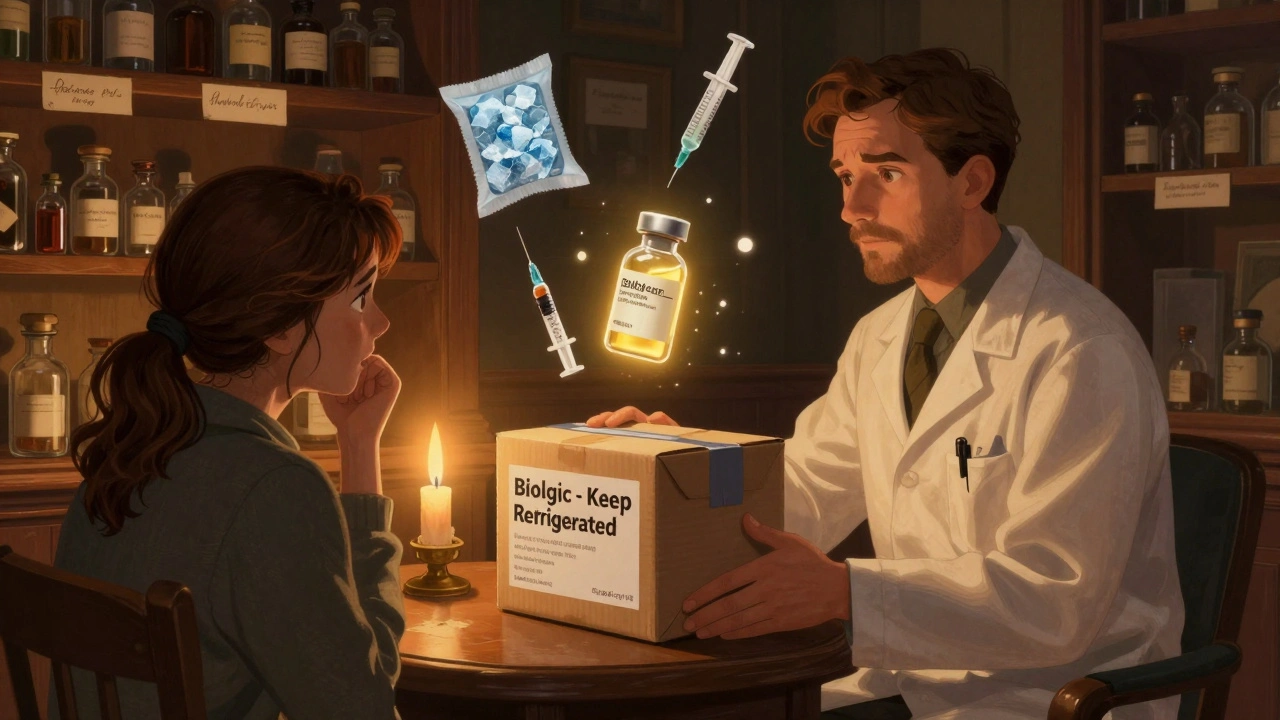
When a patient with multiple sclerosis starts a new treatment, they don’t just get a prescription-they get a whole support system. That’s the reality of specialty pharmacy. These pharmacies handle high-cost, complex drugs for chronic conditions like cancer, rheumatoid arthritis, and hepatitis C. Many of these drugs are biologics: large, delicate molecules that need cold storage, special handling, and close monitoring. But here’s the twist: as patents expire, generics and biosimilars are creeping into this high-stakes space. And that’s where things get complicated.
What Makes Specialty Pharmacy Different?
Specialty pharmacy isn’t just about dispensing pills. It’s about managing entire treatment journeys. These medications often cost over $1,000 a month. Some exceed $100,000 a year. Unlike a typical statin or blood pressure pill, they’re not picked up off a shelf. They’re shipped with ice packs, tracked through supply chains, and accompanied by nurse calls, adherence programs, and lab monitoring. The FDA requires brand-name specialty drugs to go through years of clinical trials before approval. But when generics enter the picture, the rules change. For small-molecule drugs, generics must prove bioequivalence-meaning they deliver the same active ingredient at the same rate and extent as the brand. That’s straightforward for a pill like metformin. But for a biologic like Humira? That’s not possible. Instead, we get biosimilars. Biosimilars aren’t exact copies. They’re highly similar versions of complex biologic drugs, made from living cells. The FDA approved its first interchangeable biosimilar, Semglee (for insulin glargine), in 2021. By December 2023, 35 biosimilars had been approved. But approval doesn’t mean adoption. Many patients and providers still hesitate.Why Generics Don’t Always Fit in Specialty Pharmacy
In a regular pharmacy, 90% of prescriptions are filled with generics. That’s the norm. In specialty pharmacy? It’s often less than 10%. Why? Because most specialty drugs still have no generic alternative. Even when one exists, switching isn’t automatic. Take Copaxone, a drug for multiple sclerosis. When its generic version, glatiramer acetate, hit the market, the annual cost dropped from $78,000 to $45,000. That’s a huge savings. But many clinics didn’t switch immediately. Why? Because patients were stable. Changing the medication-even to an FDA-approved generic-could trigger unpredictable side effects. For drugs with a narrow therapeutic index (NTI), like levothyroxine or warfarin, even tiny differences in absorption can cause harm. Patients have reported confusion and anxiety when their medication changes color, shape, or size. One Reddit user wrote about switching from one generic levothyroxine to another and developing palpitations. Their pharmacist assured them it was bioequivalent. But bioequivalence doesn’t always mean identical patient experience. Inactive ingredients-fillers, dyes, coatings-can vary. For someone with a rare allergy or sensitivity, that matters.
The PBM Problem: When Cost-Cutting Backfires
Pharmacy Benefit Managers (PBMs) control most specialty drug reimbursement. They set prices, determine formularies, and track metrics like the Generic Dispensing Ratio (GDR). Here’s the catch: PBMs often penalize specialty pharmacies for not hitting GDR targets-even when no generic exists for the drug being dispensed. Imagine a specialty pharmacy that fills 100 prescriptions for a biologic with no generic version. The PBM still expects them to hit a 70% GDR. They don’t. The pharmacy gets fined. This creates a perverse incentive: pharmacies might avoid stocking drugs with no generics, even if those are the only options for patients. Or worse, they might pressure providers to switch patients to generics even when it’s not clinically safe. A 2023 survey from Specialty Pharmacy Times found that 65% of specialty pharmacy staff struggle with tracking multiple manufacturers of the same generic drug. Why? Because PBMs often push the cheapest version, regardless of consistency. One patient might get a generic from Manufacturer A this month, Manufacturer B next month. Their body adapts. Then the switch happens again. Side effects appear. The patient blames the drug. The provider blames the pharmacy. The PBM blames the patient.How Specialty Pharmacies Should Handle Generics
There’s a better way. It starts with policy. First, don’t assume all generics are equal. Build a preferred list based on evidence, patient outcomes, and supplier reliability. Don’t just pick the lowest price. Pick the one with the fewest complaints, the most consistent supply, and the best documentation. Second, document everything. If a patient has had a reaction to a specific generic manufacturer in the past, flag it in their record. If they’re on a stable dose of a biologic, don’t switch unless there’s a clear clinical benefit. For NTI drugs, consider holding off on substitution until the patient has been on the same version for at least 6 months. Third, train your team. Staff need to know how to explain biosimilars to patients. They need to recognize when a patient’s anxiety about a pill change is real-even if the science says it shouldn’t matter. A 2022 study found that 78% of specialty pharmacy staff cited patient concerns about generic substitution as a major workflow challenge. That’s not just a communication issue. It’s a trust issue. Fourth, partner with reliable distributors. McKesson Medical-Surgical recommends sourcing generics from a single, trusted distributor to avoid supply chain chaos. Mixing suppliers means more inventory errors, more labeling confusion, and more patient complaints.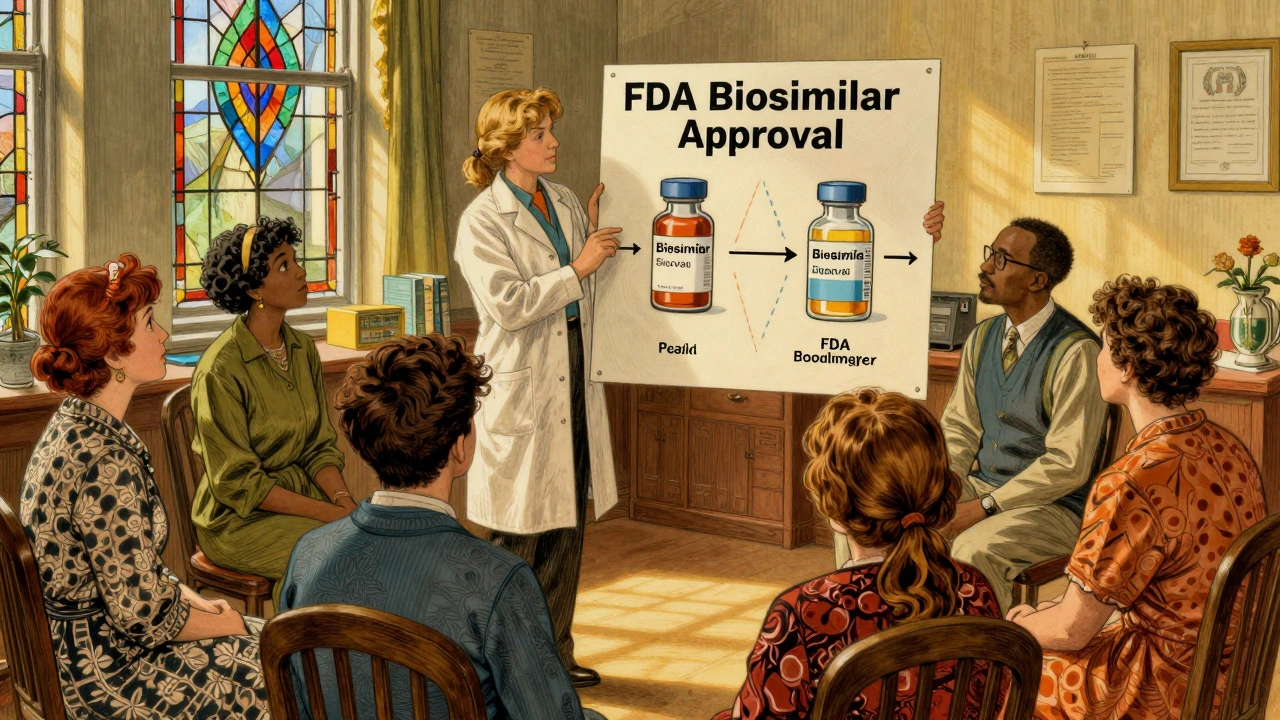
Biosimilars: The Next Frontier
Biosimilars are the future of specialty pharmacy. But they’re not generics. They’re more like the next-generation version of a biologic. They’re complex. They require different handling. And their substitution rules vary by state and payer. In some states, pharmacists can substitute a biosimilar for its reference product without the prescriber’s permission-if it’s labeled as “interchangeable.” Semglee is one. But not all biosimilars have that designation. And even when they do, many prescribers still require explicit approval. The Congressional Budget Office estimates biosimilars could save the U.S. healthcare system $54 billion over the next decade. But savings won’t happen unless patients and providers trust them. That’s where specialty pharmacies come in. They’re the bridge between the science and the patient. Educate. Don’t assume. Use visual aids. Show patients the FDA’s biosimilar approval process. Explain that while the molecule isn’t identical, the clinical outcomes are proven to be the same. And never, ever treat a biosimilar like a discount brand-name drug.What’s Next for Specialty Pharmacy?
More biosimilars are coming. Humira’s first biosimilars launched in 2023 after years of patent battles. Others will follow. The market for specialty drugs is growing fast-they make up just 2% of prescriptions but nearly half of all drug spending. Specialty pharmacies that survive will be the ones that stop treating generics like commodities. They’ll start treating them like clinical decisions. They’ll build systems to track manufacturer changes. They’ll train staff to have honest conversations with patients. They’ll push back on PBMs that demand unrealistic generic rates. It’s not about choosing brand over generic. It’s about choosing the right drug for the right patient at the right time. And that’s what specialty pharmacy was always meant to be.Can generics be used safely in specialty pharmacy?
Yes-but only when appropriate. Generics work well for small-molecule drugs with wide therapeutic windows, like some oral chemotherapy agents. But for drugs with narrow therapeutic indices (like levothyroxine or warfarin), or for patients who are stable on a brand-name drug, switching can pose risks. Always evaluate clinical stability, patient history, and potential excipient sensitivities before substitution.
Why are biosimilars not considered true generics?
Biosimilars are not exact copies because biologic drugs are made from living cells, not chemicals. Their structure is too complex to replicate exactly. Instead, biosimilars are highly similar, with no clinically meaningful differences in safety or effectiveness. They’re approved under a different FDA pathway (BPCIA) and require more extensive testing than traditional generics.
Do pharmacy benefit managers (PBMs) unfairly pressure specialty pharmacies to use generics?
Yes. Many PBMs use metrics like Generic Dispensing Ratio (GDR) to penalize pharmacies-even when no generic exists for the prescribed drug. This creates financial pressure to substitute unnecessarily, which can compromise patient care. Specialty pharmacies should push back with data on clinical outcomes and patient safety.
What should pharmacists tell patients when switching to a generic?
Be transparent. Explain that the active ingredient is the same, but the appearance (color, shape, size) may differ due to inactive ingredients. Warn them that rare side effects can occur with new manufacturers. Encourage them to report any changes in how they feel. Offer to contact their prescriber if concerns arise.
Are all generic manufacturers the same quality?
The FDA requires all generics to meet the same standards as brand-name drugs. But real-world experience shows variation in consistency and patient response. Some manufacturers have better supply chains, fewer recalls, and fewer patient complaints. Specialty pharmacies should track which manufacturers work best for their patient population and stick with them.
How can specialty pharmacies improve adoption of biosimilars?
By educating both providers and patients. Many clinicians and patients still believe biosimilars are inferior. Specialty pharmacies can provide clear, evidence-based materials, host Q&A sessions, and track patient outcomes after switch. Building trust is more important than pushing cost savings.
Annie Gardiner
December 6, 2025 AT 19:50Look, I get that generics save money, but let’s be real-no one’s gonna tell me that switching my MS med because a PBM got a better deal on a pill that looks like a neon green gumball is ‘clinical decision-making.’ I’ve been on the same brand for five years. My body knows it. My nerves know it. And now some algorithm thinks I’m a spreadsheet cell? Nah.
Brooke Evers
December 7, 2025 AT 08:56I’ve worked in specialty pharmacy for over a decade, and I can tell you this: the real issue isn’t generics or biosimilars-it’s that we’ve turned patient care into a cost-per-prescription metric. I had a patient last month who switched from Humira to a biosimilar because her insurer forced it. She cried in my office because she thought her body was ‘betraying’ her when she got a rash. We had to call her rheumatologist, re-educate her, and switch her back. The savings? $1,200 a month. The trauma? Unquantifiable. We need to stop treating people like line items.
Saketh Sai Rachapudi
December 8, 2025 AT 03:23USA so weak! India make generic drug better than all you guys! Why you scare of cheap medicine? Your pharma company lie to you! We make medicine for 10 dollar and you pay 100000! Shame! No need to worry about color or shape! Medicine work same! You just lazy and fat American! Get over it!
joanne humphreys
December 8, 2025 AT 05:06There’s something deeply human about the way these medications become part of someone’s identity. I’ve seen patients name their insulin pens. They keep the packaging from their first vial like a souvenir. When you change the pill, even if it’s ‘bioequivalent,’ you’re changing their daily ritual. That’s not just pharmacology-it’s psychology. And we ignore it at our peril.
Billy Schimmel
December 10, 2025 AT 04:55So let me get this straight. We spend billions developing a drug that costs $100K/year, then when a cheaper version comes out, we panic because… it’s a different shade of blue? I mean, if the FDA says it’s the same, and the math checks out, why are we acting like someone swapped out the coffee creamer and now the universe is collapsing?
Shayne Smith
December 12, 2025 AT 03:22Just had a patient tell me her new generic levothyroxine made her feel like she was underwater. We switched her back. She cried. I cried. The PBM sent us a compliance email. I just forwarded it to HR with a screenshot of her face. Sometimes the system’s just broken.
Max Manoles
December 13, 2025 AT 20:59The systemic failure here isn’t about science-it’s about accountability. PBMs are incentivized to optimize for cost, not outcomes. Specialty pharmacies are caught between regulatory compliance, financial penalties, and ethical duty. We need standardized, transparent reporting on generic manufacturer performance-not just price. A database of patient-reported outcomes by manufacturer, linked to adverse event logs, would be revolutionary. It’s not complicated. It’s just not profitable for the middlemen.
Katie O'Connell
December 14, 2025 AT 15:57It is imperative to acknowledge that the conflation of bioequivalence with therapeutic equivalence constitutes a fundamental epistemological error in contemporary pharmacoeconomic discourse. The FDA’s regulatory framework, while statistically rigorous, fails to account for inter-individual pharmacodynamic variability, particularly in patients with complex, multi-system chronic pathologies. One must therefore advocate for a paradigm shift wherein substitution protocols are governed not by cost-minimization algorithms, but by longitudinal, patient-centered clinical outcomes data-ideally curated through prospective, multi-center registries with IRB oversight.