
Pediatric Exclusivity: How the FDA Extends Market Protection for Drug Companies
 Feb, 1 2026
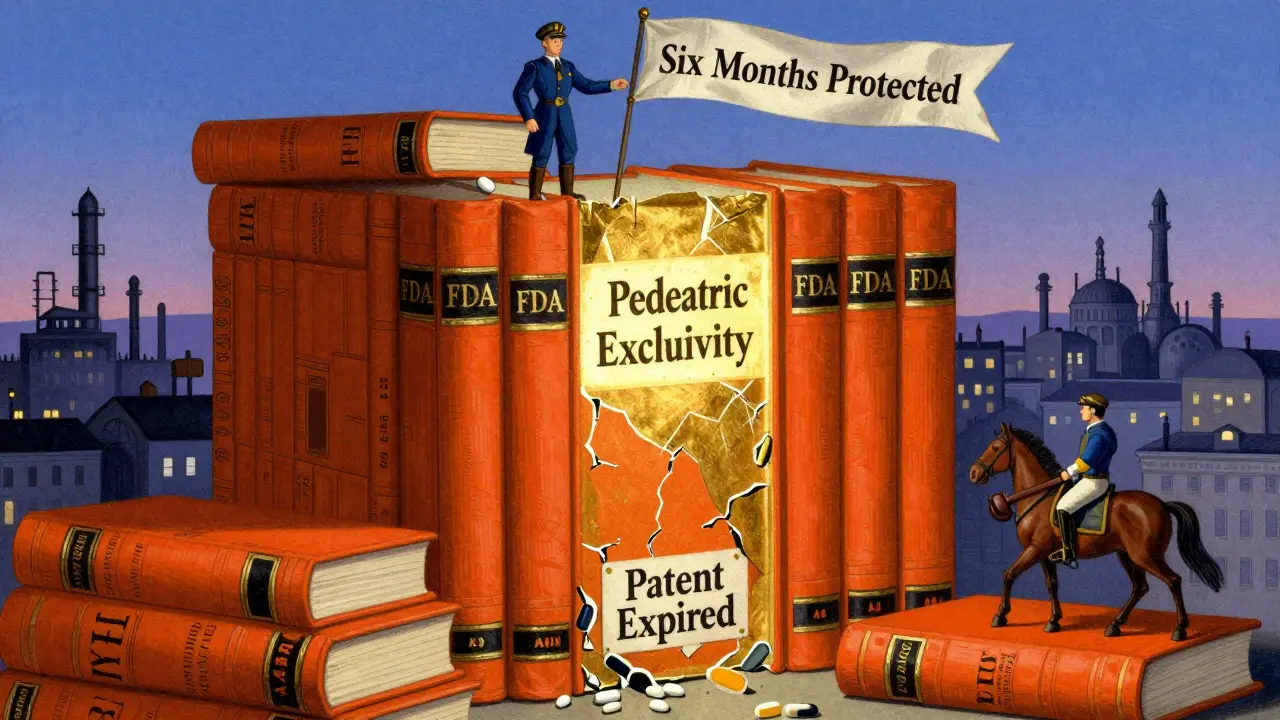
When a drug company gets approval for a new medicine, it doesn’t just get a patent. It also gets something called pediatric exclusivity-a six-month bonus period where the FDA can’t approve generic versions of that drug, even if the patent has expired. This isn’t a patent extension. It’s a regulatory lock. And it’s one of the most powerful tools in pharmaceutical lifecycle management.
What pediatric exclusivity actually does
Pediatric exclusivity doesn’t change the length of a patent. It doesn’t make the patent last longer. Instead, it stops the FDA from approving generic versions of the drug for six months, no matter what the patent says. This is critical because many drugs lose patent protection years before they’re studied in children. Without this rule, generics could flood the market immediately after patent expiry-even if no one knew how the drug affected kids.
The FDA requires drugmakers to study their medicines in children. But no one wants to spend millions doing those studies unless they get something back. So Congress gave them a deal: do the pediatric studies, and you get six extra months of market protection. It’s not a reward-it’s an incentive built into the law.
This rule comes from Section 505A of the Federal Food, Drug, and Cosmetic Act. It was made permanent in 2002 under the Best Pharmaceuticals for Children Act. Before that, pediatric data was rare. Doctors prescribed adult drugs to kids with little to no evidence of safety or dosage. Pediatric exclusivity changed that. Today, nearly every major prescription drug approved since 2002 has some kind of pediatric labeling.
How it works behind the scenes
The process starts with a Written Request from the FDA. The agency tells the drugmaker: “Here’s what we need you to study in children.” It could be a new age group, a new dosage form, or a new condition. The company then conducts the studies and submits the results. The FDA has 180 days to review them. If they meet the requirements, the six-month exclusivity kicks in.
Here’s the key part: pediatric exclusivity attaches to all versions of the drug with the same active ingredient. So if a company has an oral tablet, a liquid suspension, and a topical cream-all with the same active moiety-and they do the pediatric study for one, all three get the six-month extension. Even if one of those forms was approved years ago and had no patent left, it still gets protected.
This is why pediatric exclusivity is so valuable. A blockbuster drug like Adderall or Lipitor might have multiple formulations. One pediatric study can lock out generics across the entire product line. That’s why companies often wait until the last possible moment to submit their studies-maximizing the overlap with expiring patents.
It extends more than just patents
Pediatric exclusivity doesn’t just extend patents. It extends every kind of marketing exclusivity the drug already has. That includes:
- Five-year exclusivity for new chemical entities (NCEs)
- Three-year exclusivity for new clinical studies
- Orphan drug exclusivity (seven years for rare diseases)
But there’s a catch. The drug must still have at least nine months of existing exclusivity left when the pediatric exclusivity is granted. If the five-year NCE period is about to expire in three months, pediatric exclusivity won’t attach. The law requires that buffer. It’s designed to prevent abuse-no one can get a six-month extension on a drug that’s already off-patent and out of exclusivity.
There’s one exception. If a company submits a new application to expand a drug’s use to children-and that application requires new clinical data-it can get pediatric exclusivity even if the original product had no exclusivity left. This happened with some cancer drugs where adult approval existed but pediatric use was unapproved. The FDA treated the pediatric expansion as a new application, and granted exclusivity.
The Orange Book trick
If you look up a drug in the FDA’s Orange Book-which lists patents and exclusivities-you’ll sometimes see the same patent listed twice. Once with the original expiration date. Once with a later date: six months later. That’s pediatric exclusivity in action.
Even after the patent expires, the FDA still can’t approve generics if pediatric exclusivity is active. This is where most people get confused. They think: “Patent expired, so generics can come in.” Not true. Pediatric exclusivity becomes the only barrier. The FDA treats it like a regulatory fence. No court order. No waiver. No approval.
Legal cases have confirmed this. In the Apotex case, the court ruled that pediatric exclusivity can block generic approval even after patent expiry-unless the generic company has already won a patent lawsuit. If a generic manufacturer files a Paragraph IV challenge and wins, pediatric exclusivity doesn’t apply. But if they don’t challenge the patent, or lose the case, the six-month clock keeps ticking.
Who gets blocked-and who doesn’t
Generic manufacturers have only four ways to get approval during pediatric exclusivity:
- Get a waiver from the original drugmaker
- Win a court ruling that the patent is invalid or not infringed
- Have the patent lawsuit dismissed and get a waiver
- Not be sued within 45 days of filing the ANDA-and get a waiver
That last one is a loophole. If a generic company files an ANDA and the brand company doesn’t sue within 45 days, the generic can get approval-unless pediatric exclusivity is active. But even then, the FDA still requires a waiver. No exceptions. The agency won’t approve a generic without legal proof the exclusivity barrier is gone.
This is why pediatric exclusivity is called “ironclad.” It’s not just a delay. It’s a legal wall. And the FDA has consistently defended it in court. Even when patents are expired, even when generics are ready to go, the six-month clock holds.
Why biologics are left out
Here’s something important: pediatric exclusivity does not apply to biologics. That’s because biologics are regulated under a different law-the Biologics Price Competition and Innovation Act (BPCIA). Unlike small-molecule drugs, biologics don’t have a patent linkage system. The FDA can approve biosimilars without waiting for patent expiry or exclusivity to end. So even if a biologic company does pediatric studies, they don’t get the six-month extension.
This creates a major gap. Biologics are often used in children-for cancer, autoimmune diseases, and rare disorders. But because they’re not covered by pediatric exclusivity, companies have less incentive to study them in kids. The result? Many biologic drugs still lack pediatric labeling, even years after approval.
The real value: hundreds of millions per drug
Six months might sound short. But for a top-selling drug, it’s worth hundreds of millions. Take a drug that brings in $2 billion a year in sales. Six months of exclusivity = $1 billion in extra revenue. That’s more than enough to cover the cost of pediatric studies-and then some.
Companies know this. That’s why they often time their pediatric studies to coincide with patent expirations. One study can extend market dominance for half a year, sometimes longer if it overlaps with other exclusivities. It’s a legal, FDA-approved way to delay generics without changing the patent.
And because pediatric exclusivity applies to all dosage forms and indications, a single study can protect a whole portfolio. A drug company might have 10 products with the same active ingredient. One study. Six months of protection for all of them.
What this means for patients and generics
On one hand, pediatric exclusivity has improved child healthcare. More drugs now have dosing guidelines for kids. More safety data exists. More prescriptions are evidence-based.
On the other hand, it delays cheaper generics. Families and insurers pay more for brand-name drugs longer. Some argue the six-month extension is too long. Others say it’s necessary to make pediatric studies financially viable.
The truth? It’s a trade-off. The system works-but only if the FDA keeps enforcing it strictly. And they do. Every year, dozens of drugs get pediatric exclusivity. Every year, generics wait. And every year, the FDA holds the line.
What’s next?
There’s no sign this system is changing. In fact, the FDA has become more aggressive in issuing Written Requests. More drugs are being flagged for pediatric study. More companies are submitting data. The rules are clear. The process is predictable. And the payoff? Huge.
For drugmakers, pediatric exclusivity is a silent powerhouse. For generics, it’s a hurdle they must navigate with legal precision. For patients, it’s a balance between better science and slower access to low-cost medicine.
It’s not perfect. But it’s working. And it’s here to stay.
Does pediatric exclusivity extend the actual patent term?
No. Pediatric exclusivity does not extend the patent term itself. It extends the period during which the FDA can approve generic versions of the drug. Even after a patent expires, generics are blocked for six months if pediatric exclusivity is active.
Can a drug get pediatric exclusivity if it has no patents left?
Yes-but only under specific conditions. If the drug has no remaining patent or exclusivity, pediatric exclusivity can still be granted if the company submits a supplemental application to expand the drug’s use to children and the FDA requires new clinical data for approval. The exclusivity attaches to the new pediatric indication, not the original product.
Does pediatric exclusivity apply to biologics?
No. Pediatric exclusivity only applies to small-molecule drugs regulated under the Hatch-Waxman Act. Biologics are regulated under a different law (BPCIA) and do not have patent linkage or exclusivity extensions like pediatric exclusivity.
How long does the FDA take to review pediatric study results?
The FDA has up to 180 days to review whether the pediatric studies meet the requirements of the Written Request. Once approved, the six-month exclusivity period begins immediately, even if the drug’s labeling hasn’t been updated yet.
Can a generic drug company bypass pediatric exclusivity by challenging the patent?
Only if they win a Paragraph IV patent lawsuit. If a generic company files a certification that the patent is invalid or not infringed and wins in court, pediatric exclusivity does not block approval. But if they don’t challenge the patent-or lose the case-they must wait out the six months or get a waiver.
Does pediatric exclusivity apply to all dosage forms of a drug?
Yes. If a company conducts pediatric studies on one formulation (e.g., an oral tablet), the six-month exclusivity extends to all other dosage forms (liquid, cream, injection, etc.) that contain the same active ingredient, as long as those forms still have some form of marketing exclusivity or patent protection.
Matt W
February 1, 2026 AT 13:16This system is insane. A six-month delay on generics can mean billions in profit for pharma, while kids still get off-label meds with no data. It’s not protection-it’s profit laundering disguised as science.
Solomon Ahonsi
February 3, 2026 AT 12:45So let me get this straight-companies get paid millions to do studies they were already gonna do anyway, and in return they get to keep prices high for half a year? Classic corporate welfare.
Anthony Massirman
February 4, 2026 AT 20:37Pharma’s got the FDA on a leash and we’re all paying for it.
Marc Durocher
February 6, 2026 AT 10:44Meanwhile, the same companies that lobby for this exclusivity won’t even bother studying ADHD meds in girls because ‘the market’s too small.’ Funny how incentives work, huh?
Monica Slypig
February 6, 2026 AT 13:00Why do we even let these greedy corporations play games with kids health? In America we dont tolerate this kind of BS anymore
George Firican
February 7, 2026 AT 01:46The irony is thick here. We’ve created a system where the only way to ensure children aren’t being dosed like miniature adults is to financially incentivize the very entities that profit from their vulnerability. It’s not a policy-it’s a paradox wrapped in regulatory jargon. Pediatric exclusivity doesn’t solve the problem of evidence-based pediatric care; it merely masks it with a six-month financial bandage. The studies are mandated, yes, but they’re not driven by medical need-they’re driven by profit calculus. And the FDA, instead of being a gatekeeper of public health, has become a clerk for corporate accounting. We celebrate the rise in pediatric labeling like it’s a triumph, but we ignore that the labeling often exists only because a company needed to extend its monopoly. The real tragedy? The kids who needed those studies five years ago are now teenagers, and the data still came too late.
Hannah Gliane
February 7, 2026 AT 19:18So basically, if you’re rich enough to make a drug, you get to decide who gets safe meds and when… and the FDA lets you? 😤
Murarikar Satishwar
February 9, 2026 AT 03:57Interesting how this system works, but I think the real issue is the lack of public funding for pediatric research. If the government funded these studies, we wouldn’t need to give pharma a six-month monopoly as a bribe. It’s like paying a thief to return your wallet.
Bob Hynes
February 9, 2026 AT 18:39They say 'for the kids' but it's really 'for the stockholders.' I mean, come on. A billion dollars for six months? That's not medicine, that's a casino payout.
Dan Pearson
February 11, 2026 AT 08:44Oh please, you think this is bad? Wait till you see how biologics get screwed-no pediatric exclusivity at all. So kids with cancer get the same ‘guess the dose’ treatment they did in 1995. But hey, at least Lipitor’s liquid form got its six-month delay. Priorities, folks.
Eli Kiseop
February 11, 2026 AT 13:13so the FDA just blocks generics even after patents expire? that seems kinda illegal
Becky M.
February 13, 2026 AT 12:35i used to work in a hospital pharmacy and we had to tell parents ‘we dont know the right dose for kids’ for so many meds… now at least we have some data. maybe the system is flawed but its better than nothing
Solomon Ahonsi
February 14, 2026 AT 20:29And the author acts like this is normal. It’s not. It’s corporate capture. We’re not protecting kids-we’re protecting profits. And the FDA is the enforcer, not the guardian.