
Methadone and QT-Prolonging Drugs: Understanding the Additive Arrhythmia Risk
 Jan, 5 2026
Methadone QT Risk Calculator
Methadone Risk Assessment
This tool estimates your cumulative QT interval prolongation risk when taking methadone combined with other medications. QT prolongation can lead to dangerous heart rhythms like torsades de pointes.
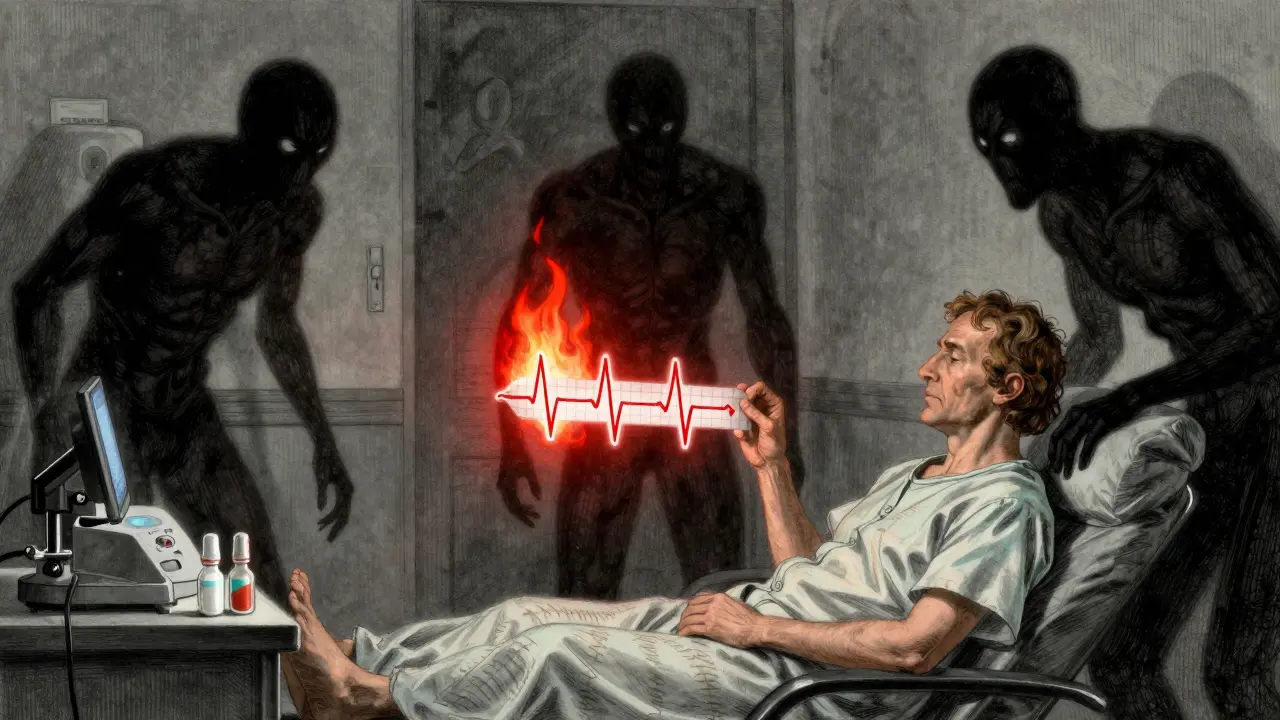
When someone starts methadone for opioid dependence or chronic pain, the focus is often on pain relief or reducing cravings. But there’s a quiet, dangerous side effect that doesn’t get enough attention: methadone can mess with your heart’s electrical rhythm - especially when taken with other common medications. This isn’t theoretical. People have died from it. And the risk doesn’t just go up a little - it multiplies when methadone is paired with other drugs that also stretch out the heart’s QT interval.
What Happens When Methadone Slows Down Your Heart’s Reset Button
Your heart beats because of a precise sequence of electrical signals. After each beat, it needs to reset - a process called repolarization. The QT interval on an ECG measures how long that reset takes. If it’s too long, your heart can slip into a dangerous rhythm called torsades de pointes (TdP), which can turn into sudden cardiac arrest.
Methadone blocks two key potassium channels in heart cells: IKr and IK1. Most drugs only block one - but methadone blocks both. That’s rare. And it’s why methadone is far more dangerous than other opioids like buprenorphine, which barely touches these channels. Studies show methadone’s hERG (IKr) blockade is about 100 times stronger than buprenorphine’s at typical doses. That’s not a small difference - it’s the difference between a manageable risk and a life-threatening one.
By 2006, the FDA had to issue a black box warning - the strongest safety alert they have - because people were dying from methadone-induced arrhythmias. Even more alarming? The risk builds over time. A 2007 study found that after 16 weeks of methadone therapy, nearly 70% of men and over 70% of women had QTc intervals above the danger threshold. That’s not a one-time spike. It’s a slow, silent creep.
When Two Dangerous Drugs Meet: The Additive Effect
Methadone alone is risky. But combine it with another drug that also prolongs QT, and the danger isn’t just doubled - it’s exponential.
Think of your heart’s repolarization like a battery. Methadone drains it a little. Another QT-prolonging drug drains it more. Together, they drain it so fast that the heart can’t recover properly. That’s when TdP happens.
Common culprits include:
- Antibiotics like erythromycin and clarithromycin (macrolides)
- Fluoroquinolones like moxifloxacin
- Antifungals like fluconazole
- Antidepressants like citalopram and venlafaxine
- Antipsychotics like haloperidol
- HIV drugs like ritonavir
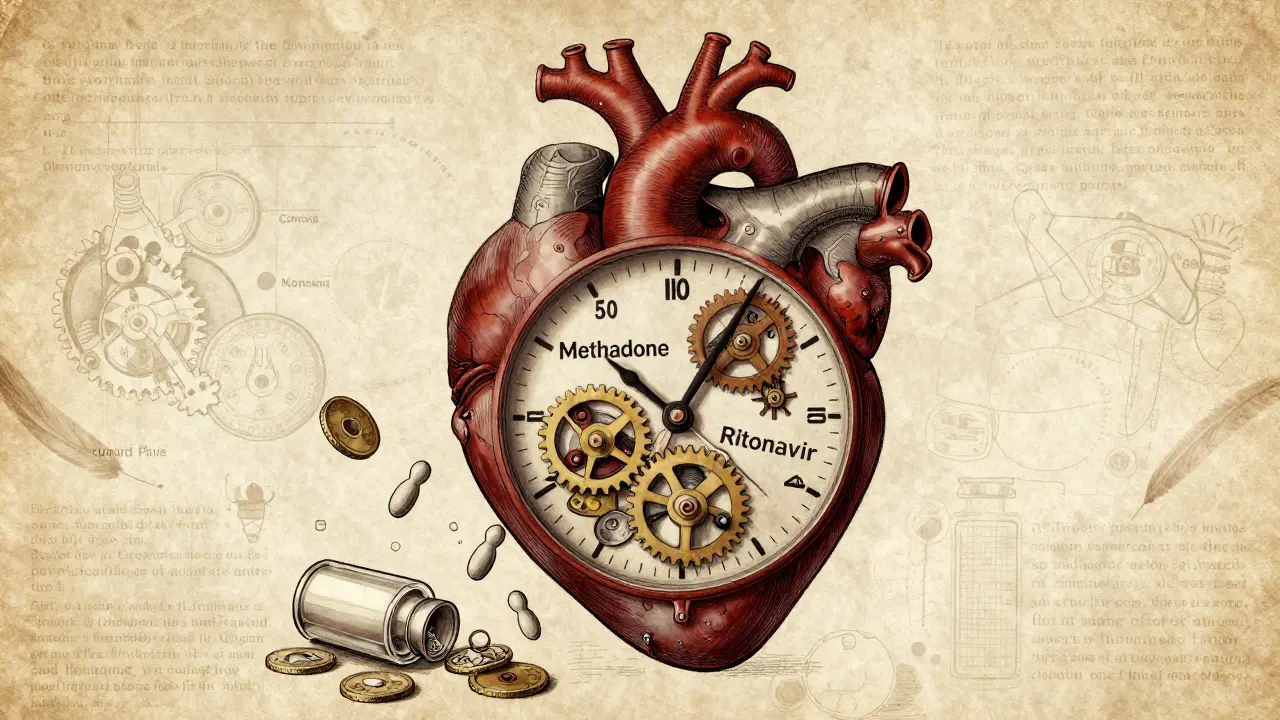
Ritonavir is especially nasty. It doesn’t just prolong QT - it also blocks the liver enzyme (CYP3A4) that breaks down methadone. That means methadone builds up in your blood, making the heart risk even higher. One case report described a patient who developed TdP after starting methadone and ritonavir together. The patient didn’t have any other risk factors. Just the combination.
Even short-term drugs can be dangerous. Cocaine, for example, isn’t a long-term medication - but it’s a known QT-prolonger. One patient on methadone developed persistent QT prolongation and TdP after using cocaine. The drug was gone from their system in hours. But the damage? It lasted.
Who’s Most at Risk?
Not everyone on methadone will have problems. But some people are walking into a minefield without knowing it.
High-risk groups include:
- Those taking doses above 100 mg/day - QTc prolongation becomes much more common here
- People with existing heart conditions like heart failure or prior arrhythmias
- Those with low potassium or magnesium levels - electrolyte imbalances make the heart more electrically unstable
- People with a family history of long QT syndrome or sudden cardiac death
- Women - they’re more sensitive to QT prolongation than men
- Older adults - metabolism slows, and heart tissue becomes more vulnerable
And here’s the kicker: many of these risk factors are invisible. You might feel fine. Your blood pressure might be normal. But your heart’s electrical system could be on the edge of failure.
What the Numbers Don’t Tell You
Let’s talk numbers. A normal QTc is ≤430 ms for men and ≤450 ms for women. Borderline is 431-450 ms (men) or 451-470 ms (women). Anything above 500 ms? That’s a red flag. Studies show 1.3% to 16% of methadone patients hit that mark. That’s not rare. That’s common enough that every provider should assume it’s happening until proven otherwise.
One New Zealand case had a patient on 120 mg/day of methadone who developed TdP. They lowered the dose to 60 mg/day - and the QTc returned to normal. No surgery. No stent. Just a simple dose reduction. That’s powerful. It means the risk isn’t always permanent - but it’s also not always predictable.
Another study found that methadone increases QTc by an average of 10.8 milliseconds - but that’s just the mean. Some people saw increases of over 60 ms. That’s enough to push someone from borderline to life-threatening in weeks.
What Should You Do?
If you’re on methadone, here’s what you need to do - not what you *hope* your doctor will do, but what you need to insist on:
- Get a baseline ECG before starting methadone - no exceptions.
- Get another ECG after 2-4 weeks, and again after 12 weeks - even if you feel fine.
- Ask your doctor to check your potassium and magnesium levels. Low levels are easy to fix - and they make QT prolongation worse.
- Review every medication you take - including over-the-counter drugs, supplements, and herbal products. Some antihistamines, cough syrups, and even St. John’s wort can prolong QT.
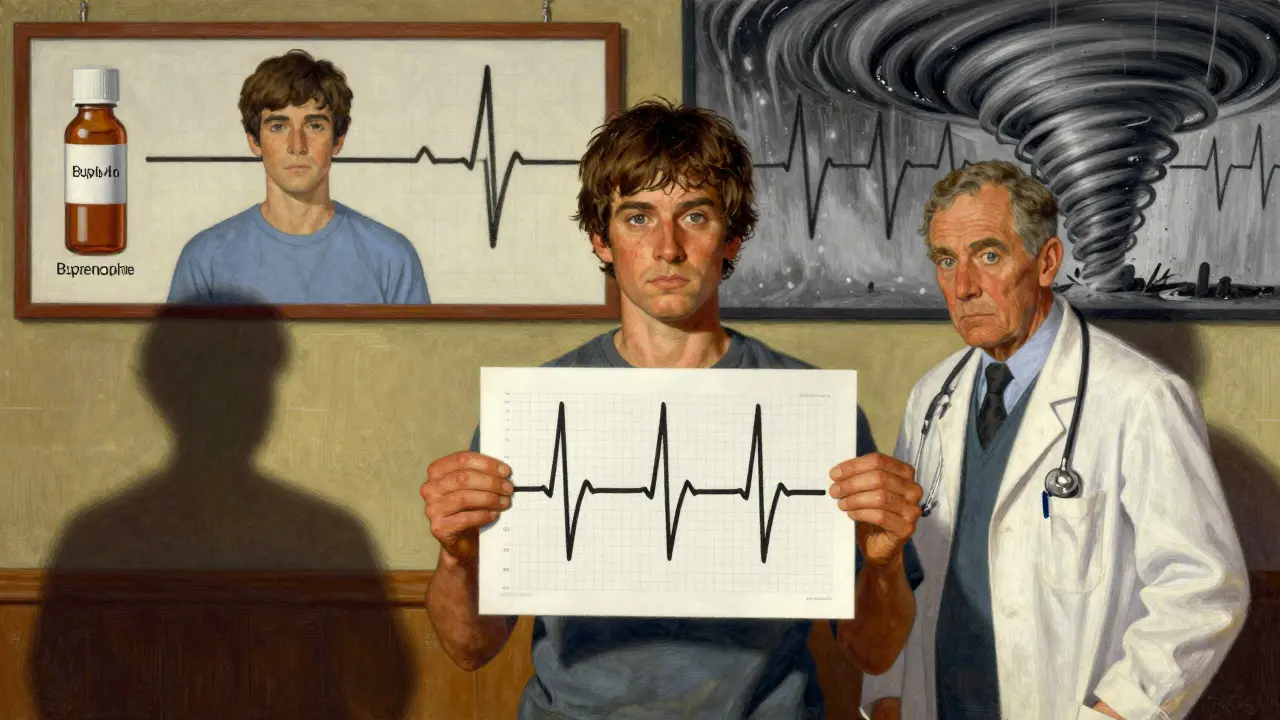
- If your QTc goes above 500 ms or increases by more than 60 ms from baseline, don’t wait. Ask about switching to buprenorphine. It’s just as effective for opioid dependence but has 100 times less hERG blockade.
Some providers still think, “But methadone works better.” Yes, it does. It reduces overdose deaths by 20-50%. It lowers crime and improves adherence. But those benefits don’t cancel out the risk - they make it more urgent to manage it properly. You don’t have to choose between survival and safety. You can have both - if you’re monitored.
The Bottom Line
Methadone isn’t evil. It’s a tool. But like any powerful tool, it needs respect. It’s not the dose alone that kills - it’s the combination. The hidden interactions. The silent QT prolongation. The lack of monitoring.
If you’re on methadone, don’t assume you’re safe because you’ve been on it for years. Don’t assume your doctor knows all your meds. Don’t assume a normal ECG last year means you’re fine now. The heart changes. The drugs change. The risk changes.
Ask for your ECG results. Ask what your QTc is. Ask if any of your other meds could be adding to the risk. If your provider brushes you off - get a second opinion. Your heart isn’t a gamble. And with methadone, you don’t get a second chance if it stops.
Can methadone cause sudden death even at low doses?
Yes, though it’s less common. Most deaths occur at doses above 100 mg/day, but cases have been reported at lower doses - especially when combined with other QT-prolonging drugs, electrolyte imbalances, or pre-existing heart conditions. There’s no completely safe dose, only safer ones with proper monitoring.
Is buprenorphine safer than methadone for the heart?
Yes, significantly. Buprenorphine has about 100 times less hERG channel blockade than methadone. It rarely causes QT prolongation, even at high doses. For patients with heart risk factors, buprenorphine is often the preferred choice for opioid use disorder treatment.
How often should I get an ECG if I’m on methadone?
At least three times: before starting, 2-4 weeks after starting or after any dose increase, and again at 12 weeks. After that, annual ECGs are recommended if you’re stable. If you’re over 65, have heart disease, or take other QT-prolonging drugs, every 6 months is safer.
Can I take antibiotics like amoxicillin while on methadone?
Amoxicillin is safe. It doesn’t prolong the QT interval. But avoid macrolides like erythromycin or clarithromycin, and fluoroquinolones like moxifloxacin. Always check with your pharmacist or doctor before starting any new medication - even a simple antibiotic - if you’re on methadone.
What if my QTc is borderline - should I stop methadone?
Not necessarily. A borderline QTc (431-450 ms for men, 451-470 ms for women) means you need closer monitoring, not immediate discontinuation. Your doctor should check electrolytes, review all medications, and repeat the ECG in 4-6 weeks. Many patients stabilize with dose adjustments or avoiding other QT drugs. Stopping methadone abruptly can trigger withdrawal and increase overdose risk.
Are there any new tests to detect methadone’s heart risk better than ECG?
Research is exploring U-wave integral analysis and Tpeak-Tend interval measurements to better assess repolarization reserve. These aren’t standard yet, but they’re promising. For now, a careful ECG interpretation by someone trained in cardiac pharmacology remains the best tool.
Jeane Hendrix
January 7, 2026 AT 10:29Wow, this post hit me right in the chest. I’ve been on methadone for 5 years and never once had an ECG. My doctor just said, 'You’re fine.' But now I’m terrified. I take citalopram for anxiety and clarithromycin last year for a sinus infection. Did I almost die and not know it? I’m scheduling an ECG tomorrow. Thanks for sharing this.
Rachel Wermager
January 8, 2026 AT 11:14Let’s be clear: methadone’s hERG blockade is not just ‘stronger’ than buprenorphine-it’s orders of magnitude more dangerous. The IC50 for IKr inhibition is ~0.3 µM for methadone versus ~30 µM for buprenorphine. That’s not a ‘slight difference’-it’s a pharmacological chasm. And don’t even get me started on ritonavir’s dual CYP3A4 inhibition + QT prolongation. That combo is a perfect storm. If your prescriber doesn’t know this, they’re practicing dangerous guesswork.
Tom Swinton
January 8, 2026 AT 12:52I just want to say-I’ve been there. I was on 140 mg of methadone, taking fluconazole for a yeast infection, and my potassium was low because I was drinking too much coffee and not eating. I started feeling dizzy, like my heart was skipping. I thought it was stress. Turns out, my QTc was 542 ms. I almost didn’t make it. I’m alive today because I listened to my gut and went to the ER. Please, if you’re on methadone, don’t wait until you’re dizzy. Get tested. Fix your electrolytes. Ask about buprenorphine. Your heart doesn’t get a second chance. I’m so glad this post exists. You’re saving lives.
Leonard Shit
January 9, 2026 AT 13:43so like… i’ve been on methadone for 8 years. never had an ekg. my doc says ‘you’re fine’. but now i’m wondering if ‘fine’ just means ‘not dead yet’. also, i take otc cough syrup with dextromethorphan. is that bad? idk. but i’m scared now. thanks for the post. 🤔
Gabrielle Panchev
January 11, 2026 AT 07:33Actually, this entire narrative is dangerously oversimplified. You’re implying that all methadone patients are walking time bombs, but what about the millions who’ve taken it safely for decades? The FDA black box warning? It was based on a handful of cases, mostly involving polypharmacy and pre-existing conditions. You’re scaring people away from a life-saving treatment because of fearmongering. Methadone reduces overdose deaths by up to 50%-that’s not a trivial trade-off. And buprenorphine? It’s not a magic bullet-it’s harder to access, less effective for high-tolerance patients, and still carries some QT risk. This isn’t black and white. It’s complex. Stop treating patients like children.
Katelyn Slack
January 12, 2026 AT 17:31i just got my first ekg last week. qt was 442. i was so nervous. my doc said it’s borderline but not dangerous. i’m taking mag and k supplements now. i didn’t know about the drug interactions. thank you for this. i’ll keep checking.
Melanie Clark
January 12, 2026 AT 18:12They don’t want you to know this but the pharmaceutical companies know methadone kills people. That’s why they pushed buprenorphine as the ‘safer’ option. But they still profit off methadone because it’s cheaper to produce. And the clinics? They don’t want to pay for ECGs. So they ignore it. The government knows. The doctors know. But you? You’re just supposed to trust them. I’ve seen 3 people die from this. All of them were told ‘you’re fine.’ Don’t be fooled. This is corporate negligence wrapped in medical jargon.
Harshit Kansal
January 13, 2026 AT 04:27Bro this is wild. I’m from India and we don’t even have access to ECGs in most clinics. Methadone is given like candy here. No monitoring. No labs. Just ‘take it and go.’ I’ve seen patients collapse. No one connects it to the drug. We need awareness. This post should be translated to Hindi, Tamil, Telugu. This is life or death.
Brian Anaz
January 14, 2026 AT 20:28Why are we even talking about this? Methadone is for junkies. If you can’t handle the side effects, don’t take it. We’ve got real problems in this country-border security, inflation, crime. But no, we’re spending millions on heart monitors for people who chose addiction. Wake up. There are better ways to help than turning them into medical lab rats.
Venkataramanan Viswanathan
January 16, 2026 AT 08:24As a physician from India, I must say this post is both timely and alarming. In our setting, methadone is often administered without baseline ECGs, electrolyte checks, or follow-up. The lack of infrastructure makes monitoring nearly impossible. We need policy changes, not just awareness. I’ve seen two cases of torsades in our clinic-both were on methadone plus fluconazole. Both survived because we caught it early. This must be standardized. Thank you for the clarity.
Vinayak Naik
January 17, 2026 AT 17:41yo this is straight fire. methadone ain’t no joke. i got a homie on 120mg who took azithromycin for a cold and ended up in the hospital. they thought it was a drug overdose. turns out his QT was 520. he’s good now but man. i’m telling everyone. check your meds. check your ekg. don’t be that guy who thinks ‘i’ve been fine for 5 years’-your heart don’t care how long you’ve been on it. it only cares what’s in your system right now. stay woke.
Saylor Frye
January 19, 2026 AT 12:10How quaint. A 12-page essay on a pharmacological nuance that’s been known since the 1990s. The real issue is the lack of clinical sophistication among prescribers. If you need a Reddit post to understand QT prolongation, you shouldn’t be prescribing methadone. This isn’t groundbreaking-it’s remedial. And yet, here we are. The system is broken, but this isn’t the solution-it’s just noise.
Kelly Beck
January 20, 2026 AT 15:08you are NOT alone 💪💖. if you’re reading this and scared-take a deep breath. you’re already doing the right thing by learning. get that ECG. talk to your pharmacist. ask about potassium. you’re not weak for asking questions-you’re brave. your heart matters. your life matters. i believe in you. you got this. 🌈❤️🫶
Molly McLane
January 21, 2026 AT 07:57Thank you for this. I’ve been a nurse in an addiction clinic for 12 years. I’ve seen people die from this. I’ve also seen people thrive-because they got monitored. I wish every provider had to sit through a cardiac pharmacology refresher before prescribing methadone. This isn’t about fear. It’s about respect. Respect for the drug. Respect for the patient. Respect for the heart. Please, if you’re on methadone-ask for your QTc. Write it down. Track it. You’re worth the effort.