
Medications and Work Safety Risks: What Workers Need to Know
 Mar, 2 2026
Medication Safety Risk Calculator
Assess Your Workplace Medication Risk
This tool calculates potential safety risks based on the article's research showing how prescription medications affect work performance and exposure risks.
Think your prescription meds are just a personal health issue? Think again. Millions of workers take medications that can turn a routine task into a serious safety risk - and millions more handle dangerous drugs every day without even realizing how much they’re exposed. This isn’t about drug abuse. It’s about medication use in the real world - where a painkiller, an anxiety pill, or a chemotherapy drug can change everything on the job.
When Your Medicine Makes You a Risk
It’s not just opioids. It’s not just benzodiazepines. It’s the combination. A 2017 study in the Journal of Occupational and Environmental Medicine found workers taking both opioids and benzodiazepines had an 84% higher chance of falling at work. That’s not a small number. That’s a near-doubling of risk. And it’s not just falls. These drugs slow reaction time, blur vision, and make it harder to focus. For someone operating machinery, driving a truck, or even walking down a hospital hallway with a loaded IV bag, that’s dangerous.
NIOSH data from 2018 shows 18.7% of U.S. workers with chronic pain are on opioids. Another 7.2% are on benzodiazepines for stress or anxiety. That’s nearly one in four workers in high-risk jobs. And here’s the catch: many don’t realize their meds are affecting their performance. They feel fine. But their body isn’t. A study from the CDC found workers on these drugs had 2.1 times more workplace injuries than those not taking them.
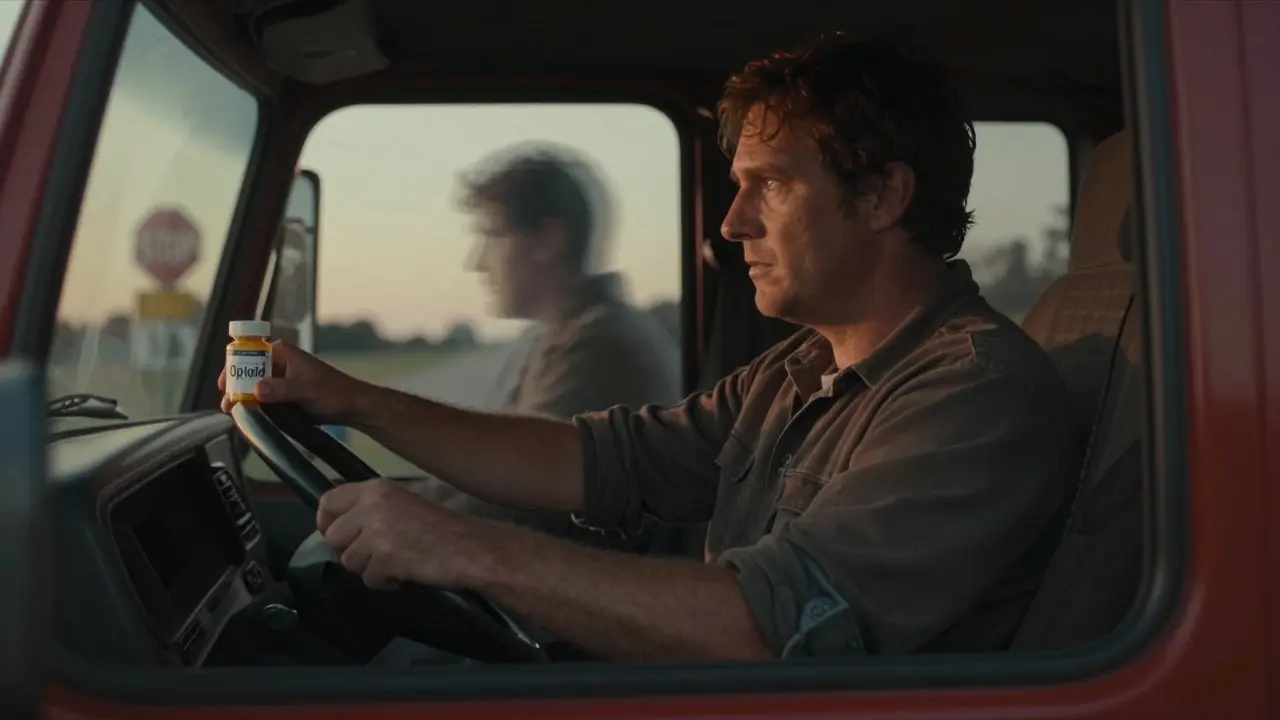
It’s not just about the drug. It’s about the job. A nurse on opioids after a back injury might feel okay - until they’re reaching for a heavy patient. A truck driver on a benzodiazepine might not feel drowsy - until they miss a stop sign. The risk isn’t always obvious. But the consequences? They are.
Handling Hazardous Drugs: The Invisible Threat
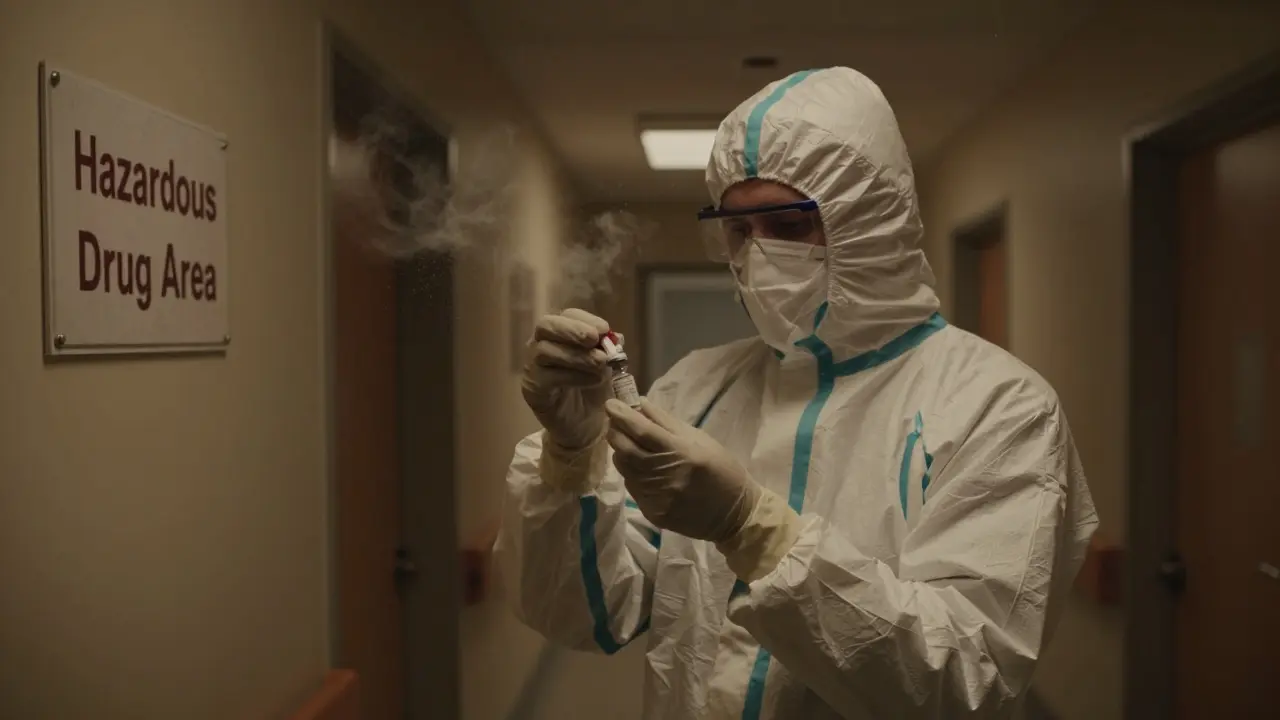
Now flip the script. What if you’re not the one taking the drug - you’re the one handling it? Healthcare workers, pharmacists, and lab techs deal with hundreds of hazardous drugs daily. The NIOSH 2024 list includes 370 of them - 267 are cancer drugs, 78 are other toxic meds, and 25 affect reproduction.
Exposure doesn’t come from swallowing it. It comes from breathing in tiny particles, touching a contaminated surface, or getting splashed. WorkSafeBC’s 2022 analysis found 38% of exposures happen through inhalation. Another 29% come from splashes. Skin contact with a dirty counter? That’s 22%. Even a tiny amount - like a speck of chemotherapy drug dust - can build up over time.
And it’s not just cancer. Chronic exposure is linked to a 2.3 times higher risk of miscarriage, infertility, and birth defects, according to a CDC meta-analysis of 47 studies. One nurse on Reddit described developing chronic skin rashes after three years of handling chemo drugs - even while following all protocols. Surface tests later showed detectable levels in 68% of her work areas.
Controls That Actually Work
It’s not all doom and gloom. We know how to stop this. The tools exist. The science is clear. The question is: are they being used?
Engineering controls are the gold standard. Closed-system transfer devices (CSTDs) - special connectors that seal drug vials during preparation - reduce surface contamination by 94.7%, according to WorkSafeBC’s 2021 tests. Mayo Clinic cut hazardous drug exposures by 89% using these devices, better training, and redesigned workspaces. That’s not luck. That’s science.
But here’s the problem: not every workplace has them. A 2024 American Hospital Association report found only 78% of large hospitals (200+ beds) have full programs. At small clinics? Just 34%. That’s a huge gap. And OSHA’s Hazard Communication Standard doesn’t cover all facilities - leaving 1.8 million workers in unprotected settings.
PPE alone isn’t enough. Gloves can tear. Gowns can leak. Airflow systems can fail. A CDC field study in 2021 found 43% of workers didn’t properly wear their PPE - even after training. Why? Because it’s uncomfortable. Because it’s rushed. Because no one checks.
Who’s Protected? Who’s Not?
The system is broken in places. USP General Chapter 800, which sets strict handling rules for compounding pharmacies, covers only about 58,000 workers. That’s a drop in the bucket. Meanwhile, oncology units, ambulatory surgery centers, and home health nurses - who handle the same drugs - often operate without any formal safety protocols.
Unionized workers have it better. AFL-CIO data from 2023 shows they report 22% fewer medication-related incidents than non-unionized staff. Why? Because they have bargaining power. They can demand better equipment. They can push for training. They can report unsafe conditions without fear.
And then there’s the policy problem. Drug-free workplace programs - meant to keep people off illegal drugs - often end up punishing workers with legitimate prescriptions. Dr. Robert Gotlin wrote in the Journal of Occupational Rehabilitation that 32% of workers lost their jobs because they needed meds for chronic pain - even when they never had an accident. That’s not safety. That’s discrimination.
What Needs to Change
Three things need to happen now.
First: Expand protections. OSHA’s proposed rule to set a surface contamination limit of 0.1 ng/cm² for hazardous drugs - expected in late 2024 - is a step forward. But it needs to apply to every workplace, not just big hospitals. Every pharmacy. Every clinic. Every home care provider.
Second: Train properly. You can’t do a 30-minute online video and call it training. NIOSH says it takes 16 to 24 hours of hands-on learning to handle hazardous drugs safely. Then, 4 to 8 hours every year. That’s not optional. That’s basic.
Third: Stop stigmatizing. Workers on opioids or benzodiazepines aren’t weak. They’re managing pain. They’re managing anxiety. The answer isn’t firing them. It’s adjusting their duties. Moving them away from heavy lifting. Giving them more breaks. Monitoring their performance - not their prescriptions.
Real Stories, Real Consequences
An anesthesiologist on Medscape described nearly causing a surgical mishap after taking prescribed opioids for a back injury. He felt dizzy. Nauseous. His hands shook. He didn’t tell anyone. He thought he could push through. He almost lost a patient.
On the flip side, a pharmacy technician on WorkCompWire said her facility cut surface contamination from 42% to 4.7% in six months after adopting NIOSH’s 2024 guidelines. No magic. Just proper gloves, sealed systems, and daily checks.
These aren’t abstract risks. They’re daily realities. And they’re preventable.
What You Can Do
If you’re a worker:
- Know your meds. Talk to your doctor about how they affect your job.
- Report side effects - dizziness, fatigue, blurred vision - even if you think it’s "just stress."
- Ask: "Does my workplace have closed-system devices? Are we tested for contamination?"
If you’re an employer:
- Use the NIOSH 2024 list. Don’t guess. Know what’s hazardous.
- Invest in CSTDs. They’re expensive - but not as expensive as a cancer diagnosis or a worker’s compensation claim.
- Train like your life depends on it - because it does.
- Don’t punish people for taking meds. Protect them.
The bottom line? Medications aren’t just personal. They’re workplace issues. Whether you’re taking them or handling them, your safety matters. And it’s not something you should have to fight for.
Can prescription medications really cause workplace accidents?
Yes. Opioids and benzodiazepines are the most common culprits. A 2017 study found workers using both together had an 84% higher risk of falls. Opioid users alone had 2.1 times more workplace injuries than non-users, according to NIOSH. These drugs slow reaction time, impair coordination, and reduce alertness - all critical for safety in construction, healthcare, transportation, and manufacturing.
Which workers are most at risk from hazardous drugs?
Healthcare workers handling chemotherapy, antiviral, or hormone drugs are at highest risk. This includes nurses, pharmacists, pharmacy technicians, lab staff, and cleaning crews in oncology units, infusion centers, and compounding pharmacies. The NIOSH 2024 list identifies 370 hazardous drugs, with antineoplastic agents (cancer drugs) making up the largest group. Exposure also occurs in veterinary clinics and research labs.
How do you get exposed to hazardous drugs at work?
Exposure happens through four main routes: inhalation (38% of cases - from aerosols during drug preparation), skin contact (29% from splashes), surface contamination (22% from touching contaminated equipment), and accidental ingestion (7% from poor hand hygiene). Sharps injuries account for 4%. Even tiny amounts can build up over time, especially with repeated exposure.
Are there safety standards for handling hazardous drugs?
Yes, but not everywhere. OSHA’s Hazard Communication Standard (29 CFR 1910.1200) applies to some workplaces, but leaves out 1.8 million workers in smaller healthcare settings. USP Chapter 800, which requires closed-system transfer devices and strict handling protocols, only applies to compounding pharmacies. NIOSH’s 2024 list is the most comprehensive guide, but it’s advisory - not legally required. Many facilities still operate without proper controls.
What can employers do to reduce risks?
Employers should start by identifying hazardous drugs using NIOSH’s 2024 list. Then implement engineering controls like closed-system transfer devices and proper ventilation. Train staff for 16-24 hours initially, plus 4-8 hours annually. Use regular surface testing to monitor contamination. Replace outdated safety cabinets. And don’t punish workers for taking legally prescribed meds - instead, adjust their duties if needed.
Is there a link between workplace stress and medication use?
Yes. Dr. John Howard, former NIOSH director, noted that workplace stress drives increased use of benzodiazepines and other sedatives. This creates a cycle: stress leads to medication, medication impairs performance, impaired performance increases stress. Workers in high-pressure environments - ER nurses, paramedics, emergency responders - are especially vulnerable. Addressing stress through mental health support is as important as controlling drug exposure.
Dean Jones
March 3, 2026 AT 13:42Let’s be real: we’re treating medication like it’s a personal choice when it’s clearly a systemic failure. You can’t just tell a nurse with chronic back pain to "just push through" while she’s lugging 200-pound patients around. The system doesn’t ask if the medicine is prescribed-it asks if it’s convenient for the employer. That’s not safety. That’s negligence dressed up as policy. The data is overwhelming: 84% higher fall risk with opioid-benzodiazepine combos? That’s not a statistical anomaly. That’s a ticking time bomb in every ER, every warehouse, every truck cab. And yet we still don’t mandate closed-system transfer devices in clinics with 12 beds? We’re not protecting workers. We’re just hoping they don’t die on shift.
And don’t get me started on the stigma. Workers aren’t weak for needing painkillers. They’re weak because their employers won’t adjust their duties. We’d never tell a blind worker to keep driving. Why do we tell someone with impaired coordination to keep handling IV bags? It’s not about discipline. It’s about recognizing that human biology doesn’t care about your productivity metrics.
NIOSH has the guidelines. Mayo Clinic proved they work. Yet small clinics? Barely 34% compliance. That’s not a gap. That’s a chasm. And the people falling through it? They’re not statistics. They’re someone’s brother, sister, parent. This isn’t about compliance. It’s about moral responsibility. If you’re not doing more than the bare minimum, you’re part of the problem.
Training isn’t a 30-minute video. It’s hands-on, repeated, observed. PPE isn’t optional gear-it’s a lifeline. And surface contamination at 68%? That’s not bad luck. That’s institutional failure. We’ve known how to fix this for years. The only thing missing is the will to do it.
Stop calling it a "health issue." It’s a workplace hazard. And until we treat it like one, people will keep getting hurt. Not because they’re careless. Because the system is.
Zacharia Reda
March 5, 2026 AT 06:03So let me get this straight-we’re okay with workers taking meds that make them a walking hazard, but we’ll fire them if they test positive? That’s not a safety protocol. That’s a corporate joke wrapped in a HIPAA form.
Meanwhile, the same hospitals that won’t spend $5k on CSTDs are shelling out $50k on "wellness programs" that teach employees how to breathe better. Funny how the money flows toward optics, not outcomes.
And yet somehow, the guy who got cancer from chemo dust in 2019? He’s the one who got blamed for "not wearing his gloves right." Not the facility that never tested surfaces. Not the admin who cut the safety budget. Nope. Him.
At this point, I’m convinced the real hazard isn’t the drugs. It’s the people who think this is a personal responsibility issue instead of an engineering one.
Jeff Card
March 6, 2026 AT 16:45I’ve worked in oncology for 12 years. I’ve seen coworkers develop rashes, infertility, chronic fatigue-all from exposure we were told was "minimal." We had a nurse who had three miscarriages in five years. No one connected it until someone ran a swab test and found chemo residue on the coffee machine.
It’s not paranoia. It’s pattern recognition.
We didn’t get CSTDs until the union forced it. Before that? Gloves torn, spills wiped with paper towels, air vents clogged. No one checked. No one cared. We were told to "just be careful."
Now? Contamination dropped to 4%. Not because we’re better workers. Because we stopped treating safety like a favor and started treating it like a requirement.
Don’t tell me this is about individual responsibility. It’s about leadership. And too many leaders don’t care until someone dies.
Stephen Vassilev
March 8, 2026 AT 15:53Have you considered the possibility that this entire narrative is a distraction? The pharmaceutical industry, in collusion with regulatory agencies, has systematically downplayed the long-term effects of these drugs-not just in the workplace, but in society at large. The 370 hazardous drugs on NIOSH’s list? Only 12% are officially classified as carcinogens by the EPA. Why? Because the data is suppressed. The CDC’s meta-analysis? It was pulled from public archives for "review."
And don’t you dare think that unions are the solution. They’re just another layer of bureaucracy that redirects funds into administrative overhead while workers still handle chemo with bare hands. The real problem? The FDA approves these drugs without requiring environmental exposure studies. Why? Because lobbyists. Why? Because profit.
There’s no such thing as "safe handling." There’s only delayed consequences. And if you think OSHA’s 0.1 ng/cm² limit will help-you’re not seeing the full picture. The limit is arbitrary. The science is politicized. The truth? We’re all lab rats in a system that doesn’t care if we live or die-as long as the quarterly reports look good.
Helen Brown
March 9, 2026 AT 00:26My cousin works in a small clinic. She’s on anti-anxiety meds. She’s scared to tell anyone. She says if she does, they’ll fire her or make her quit. I asked her if she’s been tested for contamination. She said no one ever told her to. She just wears gloves because she’s "scared of the needles."
That’s not safety. That’s survival.
And now I’m scared for my kids. What if they grow up and get a job like hers? What if they take a pill to sleep? What if they get cancer from touching a counter? Who’s gonna protect them? Not the government. Not their boss. Not even the union. Just... luck.
John Smith
March 9, 2026 AT 16:32Y’all are overthinking this. It’s simple: if your meds make you slow, you don’t get to handle heavy shit or drive rigs. Period. No drama. No stigma. No "adjusting duties." That’s not discrimination-that’s physics. You can’t outthink gravity. You can’t outwork a drug-induced lag.
Here’s the real problem: we’ve turned workplace safety into a moral crusade instead of a risk management game. You want to take opioids? Fine. But don’t touch a forklift. Don’t prep chemo. Don’t operate a crane. That’s not cruel. That’s common sense.
And for the love of god, stop acting like PPE is a magic shield. Gloves tear. Gowns leak. Airflow fails. If you’re not doing regular swab tests, you’re gambling with lives. And if your boss won’t pay for CSTDs? Quit. Find a job that doesn’t treat you like a disposable tool.
This isn’t about being woke. It’s about not dying. Simple as that.
Sharon Lammas
March 10, 2026 AT 23:13I’ve watched too many coworkers quietly suffer because they didn’t want to be seen as "weak." One nurse stopped coming to team meetings because she was on a benzodiazepine. She didn’t say why. We found out later she’d been having tremors during shifts. No one noticed. No one asked.
It’s not about the meds. It’s about the silence.
We need spaces where people can say, "I’m on something that might affect me," without fear. Not because we’re coddling them. Because we’re keeping them alive.
And if we’re going to demand safety protocols for handling chemo, we need to demand the same for the people taking it. One system. One standard. No exceptions.
marjorie arsenault
March 11, 2026 AT 21:01My dad was a trucker. Took painkillers for his back. Never had an accident. Never said a word. He just drove slower. Took more breaks. Knew his limits.
That’s the answer. Not bans. Not lawsuits. Not fancy devices.
Trust people. Give them space. Let them adjust.
They’ll do the right thing if you let them.
Deborah Dennis
March 12, 2026 AT 12:19This whole post is a scam. People take meds because they’re lazy. They don’t want to deal with pain. They don’t want to deal with stress. So they pop pills. And now we’re supposed to pay for special gloves? Special training? Special rules? No. Just fire them. If you can’t do the job without drugs, you’re not fit for the job. Simple. No drama. No guilt trips. Just facts.