
Liver-Healthy Diet: Proven Nutrition Strategies for Hepatic Disease
 Jan, 30 2026
When your liver is struggling, food isn’t just fuel-it’s medicine. Too many people think liver disease means you need to starve yourself or drink strange juices to ‘detox.’ That’s not how it works. The truth is simpler, and more powerful: what you eat every day can actually reverse early liver damage. No pills. No surgeries. Just real food, eaten the right way.
What a Liver-Healthy Diet Really Means
There’s no single ‘liver diet’ you can buy in a box. Instead, there’s a pattern-proven over decades of research-that helps the liver heal itself. It’s not about cutting out everything you love. It’s about shifting what you eat most often. The Mediterranean diet is the gold standard. Not because it’s trendy, but because it works. A 2013 study in Hepatology showed people with fatty liver lost up to 40% of liver fat in a year just by eating this way. No drugs. Just food. This isn’t about perfection. It’s about consistency. Even if you don’t lose weight, sticking to this pattern can lower your liver enzymes by 20-30% in six months. That’s not a small win. Those enzymes are your liver’s warning signs. Lowering them means your liver is calming down, healing, and working better.The Core Rules: What to Eat More Of
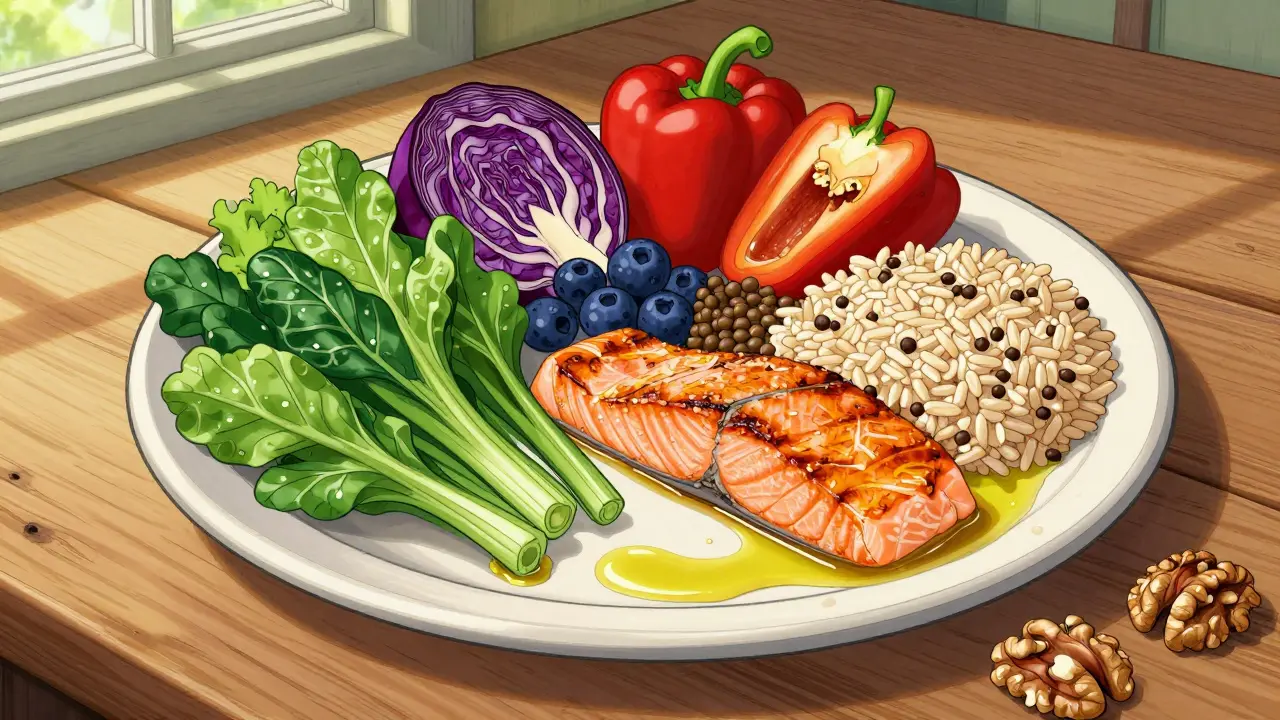
Think of your plate like a color wheel. Half of it should be vegetables and fruits. Not just carrots and apples. Think deep greens, purple cabbage, red bell peppers, blueberries, and pomegranates. Each color gives you different plant compounds that fight liver inflammation. Blueberries, for example, contain anthocyanins shown in studies to cut liver inflammation by 25%. One-quarter of your plate should be lean protein. That’s about the size of a deck of cards-chicken, fish, tofu, or legumes. Not steak every night. Fish like salmon and sardines are rich in omega-3s, which directly reduce liver fat. Beans and lentils are just as good, and cheaper. The last quarter? Whole grains. Brown rice, quinoa, oats, barley. Not white bread, not pasta made from refined flour. Whole grains are packed with fiber, which helps your liver process fats and sugar better. Aim for at least 3 servings of vegetables and 2 servings of fruit every day. That’s not hard when you start adding spinach to your eggs or an apple with your lunch.What to Cut Out-For Real
The biggest enemy of your liver isn’t fat. It’s sugar. Especially liquid sugar. A single 12-ounce soda has 39 grams of sugar-that’s nearly 10 teaspoons. That sugar doesn’t go to your muscles. It goes straight to your liver, where it turns into fat. And that’s how fatty liver starts. Cut out soda, energy drinks, sweetened teas, and even fruit juices. They’re all sugar bombs. If you crave something sweet, reach for whole fruit. The fiber slows down the sugar, so your liver doesn’t get overwhelmed. Also ditch trans fats. They’re in fried foods, packaged snacks, and anything that says ‘partially hydrogenated oils’ on the label. These fats increase liver inflammation and make fat buildup worse. Read labels. If you can’t pronounce it, don’t eat it. Salt is another silent problem. Too much sodium causes fluid retention, which is dangerous if you have advanced liver disease. Keep it under 2,000 mg a day. That means skipping processed soups, canned beans, and deli meats. Use lemon juice, garlic, herbs, and spices instead. They add flavor without hurting your liver.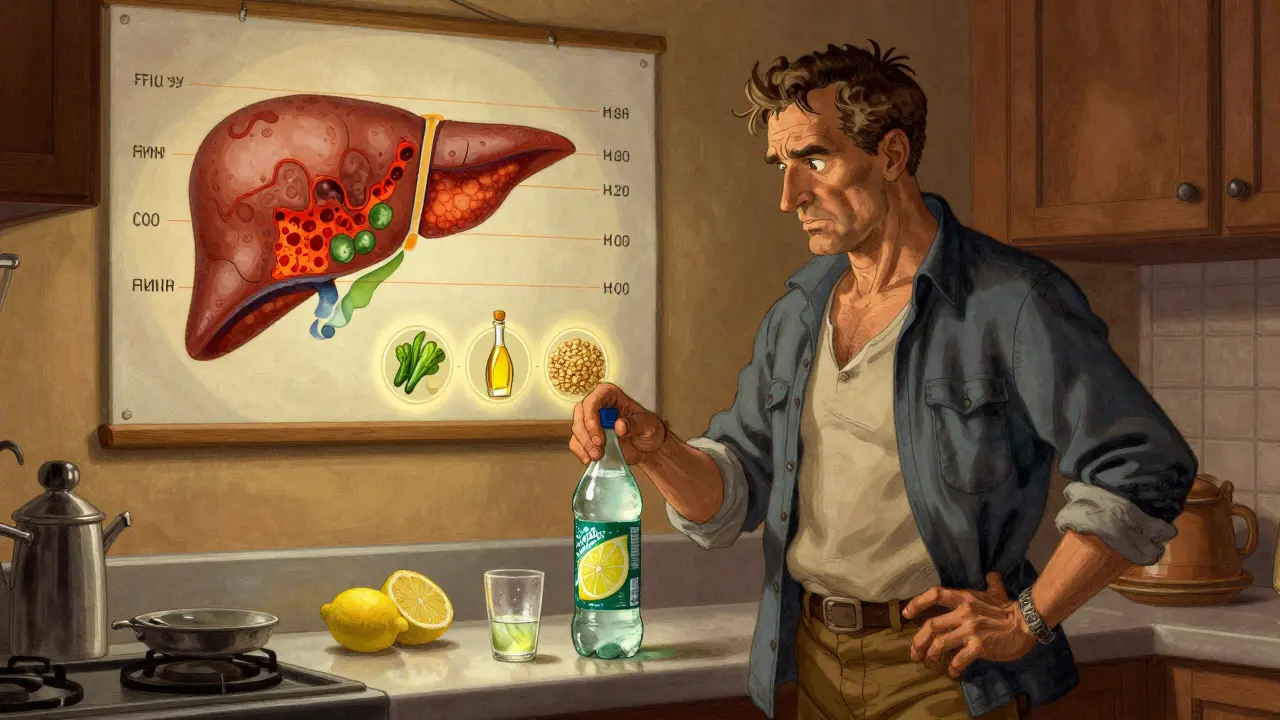
Why the Mediterranean Diet Wins
You’ve probably heard of it. But why does it work better than keto or low-fat diets? Because it’s balanced. Keto might drop weight fast, but it can spike liver fat in some people. Low-fat diets often replace fat with sugar-worse for your liver. The Mediterranean diet gets its power from olive oil, nuts, fish, and plants. Olive oil is rich in monounsaturated fats, which lower bad cholesterol and reduce liver fat. A 2014 study showed that getting 40% of your daily calories from these healthy fats significantly lowered the fats your liver produces. A 2021 meta-analysis found that people on the Mediterranean diet lost 32% more liver fat than those on low-fat diets. They also saw better fibrosis scores than those on keto. It’s not just about fat loss-it’s about reducing inflammation and protecting liver cells. And here’s the bonus: it’s good for your heart too. The same diet that helps your liver also cuts heart disease risk by 30%. That’s rare. Most liver diets ignore the body’s bigger picture. This one doesn’t.What About Detox Diets and Juice Cleanses?
They don’t work. And they’re not just useless-they’re misleading. The liver is already a detox machine. It doesn’t need a cleanse. Juice cleanses flood your liver with sugar, strip away protein, and leave you weak. The American Liver Foundation says it plainly: there’s zero scientific evidence supporting any detox diet for liver health. If someone tells you to drink lemon water and apple cider vinegar to ‘flush’ your liver, walk away. That’s marketing, not medicine. Real healing comes from consistent, balanced eating-not short-term extremes.Practical Tips That Actually Work
You don’t need to overhaul your life overnight. Start small.- Swap soda for sparkling water with lemon.
- Replace white rice with brown rice or quinoa once a day.
- Have a handful of walnuts as a snack. Just 30 grams a day has been shown to lower bad cholesterol by 15% in people with fatty liver.
- Use frozen vegetables. They’re just as nutritious, cheaper, and ready in minutes.
- Batch cook on Sundays. Make a big pot of lentil stew or grilled chicken and veggies. Eat it for lunch all week.
When Things Get Complicated
If you have advanced cirrhosis, protein needs change. Some doctors used to restrict protein to prevent confusion (hepatic encephalopathy). But new research shows that’s outdated. Not getting enough protein leads to muscle loss-and that makes your prognosis worse. The European Association for the Study of the Liver now recommends adequate protein (0.8-1.2g per kg of body weight) even in cirrhosis, unless you’re actively confused. Also, if cutting out sugar gives you headaches or mood swings, talk to your doctor. One woman in Australia had severe migraines when she quit sugar cold turkey. Her hepatologist adjusted her plan: she could have 15 grams of natural sugar a day from berries. That’s not giving in-it’s personalizing care.What’s Next for Liver Nutrition
Science is moving fast. In September 2024, a major trial will test time-restricted eating-eating only within a 10-hour window-combined with the Mediterranean diet. Early results suggest this combo cuts liver fat 27% more than diet alone. The Mayo Clinic is also launching a $2.1 million study in early 2024 to see how your gut bacteria predict which foods work best for you. Personalized liver diets might be coming soon. For now, the message is clear: your liver responds to what you feed it. Every meal is a chance to heal. You don’t need to be perfect. You just need to be consistent. Eat more plants. Cut out sugar. Choose good fats. Move your body. And give your liver the time it needs to recover.Real People, Real Results
On Reddit’s r/FattyLiver community, 68% of over 1,200 people reported more energy within three months of changing their diet. The most common complaint? Social pressure. ‘I felt weird saying no to pizza at work dinners,’ one user wrote. ‘But I started bringing my own salad-and now people ask for the recipe.’ The VA Health System’s nutrition program had an 87% satisfaction rate. Why? Because it didn’t preach. It taught people how to shop, cook, and plan meals on a budget. One nurse said, ‘We don’t tell them what to eat. We show them how to eat better without going broke.’ If you’re starting today, remember: this isn’t a diet. It’s a lifestyle. One meal at a time.Can I eat fruit on a liver-healthy diet?
Yes, whole fruit is encouraged. Berries, apples, pears, and citrus are rich in fiber and antioxidants that help reduce liver inflammation. Avoid fruit juices-they’re concentrated sugar without the fiber. Stick to 2 servings per day, and pair them with nuts or yogurt to slow sugar absorption.
Is olive oil good for fatty liver?
Yes, extra virgin olive oil is one of the best fats for liver health. It’s rich in monounsaturated fats and polyphenols that reduce liver fat and inflammation. Aim for 2-3 tablespoons a day. Use it for drizzling, salad dressings, or light cooking. Don’t fry with it-high heat breaks down its benefits.
Can I drink alcohol with a fatty liver?
No. Even small amounts of alcohol can worsen liver damage. For fatty liver disease, abstinence is the safest choice. Alcohol is directly toxic to liver cells and speeds up scarring. If you have NAFLD or MASLD, cutting out alcohol is non-negotiable for healing.
How long does it take to see results from a liver-healthy diet?
Many people notice improved energy and less bloating within 3-4 weeks. Liver enzymes often drop by 20-30% in 6 months. Significant fat reduction takes 6-12 months. The key is consistency-not speed. Even small daily changes add up over time.
Are there any foods that actively repair the liver?
No single food ‘repairs’ the liver. But certain foods support healing. Cruciferous vegetables like broccoli and Brussels sprouts contain compounds that help detoxify liver cells. Walnuts provide omega-3s and antioxidants. Coffee (black, no sugar) has been linked to lower liver fibrosis in multiple studies. The best strategy is variety-eat a rainbow of whole foods every day.
Sazzy De
January 31, 2026 AT 13:04Been following this for 6 months now and honestly my energy levels are through the roof
Used to crash by 3pm every day, now I’m still going strong after dinner
No magic pills, just swapped soda for sparkling water and started eating veggies with every meal
Feels like my liver finally stopped screaming
KATHRYN JOHNSON
January 31, 2026 AT 19:07The assertion that the Mediterranean diet is the ‘gold standard’ lacks rigorous comparative meta-analysis and ignores confounding variables in population-based studies.
Amy Insalaco
February 2, 2026 AT 18:59Let’s be real - calling it the ‘Mediterranean diet’ is just neoliberal culinary colonialism dressed up as science
They’re repackaging ancient peasant food as a premium wellness product while ignoring the structural inequities that make olive oil unaffordable for 78% of the global population
Meanwhile, the real hepatoprotective agents - flavonoids from local foraged greens, fermented legumes, ancestral cooking methods - get erased in favor of Instagram-friendly quinoa bowls
It’s not about what you eat, it’s about who gets to define ‘healthy’
Marc Bains
February 4, 2026 AT 18:52Shoutout to the guy from Ohio - that’s the kind of win we need to celebrate more
He didn’t wait for a pill or a procedure, he just started eating better and moving
And yeah, it’s not glamorous but that’s the point - healing isn’t a viral trend, it’s daily choices
Also, if you’re worried about cost, frozen spinach and canned beans are your new best friends
You don’t need fancy ingredients to heal your liver - just consistency
Diksha Srivastava
February 5, 2026 AT 06:55I started this 3 months ago and my mom who has fatty liver now asks me for recipe ideas
She used to eat fried samosas every weekend now she’s making roasted cauliflower with turmeric
Small changes really do add up
You don’t have to be perfect just persistent
owori patrick
February 5, 2026 AT 09:07Back home in Nigeria we’ve always eaten bitterleaf soup with garri and groundnuts
Turns out that’s basically a liver-friendly meal - bitterleaf is full of antioxidants, groundnuts give you good fats
Why do we always look west for health advice when our own kitchens have been healing us for centuries?
Adarsh Uttral
February 6, 2026 AT 07:21just swapped soda for water with lemon and my bloating is gone
no joke i feel like a new person
why is this so hard to do
Shubham Dixit
February 7, 2026 AT 19:21Look, I respect the science but let’s not pretend this is some revolutionary discovery
The Indian Ayurvedic tradition has been recommending turmeric, fenugreek, bitter gourd, and neem for liver cleansing for over 5,000 years
They didn’t need a 2013 Hepatology study to tell them that processed sugar is poison
Western medicine keeps rediscovering what ancient cultures already knew - then markets it as innovation
Why don’t we stop calling it ‘Mediterranean’ and start calling it ‘common sense’?
And while we’re at it, why is everyone ignoring the role of stress and sleep? You can eat all the olive oil in the world but if you’re chronically stressed your liver still suffers
Real healing is holistic - not just a plate of veggies and a glass of wine substitute
Stop reducing liver health to diet porn and start talking about the whole human being
Carolyn Whitehead
February 8, 2026 AT 16:39I used to think I had to eat perfectly to help my liver
Then I realized it’s more about showing up
Some days I eat salad, some days I eat pizza
But I never go back to soda
And that’s enough
Progress not perfection
Claire Wiltshire
February 10, 2026 AT 00:50For those concerned about protein intake in advanced cirrhosis - the latest EASL guidelines (2023) explicitly recommend 1.0–1.2 g/kg/day of high-quality protein, even in the presence of mild hepatic encephalopathy, as long as it is titrated carefully and paired with branched-chain amino acid supplementation if needed. Protein restriction is no longer standard of care. Always consult your hepatologist before making dietary changes in advanced disease.
Sidhanth SY
February 10, 2026 AT 20:37My dad had stage 3 fibrosis
He started eating brown rice instead of white, swapped chips for roasted chickpeas, and drank black coffee every morning
Two years later his FibroScan dropped from 15.8 to 7.1
He didn’t take a single pill
Just changed what was on his plate
Proof that food really is medicine