
IVIVC and Waivers: How In-Vitro Methods Are Replacing In-Vivo Bioequivalence Testing
 Jan, 26 2026
Imagine developing a generic version of a life-saving extended-release pill - but instead of testing it on 24 healthy volunteers in a clinical trial, you can predict how it will behave in the human body using a simple lab test. That’s not science fiction. It’s IVIVC - In Vitro-In Vivo Correlation - and it’s changing how generic drugs get approved.
What Exactly Is IVIVC?
IVIVC stands for In Vitro-In Vivo Correlation. In plain terms, it’s a scientific model that links what happens to a drug in a test tube (in vitro) to what happens inside the human body (in vivo). Specifically, it connects how fast a drug dissolves in a lab setting to how quickly and completely it gets absorbed into the bloodstream. This isn’t just a lab curiosity. The U.S. Food and Drug Administration (FDA) and the European Medicines Agency (EMA) recognize IVIVC as a legitimate way to skip expensive and time-consuming human trials - called bioequivalence studies - for certain generic drugs. If you can prove that your drug dissolves the same way as the brand-name version under controlled lab conditions, and you’ve built a solid IVIVC model, regulators may grant a biowaiver. That means no need to test the drug in people at all. The concept isn’t new. The FDA first laid out formal guidance in 1996. But until recently, very few companies succeeded in getting approval. Between 1996 and 2015, only 14 generic drug applications included IVIVC data - and most were rejected. Why? Because getting it right is hard.The Four Levels of IVIVC - And Why Level A Matters Most
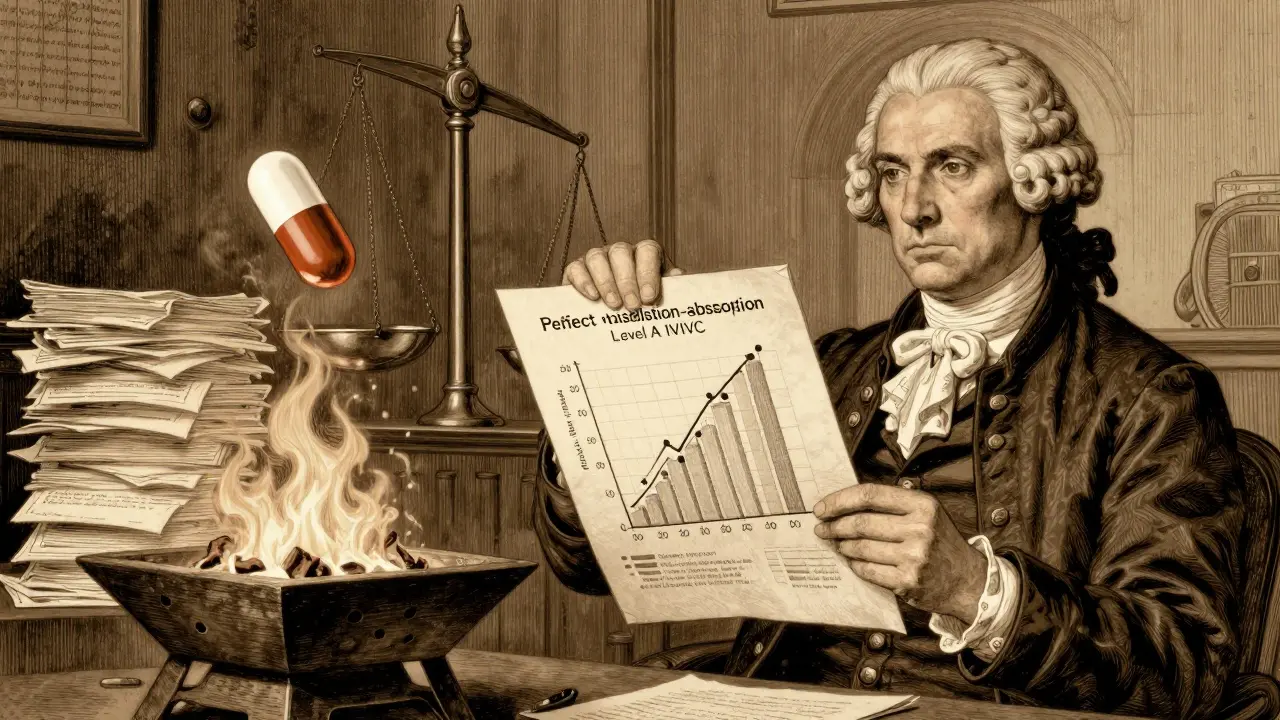
Not all IVIVC models are created equal. The FDA classifies them into four levels, based on how precisely they predict real-world performance.- Level A: This is the gold standard. It shows a point-to-point match between dissolution at every time point and drug absorption in the body. Think of it like a perfect mirror - if the drug dissolves 30% at 1 hour in the lab, it should release 30% into the blood at the same time in a person. For regulatory approval, Level A models need an R² value above 0.95, a slope near 1.0, and an intercept close to zero. They can predict the full drug concentration curve - AUC and Cmax - within ±10% and ±15% respectively.
- Level B: Uses averages. Instead of matching each time point, it compares mean dissolution time to mean residence time in the body. Less precise, but still useful in some cases.
- Level C: Only links one dissolution point (like % dissolved at 30 minutes) to one pharmacokinetic parameter (like Cmax). It’s easier to build but doesn’t predict the whole picture. Multiple Level C models - linking several dissolution points to multiple PK parameters - can sometimes be accepted, but they’re riskier.
- Level D: The weakest. Just says “dissolves faster = absorbed faster.” No numbers, no math. Not accepted for waivers.
Why Companies Are Trying IVIVC (And Why So Many Fail)
The financial incentive is huge. A single bioequivalence study in healthy volunteers costs between $500,000 and $2 million. It takes 6-12 weeks to run, plus months of planning and analysis. If you can avoid just one of those studies, you save millions. But building a valid IVIVC isn’t cheap or fast. It takes 12-18 months. You need:- At least 3-5 different versions of your drug formulation - with varying release rates - to create enough data points.
- Pharmacokinetic data from 3-5 clinical studies, each with 12-24 volunteers, with blood samples taken every 15-30 minutes for up to 48 hours.
- A dissolution method that’s discriminatory - meaning it can tell the difference between a good and bad batch. If your test can’t detect small changes in ingredients or manufacturing, it’s useless.
- Biorelevant media - not just plain water. Real stomach fluid has pH changes, bile salts, and enzymes. Testing in simple buffers won’t cut it anymore. Leading labs now use simulated intestinal fluids that mimic human physiology.
IVIVC vs. BCS: When to Use Which Path
You might have heard of the Biopharmaceutics Classification System (BCS). It’s another way to get a biowaiver - and it’s simpler. BCS categorizes drugs based on solubility and permeability:- Class I: High solubility, high permeability - like metformin or atenolol. Easy to waive.
- Class II: Low solubility, high permeability - like itraconazole.
- Class III: High solubility, low permeability - like ranitidine.
- Class IV: Low solubility, low permeability - like furosemide. Hard to waive.
Where IVIVC Falls Short - And When You Still Need Human Trials
IVIVC isn’t magic. There are limits. Regulators won’t approve a waiver if:- The drug has a narrow therapeutic index - meaning the difference between an effective dose and a toxic one is tiny. Think warfarin, digoxin, or phenytoin. Even a small change in absorption could be dangerous.
- The drug has nonlinear pharmacokinetics - where doubling the dose doesn’t double the blood level. This makes prediction unreliable.
- The drug is absorbed in the colon, not the stomach or small intestine. Dissolution tests don’t replicate colonic conditions well.
- The product is complex - like an injectable, ophthalmic, or transdermal patch. IVIVC for these is still experimental.

The Future: Machine Learning, Biorelevance, and Global Harmonization
IVIVC is evolving - fast. In 2023, the FDA released draft guidance on IVIVC for topical products. The EMA is exploring it for implants and inserts. Both agencies held a joint workshop in 2024 to discuss using machine learning to build IVIVC models. Instead of manually fitting curves, AI can analyze thousands of dissolution and PK datasets to find hidden patterns. Biorelevant dissolution is becoming standard. By 2025, the American Association of Pharmaceutical Scientists predicts 75% of new IVIVC submissions will use simulated intestinal fluids - not just water or buffer. And adoption is rising. From 2018 to 2022, IVIVC submissions to the FDA increased by 35%. Approval rates jumped from 15% to 42%. That’s not luck - it’s experience. Companies are learning. Teva’s experience with their extended-release oxycodone generic is telling: 14 months, three formulation tries, and $1.2 million spent - but they avoided five full bioequivalence studies. That’s a net savings of over $8 million. McKinsey & Company projects that by 2027, 35-40% of all modified-release generic approvals will use IVIVC waivers - up from just 22% in 2022.What This Means for Patients and the Healthcare System
You might not see IVIVC on a pill bottle. But it’s already lowering drug prices. When companies can develop generics faster and cheaper, more competitors enter the market. More competition means lower prices. Generic drugs already save the U.S. healthcare system over $300 billion a year. IVIVC helps keep that trend going - especially for complex, high-cost products like extended-release opioids, ADHD medications, or cardiovascular drugs. It also means faster access. Instead of waiting 2-3 years for a generic to clear clinical trials, a well-built IVIVC can cut that to 12-18 months. And for patients? It means safer, more reliable generics. Because IVIVC forces manufacturers to deeply understand their product - not just copy the label. They have to prove, scientifically, that their version behaves the same way in the body.Final Thoughts: It’s Not Easy, But It’s Worth It
IVIVC isn’t for every generic drug. For simple, immediate-release pills, BCS is faster. For complex products? It’s often the only viable path. The road is long, expensive, and technical. But the payoff - avoiding human trials, speeding up approval, reducing costs, and ensuring quality - makes it one of the most powerful tools in modern pharmaceutical science. It’s not about replacing human testing because it’s inconvenient. It’s about replacing it because we now have better science - and regulators are finally ready to trust it.What is an IVIVC biowaiver?
An IVIVC biowaiver is a regulatory approval that allows a generic drug manufacturer to skip human bioequivalence studies by using a scientifically validated model that links lab-based dissolution data to how the drug behaves in the human body. If the model proves the generic will absorb the same way as the brand-name drug, regulators like the FDA or EMA can approve it without clinical trials.
Is IVIVC accepted worldwide?
Yes, both the U.S. FDA and the European EMA accept IVIVC for biowaivers, particularly for extended-release oral products. Other regions, including Japan and Canada, are increasingly aligning with these standards. However, acceptance varies by product type - it’s much more common for oral drugs than for injectables or topical products.
Why do most IVIVC submissions get rejected?
The top reasons are: 1) dissolution methods aren’t biorelevant - they don’t mimic real stomach or gut conditions; 2) insufficient formulation variation - not enough different versions of the drug were tested; and 3) poor model validation - the model wasn’t tested against enough real human data to prove it’s predictive. About 64% of rejections in 2023 were due to inadequate physiological relevance.
Can IVIVC be used for immediate-release drugs?
Technically yes, but it’s rarely done. For immediate-release drugs, the Biopharmaceutics Classification System (BCS) is simpler, faster, and more commonly accepted. IVIVC is mainly used for complex, modified-release products where BCS doesn’t apply.
How long does it take to build a valid IVIVC model?
Building a Level A IVIVC typically takes 12-18 months. This includes 3-6 months to develop a discriminatory dissolution method, 6-9 months to run pharmacokinetic studies across multiple formulations, and 3-6 months to build, test, and validate the mathematical model. Rushing it leads to rejection.
What’s the difference between IVIVC and BCS?
BCS is a classification system based on a drug’s solubility and permeability. It’s used to waive bioequivalence studies for simple immediate-release drugs, especially Class I. IVIVC is a predictive model that links lab dissolution data directly to human absorption. It’s required for complex products like extended-release formulations where BCS doesn’t work.
Does IVIVC guarantee the generic will work the same in all patients?
No model can guarantee identical performance in every individual. But a validated Level A IVIVC ensures the generic behaves within strict, clinically acceptable limits compared to the brand - across the population. Regulators require the model to predict AUC and Cmax within ±10% and ±15%, which is considered therapeutically equivalent. Real-world variability (like diet or gut health) is still accounted for in the model’s design.
Henry Jenkins
January 26, 2026 AT 10:21Man, this post is a goldmine. I’ve worked in pharma QA for a decade, and IVIVC still feels like black magic to half the team. But when it works? It’s beautiful. I once saw a company cut 18 months off their timeline by nailing a Level A model for an extended-release metformin. They didn’t just save money-they saved lives by getting it to market faster. The real win isn’t the waiver-it’s the fact that they had to understand their product better than the brand did. That’s quality.
And yeah, biorelevant media? Non-negotiable anymore. Testing in plain buffer is like trying to predict how a car performs by only checking the engine in a vacuum. You need bile salts, pH shifts, the whole damn digestive symphony. The FDA’s 2023 rejection stats? Not surprising. Too many labs are still stuck in 2005.
Also, shoutout to Teva. That oxycodone case? Textbook. 14 months, $1.2M, five avoided trials. That’s not a cost center-that’s R&D done right.
And let’s be real: if we’re going to trust a machine learning model to predict human absorption, we better make sure the data feeding it isn’t garbage. Garbage in, garbage out-but with lives on the line.
Still, I’m optimistic. The fact that approval rates jumped from 15% to 42% in five years means people are finally learning how to play the game. Not just submitting half-baked models because they want to skip a clinical trial. Real science. Slow, expensive, but worth it.
Rakesh Kakkad
January 27, 2026 AT 00:53It is a matter of profound significance that regulatory agencies have begun to recognize the empirical validity of in vitro-in vivo correlation as a legitimate surrogate for human bioequivalence trials. The scientific rigor required to establish a Level A correlation is not merely technical-it is epistemological. One must demonstrate not only statistical fidelity but also physiological plausibility. The reliance upon biorelevant dissolution media, as opposed to aqueous buffers, represents a paradigmatic shift toward mechanistic understanding rather than empirical approximation. This evolution, though slow, is both necessary and commendable. The future of generic pharmaceutical development lies not in cost-cutting expedience, but in the elevation of analytical standards to mirror the complexity of human physiology.
TONY ADAMS
January 28, 2026 AT 11:05So let me get this straight-you spend over a million bucks and a year and a half just to avoid doing a test on 24 people? And you’re acting like this is genius? Bro, just test on 24 people. It’s not that hard. Why are we overcomplicating everything? I get it, big pharma wants to save cash, but this feels like building a rocket ship to deliver a sandwich.
George Rahn
January 29, 2026 AT 04:04Let’s not mince words: this isn’t science-it’s corporate theater dressed in lab coats. The FDA and EMA have become cheerleaders for cost-cutting disguised as innovation. We used to trust that a drug worked because it was tested in humans. Now? We trust a mathematical curve drawn from a beaker in a lab that doesn’t even simulate the human gut properly. And you call this progress? This is the same logic that got us the opioid crisis-trust the model, not the patient. When your algorithm predicts absorption within ±10%, you’re not predicting medicine-you’re predicting profit margins. And when a child with epilepsy gets a generic that doesn’t perform? Who’s accountable? The algorithm? The CEO? Or the regulator who signed off because it looked pretty on paper?
Ashley Karanja
January 30, 2026 AT 13:14Okay, I’m obsessed with this. The Level A IVIVC model is essentially a pharmacokinetic R² score-like a regression that actually matters. And the fact that we’re now using machine learning to auto-generate these correlations? That’s next-level. Imagine training a neural net on 10,000 dissolution curves paired with actual human PK data from the last 20 years. The model doesn’t just fit-it *learns*. It starts to recognize patterns humans miss, like how subtle changes in HPMC viscosity affect gastric retention in elderly patients with slowed motility. And the biorelevant media? Absolute game-changer. Simulated intestinal fluid isn’t just fancy water-it’s the closest we’ve come to replicating the human GI tract in a dish. The 2023 FDA rejection stats? They’re not failures-they’re data points. Every rejected submission taught the industry something. And now, with approval rates doubling? We’re not just iterating-we’re evolving. This isn’t replacing human trials because we’re lazy. It’s replacing them because we finally have the tools to do better. And honestly? That’s the most beautiful thing about modern pharma.
Karen Droege
January 30, 2026 AT 23:34Y’all need to stop acting like IVIVC is some futuristic fantasy-it’s just good science catching up to reality. I’ve watched companies waste millions on BCS waivers for extended-release products that *clearly* didn’t fit the category. BCS is for aspirin. IVIVC is for the stuff that keeps people alive for years-like extended-release stimulants for ADHD or slow-release heart meds. And the fact that 76% of failures come from not testing enough formulations? That’s not incompetence-that’s arrogance. You don’t get to skip human trials unless you’ve tortured your product with every possible variation. You need five different release profiles, not one. You need dissolution curves that can tell the difference between a batch made in Ohio and one made in Bangalore. And you need to test it in fluid that actually mimics what’s happening in the gut-not in a beaker with pH 6.8 and no bile. This isn’t cutting corners. This is building a bridge so precise, you can walk across it blindfolded and still land safely. And yeah, it’s expensive. But it’s cheaper than a lawsuit when a kid has a seizure because their generic didn’t absorb right. We’re not just saving money-we’re saving dignity. And that’s worth every penny.
Ashley Porter
February 1, 2026 AT 17:52Interesting that the FDA’s 2023 rejections were mostly about non-biorelevant media. That’s the same issue we had with the 2010 submissions. We’ve known this for 15 years. Why does it take so long to fix?
shivam utkresth
February 3, 2026 AT 10:11As someone from India, I’ve seen firsthand how this impacts access. Big pharma says IVIVC is expensive-but without it, generics just don’t get made here. The cost of a single bioequivalence study is more than what a small Indian manufacturer makes in a year. IVIVC isn’t just science-it’s equity. It’s the only way a village clinic in Bihar gets access to a cheap, reliable extended-release antihypertensive. The model might be complex, but the outcome? Simple: more medicine, less suffering. And honestly? The fact that we’re now using AI to build these models? That’s the kind of innovation that can lift entire regions. Not just profit-driven. Life-driven.
Aurelie L.
February 4, 2026 AT 15:11So we’re trusting a model over people now. Cool.