
Insurance Changes and Generic Switching: How Formulary Updates Affect Your Prescription Costs
 Mar, 23 2026
Every year, your insurance plan changes what drugs it covers and how much you pay for them. These aren’t minor tweaks-they can mean your $10 monthly copay jumps to $113 overnight. If you take medications for diabetes, arthritis, or heart conditions, you’re likely affected by formulary updates. And in 2025, these changes are bigger than ever.
What Exactly Is a Formulary?
A formulary is your insurance plan’s list of approved drugs. Not every medication is on it. Insurers pick which drugs to cover based on cost, effectiveness, and negotiations with drug makers. In 2025, most Medicare Part D plans made major shifts, pushing patients toward cheaper generics and biosimilars. The goal? Lower costs for insurers-and, ideally, for you.But here’s the catch: when a drug you’ve been taking for years gets removed or moved to a higher tier, you might not know until your pharmacy says, "Sorry, your copay just went up." That’s why understanding how formularies work matters.
How Tiered Copays Work in 2025
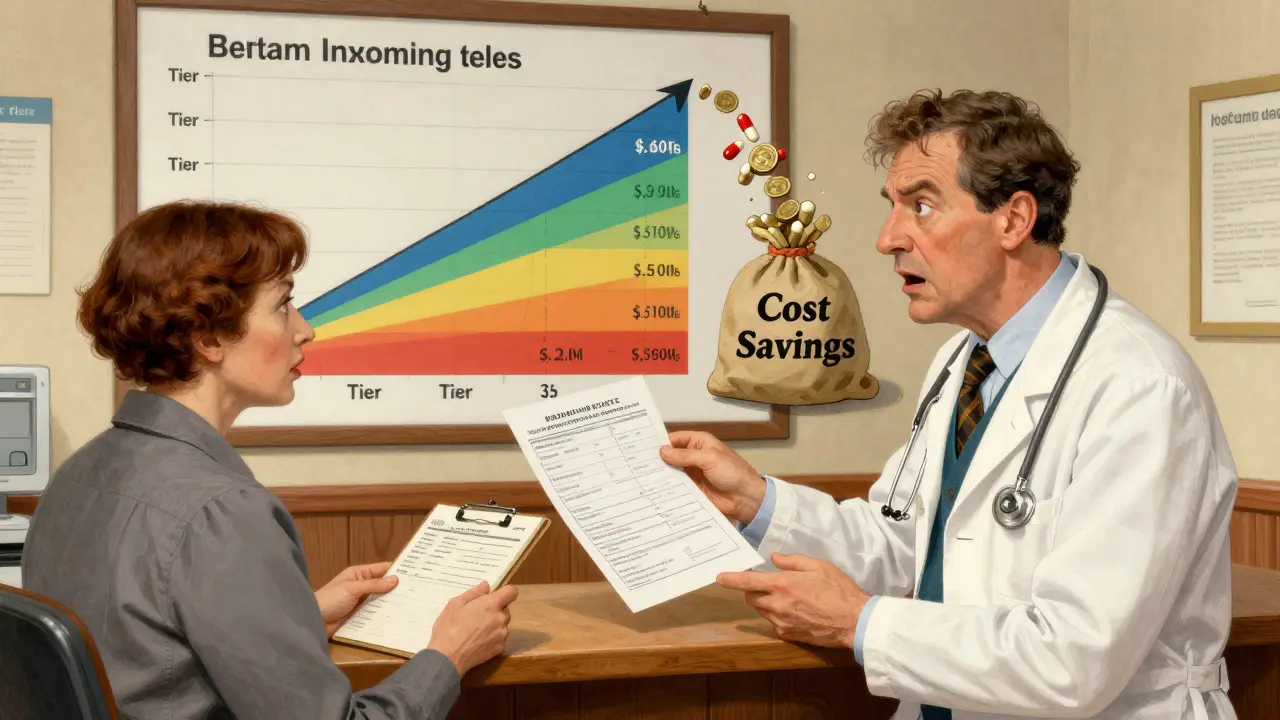
Most Medicare drug plans now use a four-tier system:- Tier 1: Preferred generics-usually $1 to $10 per prescription.
- Tier 2: Non-preferred generics or preferred brands-around $47.
- Tier 3: Non-preferred brands-$113 on average.
- Tier 4 (Specialty): High-cost drugs like biologics-either $113 or 25% of the cost, whichever is higher.
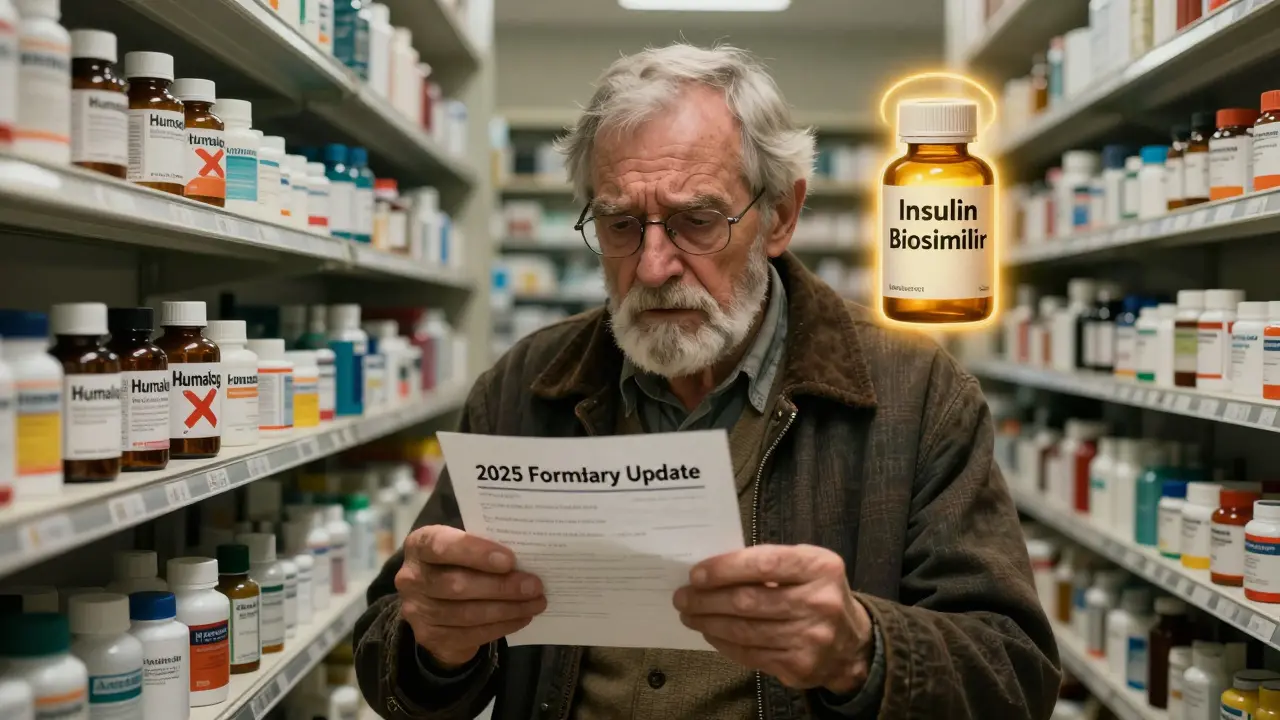
That $113 tier? That’s where many people get hit. A drug like Humalog insulin, once covered on Tier 1, was moved to Tier 3 by UnitedHealthcare in 2024. One user on Reddit reported their monthly cost jumped from $35 to $113-no change in the medication, just the plan.
Why Generic Switching Is Everywhere
Insurance companies don’t just encourage switching to generics-they’re forcing it. In 2025, 78% of standalone Medicare drug plans (PDPs) now require patients to try a generic before they can get the brand-name version. That’s called step therapy.For example, if you’ve been on Humira for rheumatoid arthritis, your plan might now require you to try Amjevita-a biosimilar-first. Biosimilars are nearly identical to the original biologic drug but cost 30% to 50% less. And insurers are pushing them hard. CVS Caremark added 11 new biosimilars to their 2025 formulary while removing older versions like Herzuma and Ogivri.
And it’s working. One user on HealthUnlocked said switching from Humira to Amjevita saved her $450 a month-with no difference in how well it worked. That’s the win insurers are betting on.
The ,000 Out-of-Pocket Cap
The Inflation Reduction Act (IRA) of 2022 changed everything. Starting January 1, 2025, Medicare Part D enrollees won’t pay more than $2,000 a year for their drugs. That’s huge. Before, people hit the "donut hole"-a coverage gap where they paid 100% out of pocket. Now, that gap is gone. And once you hit $2,000, your plan covers nearly everything else for the rest of the year.AARP estimates 3.2 million Medicare beneficiaries will save an average of $1,500 in 2025. Some will save over $3,000. But here’s the trade-off: to make this cap possible, insurers had to cut costs elsewhere. That’s why so many drugs got moved off formularies or shifted to higher tiers.
What Drugs Are Being Removed or Moved?
In 2025, CVS Caremark excluded 16 drugs, mostly specialty medications. UnitedHealthcare removed several diabetes and respiratory drugs. Aetna pulled back on certain biologics. The most common targets? Brand-name drugs with cheaper biosimilar alternatives.For instance:
- Humira (adalimumab) → replaced with Amjevita, Cimzia, or Adalimumab biosimilars
- Stelara (ustekinumab) → still covered, but only because it’s one of the first drugs under the new Medicare Drug Price Negotiation Program (MDPNP)
- Humalog insulin → moved from Tier 1 to Tier 3 in many plans
- Herzuma and Ogivri → fully removed, replaced with biosimilars Kanjinti and Trazimera
These aren’t random. They’re based on cost. If a biosimilar exists and is proven safe, insurers will make you switch-even if your doctor says otherwise.
What If Your Drug Gets Removed?
If your medication is taken off the formulary, you have options:- Request an exception: Your doctor can file a prior authorization request. In 2024, 82% of tier-change exceptions were approved. But if the drug was completely removed? Only 47% got approved.
- Use a 30-day transitional supply: If your plan changes your drug, you’re entitled to a 30-day supply at the old price. Some plans offer up to 60 days.
- Switch to a biosimilar: If your drug has a biosimilar, it’s often just as effective. Talk to your doctor about trying it.
- Appeal: If your exception is denied, you can appeal. The process takes 72 hours for standard requests, 24 hours for urgent cases.
But here’s the problem: waiting 10 to 14 days for approval means you might go without your medication. One Cigna survey found 38% of members went without drugs while waiting for approval.

When Do Changes Happen?
Insurers must give you 60 days’ notice before changing your coverage. But there’s a loophole: if a new generic is approved, they can change it with just 30 days’ notice. That’s why you should check your plan’s formulary every October and November.Most plans release their updated formularies between October and December. That’s your window to act. Call your pharmacist. Ask: "Is my medication still covered? Is there a cheaper alternative?" Pharmacists see these changes before you do.
The Big Change Coming in 2026
Starting January 1, 2026, Medicare will start negotiating prices for 10 high-cost drugs. The first three? Stelara, Prolia, and Xolair. Once negotiated, all Part D plans must cover them-at the new lower price.That means biosimilars for these drugs will flood the market in 2025. If you’re on one of these drugs now, expect your plan to push you toward the biosimilar next year. And you’ll likely pay less.
What You Should Do Now
Don’t wait until January. Here’s what to do:- Log into your plan’s website and download the 2025 formulary.
- Search for every medication you take.
- Check if it’s still covered, and what tier it’s on.
- Call your pharmacist-they can tell you if a cheaper generic or biosimilar is available.
- If your drug was moved to a higher tier, ask your doctor if you qualify for an exception.
- Consider switching plans during Open Enrollment (October 15-December 7) if your current plan no longer covers your meds.
Generic switching isn’t going away. It’s the new normal. But you don’t have to be caught off guard. Knowing how your plan works, when changes happen, and what your rights are can save you hundreds-or even thousands-of dollars a year.
What happens if my insurance stops covering my medication?
If your drug is removed from the formulary, you can request a one-time 30-day transitional supply at your old price. After that, your doctor can file an exception request. If approved, you’ll keep the drug. If denied, you’ll need to switch to a covered alternative or pay full price. You can also appeal the decision.
Are biosimilars as safe and effective as brand-name drugs?
Yes. Biosimilars are approved by the FDA after showing they’re "highly similar" to the original drug, with no clinically meaningful differences in safety, purity, or potency. Studies show they work just as well for conditions like rheumatoid arthritis, Crohn’s disease, and diabetes. Many patients switch without any issues.
Can I stay on my brand-name drug if I prefer it?
You can, but only if your doctor files an exception and your plan approves it. Insurers don’t have to let you stay on a brand-name drug if a cheaper alternative exists. Approval rates for exceptions are high for tier changes (82%), but low for complete exclusions (47%).
How do I find out if my plan changed its formulary?
Your plan must send you a notice at least 60 days before changes take effect. But don’t wait for it-check your plan’s website between October and December. Most post their updated formularies online. You can also call customer service or ask your pharmacist.
Why do insurance companies push generics so hard?
Because they’re cheaper-and the law now forces them to cap what patients pay. With the $2,000 out-of-pocket cap in place, insurers have to cut costs elsewhere. Switching patients to generics and biosimilars is the most effective way to do that without raising premiums.
Will I be notified if my medication is changing?
Yes, but not always in time. Plans must notify you at least 60 days in advance for most changes. But if a new generic is approved, they can change coverage with just 30 days’ notice. That’s why checking your formulary each fall is critical.
Amber Gray
March 23, 2026 AT 23:29Danielle Arnold
March 25, 2026 AT 04:31Donna Fogelsong
March 27, 2026 AT 04:07Seth Eugenne
March 28, 2026 AT 17:34rebecca klady
March 28, 2026 AT 23:50Namrata Goyal
March 30, 2026 AT 10:57Jefferson Moratin
March 31, 2026 AT 08:00Caroline Dennis
April 2, 2026 AT 04:58Zola Parker
April 3, 2026 AT 02:31florence matthews
April 4, 2026 AT 13:29Raphael Schwartz
April 4, 2026 AT 14:28Pat Fur
April 5, 2026 AT 04:27