
Hypertensive Retinopathy: How High Blood Pressure Damages Your Eyes
 Jan, 6 2026
Most people know that high blood pressure can hurt your heart or kidneys. But few realize it’s quietly damaging the tiny blood vessels in your eyes-sometimes long before you notice any symptoms. Hypertensive retinopathy isn’t just a eye condition. It’s a warning sign that your entire vascular system is under stress. And if left unchecked, it can lead to permanent vision loss.
What Exactly Is Hypertensive Retinopathy?
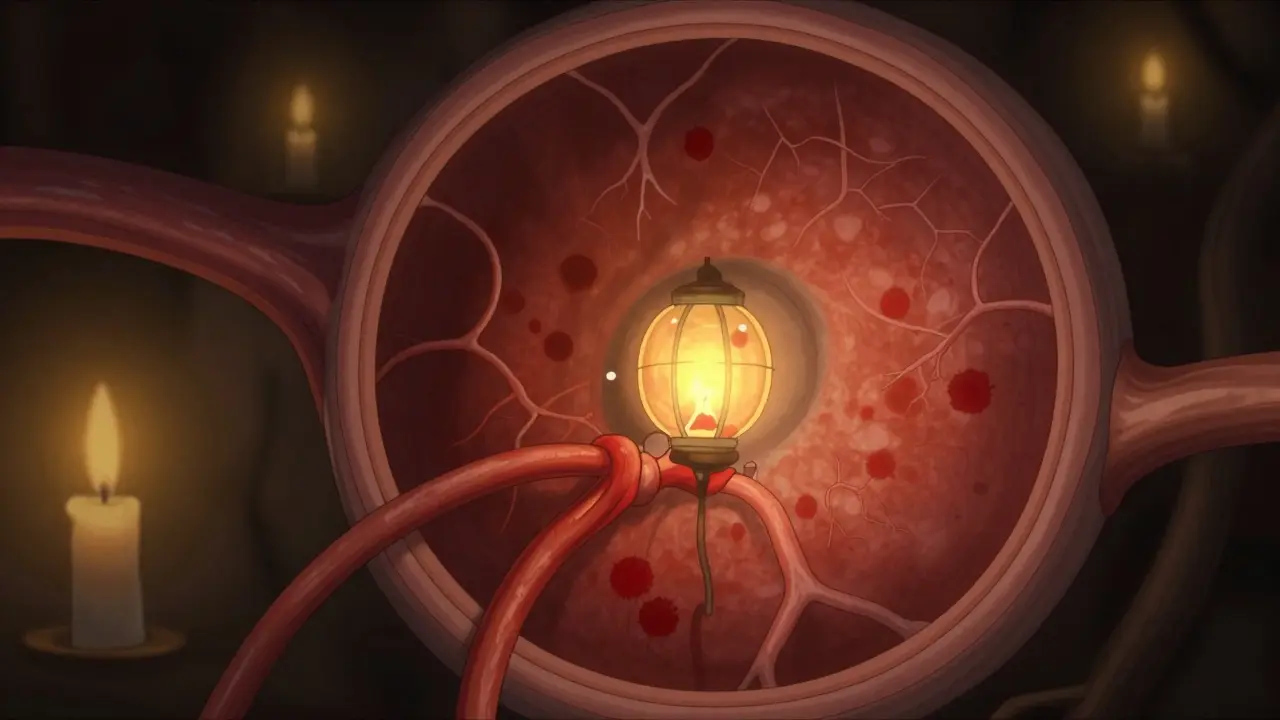
Hypertensive retinopathy happens when long-term high blood pressure damages the blood vessels in the retina-the light-sensitive layer at the back of your eye. These vessels are delicate. They’re not built to handle constant pressure. Over time, the walls thicken, narrow, and sometimes leak. That’s when you start seeing changes like blurred vision, dark spots, or even sudden vision loss.
The damage doesn’t happen overnight. It builds up over years. Studies show that after just 3 to 5 years of uncontrolled hypertension, retinal changes can already be detected. And here’s the scary part: many people have no symptoms until the damage is advanced. That’s why routine eye exams are just as important as checking your blood pressure at home.
The Four Stages of Retinal Damage
Doctors use the Keith-Wagener-Barker (KWB) system to grade how bad the damage is. It’s simple, reliable, and tells you a lot about your overall health.
- Grade 1: Mild narrowing of the retinal arteries. No bleeding or leakage yet. You won’t feel anything. But this stage is already a red flag-especially if your blood pressure has been above 130/85 for over 10 years.
- Grade 2: Arteries are more narrowed, and you’ll see arteriovenous nicking-where an artery presses down on a vein like a knot. This is a classic sign of chronic high pressure. About 22% of people with uncontrolled hypertension show this after just 3 years.
- Grade 3: Now you’ve got hemorrhages (bleeding), cotton wool spots (tiny areas of nerve damage), and hard exudates (leaked fat deposits). Vision may start to blur. This stage means your blood pressure is consistently above 160/100 mmHg.
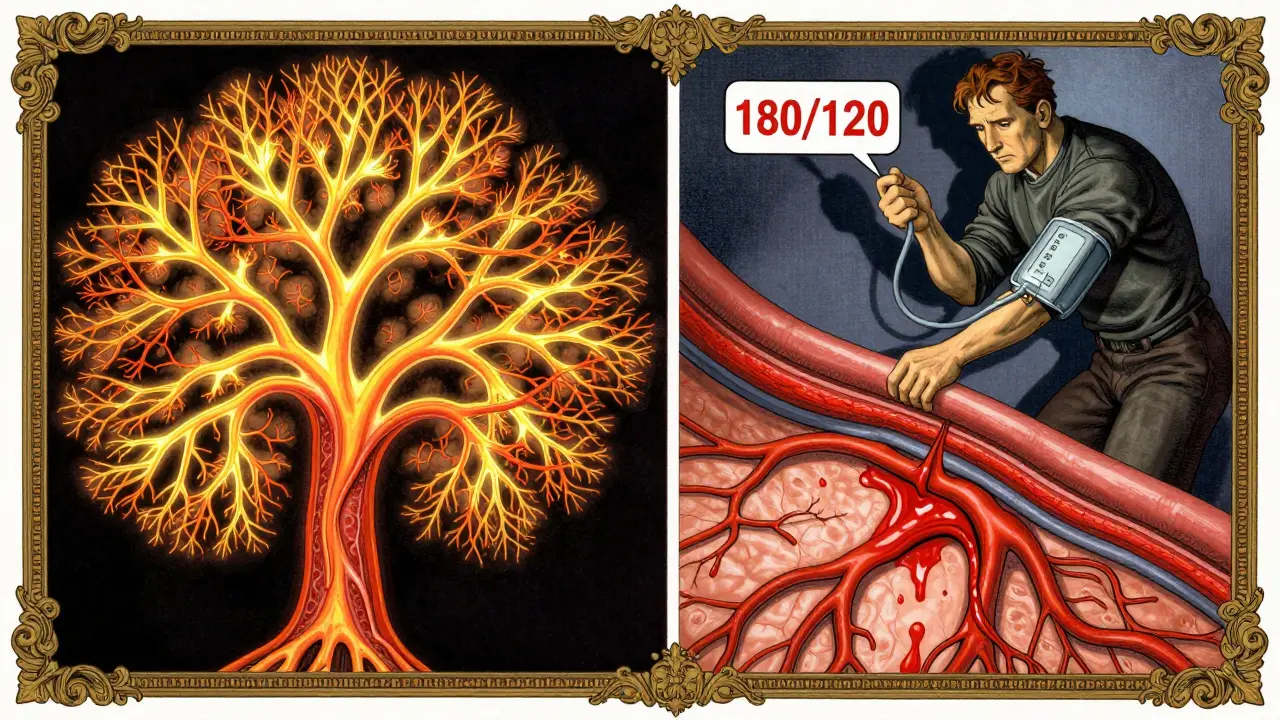
- Grade 4: This is emergency territory. Swelling of the optic nerve (papilledema) appears. It’s a sign of malignant hypertension-blood pressure over 180/120 mmHg. About 40% of these patients develop optic nerve swelling within 72 hours. Many also have kidney or heart damage. And yes, stroke risk jumps by 78%.
Grade 4 isn’t just about your eyes. It’s your body screaming for help.
What You Might Feel (And What You Won’t)
Here’s the cruel twist: you might have Grade 2 retinopathy and feel perfectly fine. In fact, 68% of people with early-stage damage report no symptoms at all. That’s why so many wait until it’s too late.
By the time symptoms show up, you’re likely in Grade 3 or 4. Common signs include:
- Blurred or double vision
- Dark spots or shadows in your central vision
- Sudden, painless vision loss-like a curtain coming down
- Severe headaches with vision changes
One Reddit user, u/RetinaWarrior, described waking up with dark spots after their blood pressure hit 210/110. Another reported double vision and a pounding headache-classic signs of a hypertensive crisis. These aren’t rare cases. They’re textbook.
And here’s the hard truth: 42% of patients delay seeing a doctor until their vision affects daily tasks like reading or driving. By then, the damage may be irreversible.
How Doctors See the Damage
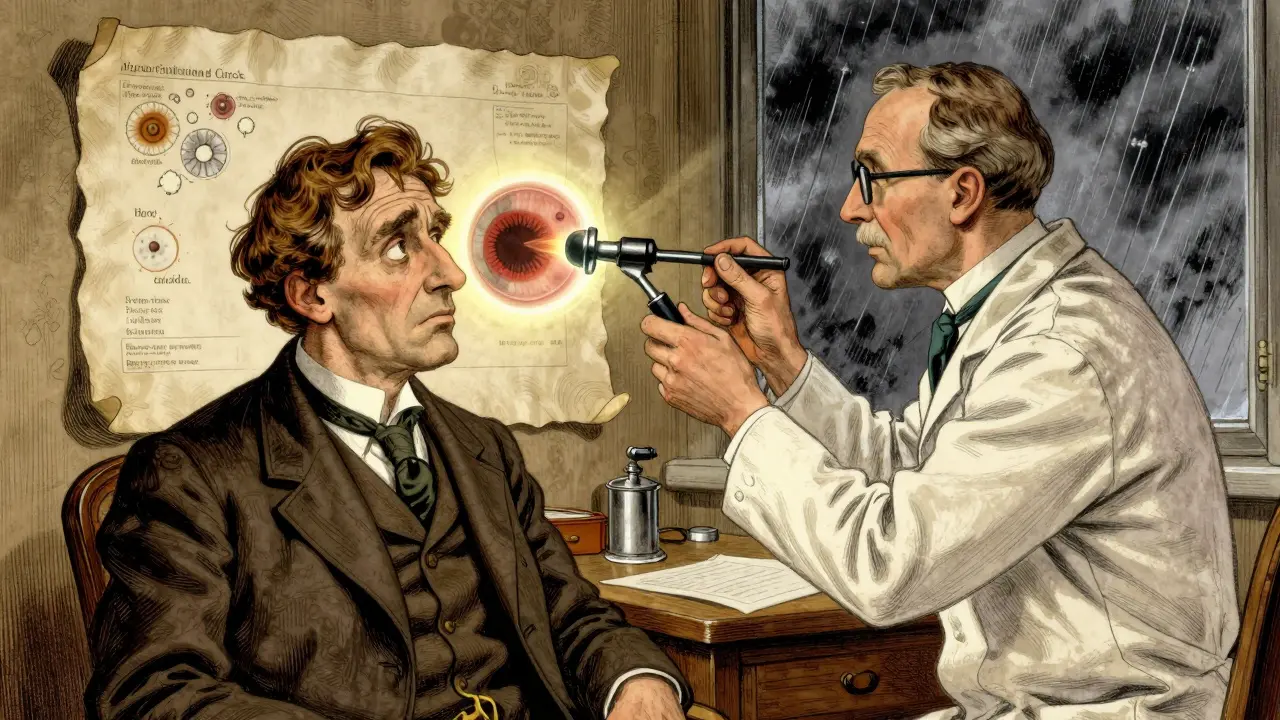
There’s no blood test for hypertensive retinopathy. You need an eye exam. A simple fundoscopic exam-where the doctor shines a light into your eye-can reveal the first signs of damage. But now, technology is making it even better.
Optical coherence tomography (OCT) scans show swelling and thickness changes in the retina. AI tools like RetinaCheck AI, cleared by the FDA in 2022, can now analyze retinal images and spot early changes with 92% accuracy-up from 75% with the human eye alone. More clinics are using these tools because they catch problems earlier.
Even more promising is the RetiFlow system, currently in Phase 3 trials. It measures blood flow in the retina without dye or injections. It’s fast, non-invasive, and detects changes before they become visible on traditional scans.
Why Your Eyes Are a Window to Your Heart
Doctors call the retina a ‘window to systemic vascular health.’ Why? Because the blood vessels in your eye are the only ones you can see without surgery. If they’re narrowing, leaking, or bleeding, the same thing is likely happening in your brain, kidneys, and heart.
Studies show:
- People with retinopathy have a 2.5x higher risk of heart attack or stroke.
- Arteriovenous nicking and optic disc swelling raise stroke risk by 3.2x.
- Retinal hemorrhages appear in 35% of patients with systolic BP over 180 mmHg for six months or longer.
That’s why a retinal exam isn’t just about vision. It’s a predictor of life-threatening events. If your eye doctor sees Grade 2 or higher, they’re not just treating your eyes-they’re alerting you to a ticking time bomb elsewhere in your body.
Can You Reverse the Damage?
Yes-sometimes. But only if you act fast.
Lowering your systolic blood pressure by 25 mmHg within 24 to 48 hours can reverse retinal changes in 65% of cases. That’s not a miracle. It’s science. The retina responds quickly when pressure drops.
But here’s the catch: if the damage has reached the macula-the part of the retina responsible for sharp central vision-it may take 3 to 6 months to recover, and 22% of people never fully regain their vision.
Medication matters. The European Society of Cardiology found that ACE inhibitors reduce retinal damage progression by 32% compared to calcium channel blockers. That’s a big difference. If you’re on blood pressure meds, ask your doctor if your current one protects your eyes.
What You Can Do Right Now
You don’t need to wait for symptoms. If you have high blood pressure, here’s your action plan:
- Get your eyes checked annually-even if your vision feels fine. If you have stage 2 hypertension (BP ≥140/90), get checked every 6 months.
- Monitor your blood pressure at home. Use a validated device. Record readings. Show them to your doctor. Studies show 70% better medication adherence when patients track their numbers.
- Know your numbers. Systolic over 130? Diastolic over 80? That’s stage 1 hypertension. It’s not ‘mild’ if it’s been going on for years. Damage can still happen.
- Don’t ignore sudden vision changes. If you wake up with dark spots, blurred vision, or a ‘curtain’ over your sight-seek help immediately. This could be a hypertensive emergency.
- Join a support program. The American Heart Association’s ‘Check. Change. Control.’ program has helped 35% more people manage their BP when they understand the eye connection.
The Bigger Picture
Over 19 million Americans have stage 2 hypertension. That’s 7.3% of the adult population. And nearly all of them are at risk for retinal damage. The diagnostic market for this condition is expected to hit $1.8 billion by 2027-not because it’s trendy, but because it’s urgent.
Researchers are now looking for genetic markers that make some people more vulnerable. Early data points to 37 specific gene variations that could predict who’s most at risk. That means in the future, we might screen not just for blood pressure-but for genetic susceptibility too.
For now, the best defense is simple: know your numbers, get regular eye exams, and treat your blood pressure like your life depends on it-because it does.
Can high blood pressure cause permanent vision loss?
Yes. If high blood pressure remains uncontrolled for years, it can permanently damage the retina, optic nerve, or macula. About 22% of patients with advanced hypertensive retinopathy experience lasting vision loss, even after their blood pressure is brought under control. Early detection and treatment are critical to prevent this.
Do I need an eye exam if I have high blood pressure but no vision problems?
Absolutely. Up to 68% of people with early-stage hypertensive retinopathy have no symptoms. Damage can be present long before you notice blurred vision or spots. Annual eye exams are recommended for anyone with hypertension, especially if your blood pressure is above 140/90.
How long does it take for high blood pressure to damage the eyes?
Retinal changes can appear after just 3 to 5 years of uncontrolled hypertension. Even ‘mild’ hypertension (130-139/85-89 mmHg) can cause damage if left untreated for 10 years or more. The longer your blood pressure stays high, the greater the risk.
Can retinopathy be reversed with medication?
In early stages, yes. Lowering systolic blood pressure by 25 mmHg within 24-48 hours can reverse retinal changes in 65% of cases. Medications like ACE inhibitors are especially effective at slowing progression. But once the macula or optic nerve is damaged, recovery is limited.
Is hypertensive retinopathy the same as diabetic retinopathy?
No. They’re different conditions with different causes. Hypertensive retinopathy is caused by high blood pressure damaging blood vessels. Diabetic retinopathy is caused by high blood sugar. But if you have both-like many people with type 2 diabetes-your risk of vision loss jumps 4.7 times higher. Managing both conditions is essential.
What should I do if I suddenly lose vision?
Seek emergency care immediately. Sudden vision loss-especially with severe headache, nausea, or confusion-could signal malignant hypertension or retinal artery occlusion. These are medical emergencies. Go to the ER or call an ambulance. Do not wait.
Kyle King
January 7, 2026 AT 01:58So let me get this straight - the government and Big Pharma are using eye exams to track your blood pressure so they can force you into their vaccine-medicine-industrial complex? I’ve seen the videos. The retina is a ‘window’? Nah, it’s a surveillance port. They’re already using AI to read your soul through your pupils. You think this is medicine? It’s control. And they’re selling you ‘OCT scans’ like it’s a spa day. Wake up.
Emma Addison Thomas
January 8, 2026 AT 06:37I’ve had my blood pressure checked annually since my father had a stroke at 52. I never thought about my eyes - but now I see how much more there is to it. My optometrist never mentioned retinopathy until I asked. Maybe we need more public awareness, not just more tech. It’s not about fear - it’s about listening to your body before it screams.
Mina Murray
January 9, 2026 AT 15:3268% asymptomatic? That’s not a statistic, that’s a lie. If you’re hypertensive and your eyes are fine, you’re either lying to yourself or your doctor is lying to you. I’ve seen patients with 180/110 and ‘no damage’ - then they go blind three months later. The system is broken. They don’t want you to know how easy it is to miss this. ACE inhibitors? Sure. But did you know some meds make retinal damage worse? They don’t tell you that. And no, I’m not a doctor - I just read the studies. All of them.
Rachel Steward
January 10, 2026 AT 13:42Let’s cut through the medical fluff. The retina isn’t a ‘window’ - it’s a mirror. It reflects the rot inside you. The same vessels that leak in your eye are clogging in your brain, hardening in your heart, and failing in your kidneys. You think this is about vision? It’s about denial. People treat BP like a number on a screen, not a countdown. And now we’ve got AI that can spot damage before you feel it - but nobody wants to act until they’re legally blind. That’s not medical failure. That’s moral failure. You don’t need a scan. You need to stop lying to yourself.
Christine Joy Chicano
January 10, 2026 AT 17:42The way the retina responds to pressure changes is breathtakingly elegant - it’s like nature’s own barometer. When the arteries narrow, they don’t just stiffen - they whisper. And those cotton wool spots? They’re not just debris. They’re the ghostly footprints of dying neurons. The fact that we can now map blood flow without dyes or needles? That’s not just innovation - it’s poetry in motion. We’re learning to read the body’s silent language, and it’s telling us to slow down, breathe, and care. Not just for the eyes - for the whole damn system.
Adam Gainski
January 11, 2026 AT 16:05I’m a nurse and I’ve seen this too many times. Patient comes in with blurry vision, says ‘I thought it was just aging.’ BP’s 190/105. Retinopathy Grade 3. We get them stabilized, start them on an ACE inhibitor, and within 6 weeks, the hemorrhages start fading. It’s not magic - it’s biology. But the real win? When they start checking their BP at home and actually show up to follow-ups. It’s not about fear. It’s about empowerment. You’ve got the tools. Use them.
Anastasia Novak
January 12, 2026 AT 01:39Oh my god. I just Googled ‘hypertensive retinopathy’ and I cried. Like, full ugly cry. I’m 34, my BP’s been 145/92 for two years, and I thought ‘it’s fine, I’m young.’ Now I’m staring at my phone like it’s a death sentence. I’ve got a 10am appointment with my optometrist. If they find anything, I’m quitting my job, moving to a cabin, and eating only kale. This isn’t a health article - it’s a horror movie. And I’m the main character.
Jonathan Larson
January 12, 2026 AT 21:14While the clinical data presented is compelling and well-documented, one must not overlook the existential dimension of this condition. The human body, in its intricate architecture, is not merely a machine to be calibrated - it is a living testament to the consequences of neglect. To ignore retinal changes is to ignore the silent covenant between mind, body, and time. The retina does not lie. It reflects not only vascular stress, but the erosion of self-care, of mindfulness, of presence. To act is not merely to treat - it is to recommit to life itself.
Katrina Morris
January 13, 2026 AT 03:26steve rumsford
January 14, 2026 AT 05:37my uncle went blind from this. never checked his bp. thought he was just getting old. turned out he had grade 4 for 3 years and no one said a word. now he’s got a guide dog and a 1000 page journal of all the meds he’s on. don’t be him.
Andrew N
January 14, 2026 AT 22:45Most people don’t know what a fundoscopic exam is. That’s why they die. You don’t need AI. You need a doctor with a light and 5 minutes. Stop buying gadgets. Get checked. Simple.
Anthony Capunong
January 16, 2026 AT 14:18They’re using this to push global health agendas. Retina scans? AI? It’s all part of the biometric control grid. If you’re American, you should be asking why the government is pushing this so hard. Are they trying to track who’s healthy and who’s not? This isn’t medicine - it’s surveillance dressed in white coats. And don’t fall for the ‘you’re saving your eyes’ lie. They want your data. Your BP. Your retina. Your soul.