
Hyperparathyroidism: High Calcium, Bone Loss, and When Surgery Is Needed
 Dec, 21 2025
When your blood calcium stays too high for too long, your body starts eating itself. Not metaphorically-literally. Your bones weaken. Your kidneys form stones. You feel tired all the time, even after sleeping. And your brain? It feels foggy, like you're stuck in slow motion. This isn't just aging. It's hyperparathyroidism.
What Exactly Is Hyperparathyroidism?
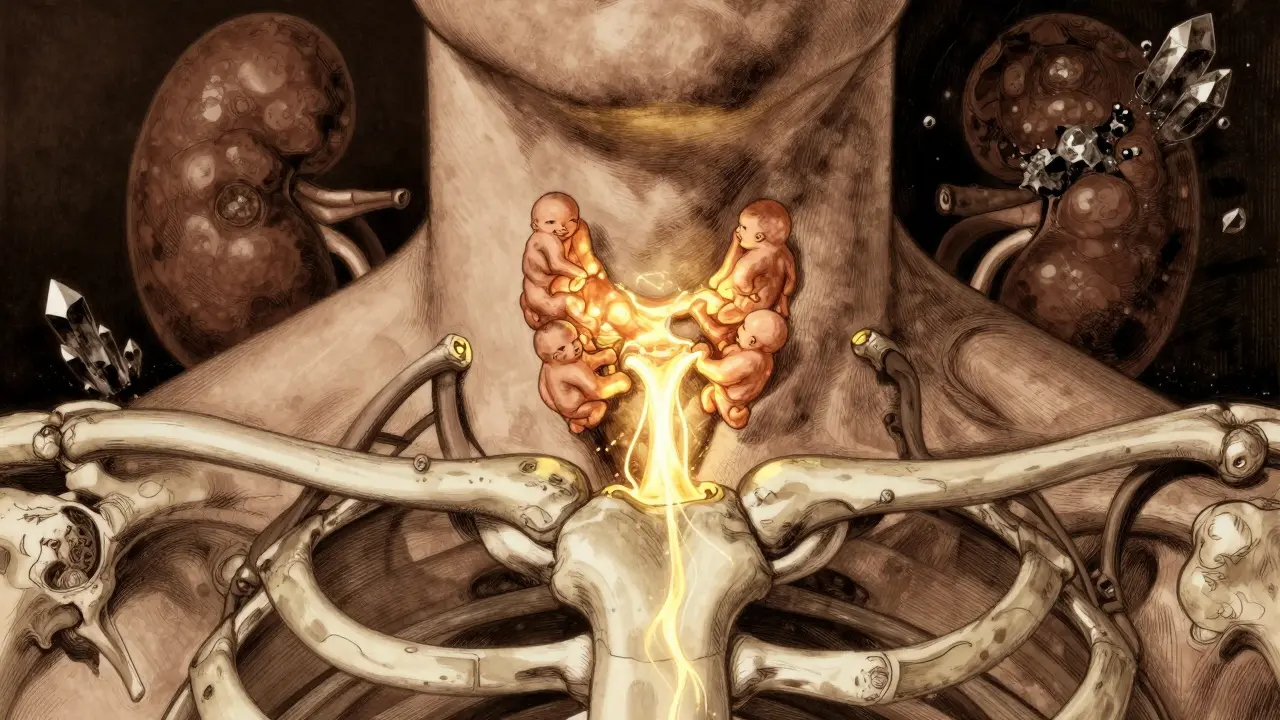
Your parathyroid glands are four tiny pea-sized organs tucked behind your thyroid in the neck. They don’t make thyroid hormone. They make PTH-parathyroid hormone. And their only job is to keep your blood calcium in a narrow, safe range: between 8.5 and 10.2 mg/dL. When calcium drops too low, PTH kicks in. It tells your bones to release calcium, your gut to absorb more from food, and your kidneys to hold onto calcium instead of peeing it out. Simple. Smart. Until it goes wrong. In primary hyperparathyroidism, one or more of these glands start pumping out too much PTH-on their own. No reason. No trigger. Just broken. And because of that, your calcium skyrockets. Often above 10.5 mg/dL. Sometimes over 12 mg/dL. That’s not just high. That’s dangerous. This isn’t rare. About 100,000 Americans get diagnosed each year. Women are three times more likely than men. And in African-American communities, rates are even higher. Most people are over 50 when it shows up. But it can hit younger people too.How It Breaks Your Bones
Your bones aren’t just scaffolding. They’re storage units for calcium. When PTH is stuck on high, your bones become a cash machine. Osteoclasts-cells that break down bone-go into overdrive. Calcium pours into your blood. And your bones? They get hollow. A DXA scan (the same test used for osteoporosis) shows this clearly. People with untreated hyperparathyroidism lose 2% to 4% of bone density every year in their spine and hips. That’s faster than most postmenopausal women lose bone. And it doesn’t stop until the PTH is turned off. The result? A 30% to 50% higher chance of breaking a bone. A hip fracture at 65 can change your life forever. A wrist fracture from a simple fall? That’s often the first sign something’s wrong.More Than Just Bones: The Hidden Symptoms
You might not feel like you have a disease. Many people don’t. That’s why it’s often missed for years. But if you’ve had:- Chronic fatigue that no amount of sleep fixes
- Brain fog-forgetting names, losing focus at work
- Recurrent kidney stones
- Bone or joint pain that won’t go away
- Depression or anxiety that doesn’t respond to therapy

How Doctors Diagnose It
It starts with a simple blood test. Two things matter: calcium and PTH. If your calcium is above 10.5 mg/dL and your PTH is above 65 pg/mL, that’s a clear sign. But here’s the twist: 20% of people have PTH levels that look “normal” on paper-between 15 and 65. But if your calcium is high and your PTH isn’t suppressed, that’s still abnormal. It’s like your car’s gas light is on, but the mechanic says the fuel tank is fine. It’s not. Doctors will usually check calcium twice, a week apart, to rule out a lab error or temporary spike. If both are high, they’ll order imaging. The go-to test is a sestamibi scan-a nuclear medicine test that lights up the overactive gland. It’s 90% accurate for finding a single adenoma (the most common cause). Ultrasound is used too. For complex cases, a 4D-CT scan can pinpoint the problem with 95% accuracy.When Surgery Is the Only Cure
There’s no pill that fixes this. Medications like cinacalcet can lower PTH a bit, but they don’t cure it. They’re for people who can’t have surgery-like those with severe kidney disease. For everyone else, surgery is the only way to get back to normal. The procedure is called a parathyroidectomy. It’s minimally invasive. Most patients go home the same day. The surgeon makes a small cut in the neck, finds the bad gland, and removes it. If there’s more than one bad gland, they remove most of them but leave a little bit to keep calcium stable. Success rates? 95% to 98% for single-gland disease. 85% to 90% for multigland. And here’s the best part: bone density starts to improve within a year. Most people gain 3% to 5% in their spine after 12 months. After two years? Up to 8%. The American Association of Endocrine Surgeons says surgery should be offered if:- Your calcium is more than 1 mg/dL above the upper limit of normal
- Your kidney function is below 60 mL/min
- Your bone density T-score is -2.5 or lower (osteoporosis)
- You’re under 50 years old
What Happens After Surgery?
You might feel better fast. Some people say their brain fog lifts in days. Fatigue fades. Kidney stones stop forming. But there’s a catch: your body is suddenly without its old calcium pump. Your bones start sucking calcium back in. And your blood calcium can crash. About 30% to 40% of patients get temporary low calcium after surgery. That means tingling in the fingers, muscle cramps, or even seizures in rare cases. It’s treated with calcium and vitamin D supplements-usually for 2 to 8 weeks. Most people stop needing them after a few months. If you had multigland disease, you’ll need annual blood tests for life. There’s a 5% to 10% chance the problem comes back. Single-gland removal? Only 2% to 3% recurrence.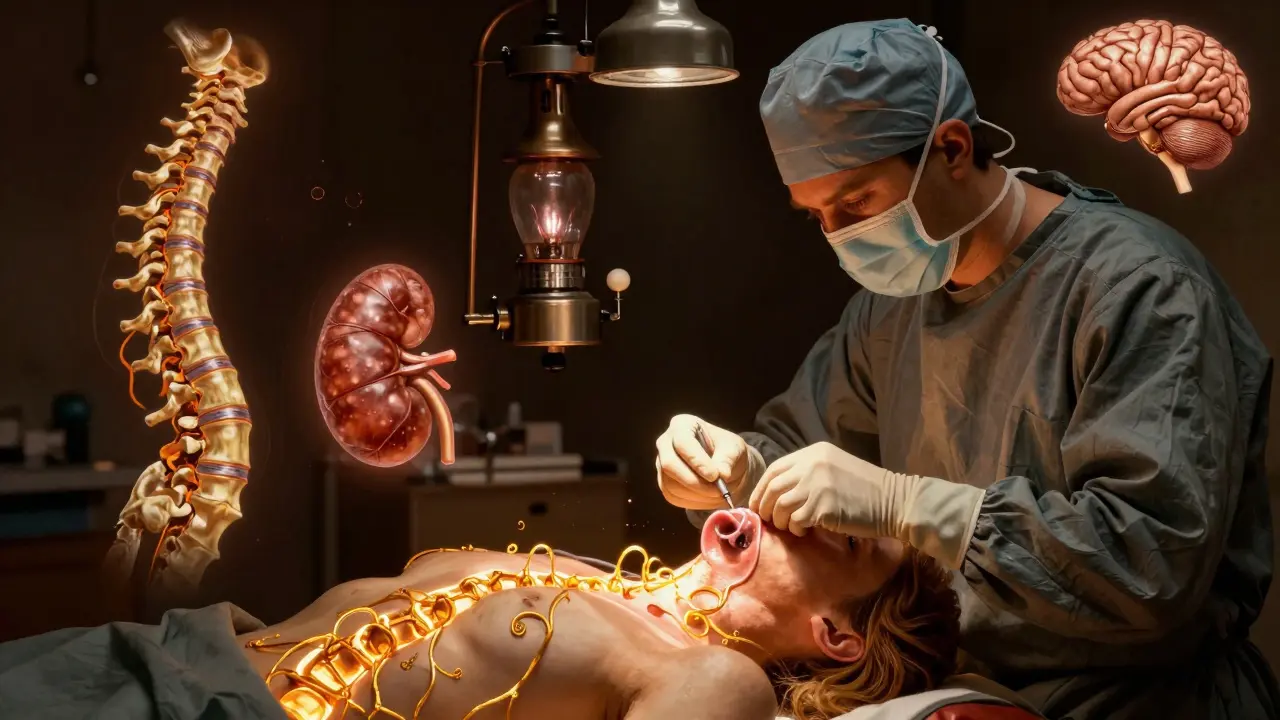
Why Some People Delay Surgery
Many patients are told to “wait and watch.” But waiting isn’t harmless. A Mayo Clinic study of 1,200 patients found that those with calcium above 12 mg/dL for years had a 22% chance of still feeling tired or foggy after surgery. Those with calcium below 11 mg/dL? Only 8% had lingering symptoms. The longer you wait, the more likely some damage becomes permanent. Another reason people delay? Fear. They worry about voice changes. But the risk of permanent nerve damage from an experienced surgeon is less than 1%. And in high-volume centers (surgeons who do over 50 of these a year), the success rate jumps to 98%.What You Can Do Now
If you’ve been told your calcium is high and your doctor says “it’s not a big deal,” ask for a second opinion. Ask for PTH levels. Ask about imaging. Ask about surgery. In the meantime:- Drink plenty of water-helps flush excess calcium
- Get 1,200 mg of calcium daily from food, not supplements
- Do weight-bearing exercise-walking, lifting, dancing-30 minutes a day
- Avoid thiazide diuretics (like hydrochlorothiazide) if you can-they make calcium go up
- Check your vitamin D. If it’s low, get it corrected before surgery
The Future Is Brighter
New tools are making diagnosis faster and surgery safer. AI is now helping radiologists spot abnormal glands on scans with 98% accuracy. A new drug called etelcalcetide showed 45% PTH reduction in trials-though it’s still being studied for primary hyperparathyroidism. But the truth hasn’t changed: if you have this condition, and you’re a candidate for surgery, doing nothing is the riskiest choice. Your bones, your kidneys, your brain-they’re all counting on you to act before it’s too late.Can hyperparathyroidism be cured without surgery?
No. Medications like cinacalcet or bisphosphonates can help manage symptoms or slow bone loss, but they don’t fix the root problem-the overactive parathyroid gland. Surgery is the only cure for primary hyperparathyroidism. Without it, calcium levels stay high, and bone damage continues.
How do I know if I need surgery?
You should consider surgery if your calcium is more than 1 mg/dL above normal, your kidney function is below 60 mL/min, your bone density shows osteoporosis (T-score ≤ -2.5), or you’re under 50. Even if you feel fine, these are clear medical reasons to act. Delaying increases your risk of fractures and long-term damage.
Is parathyroid surgery risky?
For experienced surgeons, it’s very safe. The risk of permanent voice change from nerve damage is less than 1%. Temporary low calcium is common (30-40% of cases) but easily managed with supplements. Recovery is quick-most people go home the same day and return to normal activities in 3 to 7 days. Choose a surgeon who performs over 50 parathyroidectomies a year for the best outcomes.
Why do some people still feel tired after surgery?
If hypercalcemia lasted for years, some damage may be irreversible. Studies show that patients with calcium levels above 12 mg/dL before surgery are more likely to keep feeling fatigued or foggy afterward. This doesn’t mean surgery failed-it means the body needed more time to heal, or some systems were already worn down. Early treatment gives the best chance for full recovery.
Can hyperparathyroidism come back after surgery?
Yes, but it’s rare. If only one gland was removed (single adenoma), recurrence is 2% to 3%. If multiple glands were involved, the risk rises to 5% to 10%. That’s why people with multigland disease need annual blood tests for life. Most recurrences are caught early and can be treated with a second surgery.
Ajay Brahmandam
December 22, 2025 AT 01:26Had this happen to my uncle in Bangalore - calcium hit 11.9, zero symptoms until he fell breaking his hip. Turned out his doctor dismissed it as ‘just aging.’ Surgery fixed everything. He’s hiking again at 72. If your calcium’s high, don’t wait. Get the PTH test. It’s cheap, fast, and life-changing.
jenny guachamboza
December 23, 2025 AT 04:20LOL this is all just a Big Pharma scam 😈 The real cause is 5G towers messing with your parathyroid glands. I read it on a forum where a guy in Iceland said his calcium dropped after he wrapped his head in aluminum foil. Also, vitamin D is a CIA mind control agent. 🤫📡
Kiranjit Kaur
December 24, 2025 AT 22:32My mom had this and no one believed her for years. She was told she was ‘just stressed.’ After surgery, she started remembering people’s names again. 🥹 I wish more doctors knew how serious this is. You’re not lazy - your calcium is lying to you.
Cara Hritz
December 26, 2025 AT 18:34Wait so if your calcium is high and PTH is normal its still bad? But what if the lab messed up? I once had a blood test and the nurse said my vein was ‘weird’ and they had to poke me 4 times. Maybe my calcium was high because I was crying?? 😅
Tarun Sharma
December 27, 2025 AT 08:52The clinical evidence presented here is both compelling and methodologically sound. One must acknowledge the statistical significance of bone density loss and the unequivocal superiority of surgical intervention over pharmacological palliation. The data from the Mayo Clinic study, in particular, warrants immediate clinical attention.
Art Van Gelder
December 28, 2025 AT 10:53Okay so imagine your body is a car. The parathyroid gland is the gas pedal. Normally, it’s gently pressed to keep speed steady. But in hyperparathyroidism? The pedal’s welded to the floor. You’re screaming down the highway at 120 mph, windows down, radio blasting, and your bones? They’re the tires wearing down to the metal. And no one’s stopping you because ‘you look fine.’ So you crash. And then they say, ‘Oh, you should’ve gotten a tune-up earlier.’ But the damage? It’s already done. I’ve seen people come back from this - not just healed, but reborn. But if you wait too long, you’re not just repairing a car. You’re rebuilding the whole engine from scratch. And that’s not just medical. That’s existential.
Jim Brown
December 28, 2025 AT 19:24There is a metaphysical dimension to this pathology that transcends mere biochemistry. The parathyroid, nestled in the neck like a silent sentinel, mirrors the human condition: the tension between autonomy and surrender, between the body’s instinct to hoard and the soul’s yearning to release. When calcium ascends unchecked, it is not merely a hormonal aberration - it is a metaphor for the modern human’s refusal to let go. To remove the gland is not merely to excise tissue, but to reclaim a sacred equilibrium. One wonders: if the body can be so precisely calibrated, why do we persist in ignoring its cries until they become screams?
Jamison Kissh
December 30, 2025 AT 16:52Interesting that the article mentions vitamin D correction before surgery. But what if someone has low vitamin D because their body’s trying to limit calcium absorption? Could supplementing it too early worsen hypercalcemia? I’ve read a few case reports where rapid D repletion spiked calcium further. Maybe it’s not always ‘just fix the D’ - context matters.
Johnnie R. Bailey
December 30, 2025 AT 17:49As someone who grew up in rural Texas with zero access to endocrinologists, I can tell you - this isn’t just a medical issue. It’s a justice issue. My cousin, a Black woman in her 40s, was told her fatigue was ‘depression’ for five years. No one ordered a calcium test. She had a parathyroid adenoma the size of a plum. Now she’s on disability. If this were a cancer, we’d be screening everyone over 45. But because it’s ‘rare’ and ‘asymptomatic,’ we let people suffer until they break. We need screening protocols. Not just for those who ‘look sick.’ For everyone.