
How to Interpret Risk vs. Benefit in FDA Safety Announcements
 Jan, 31 2026
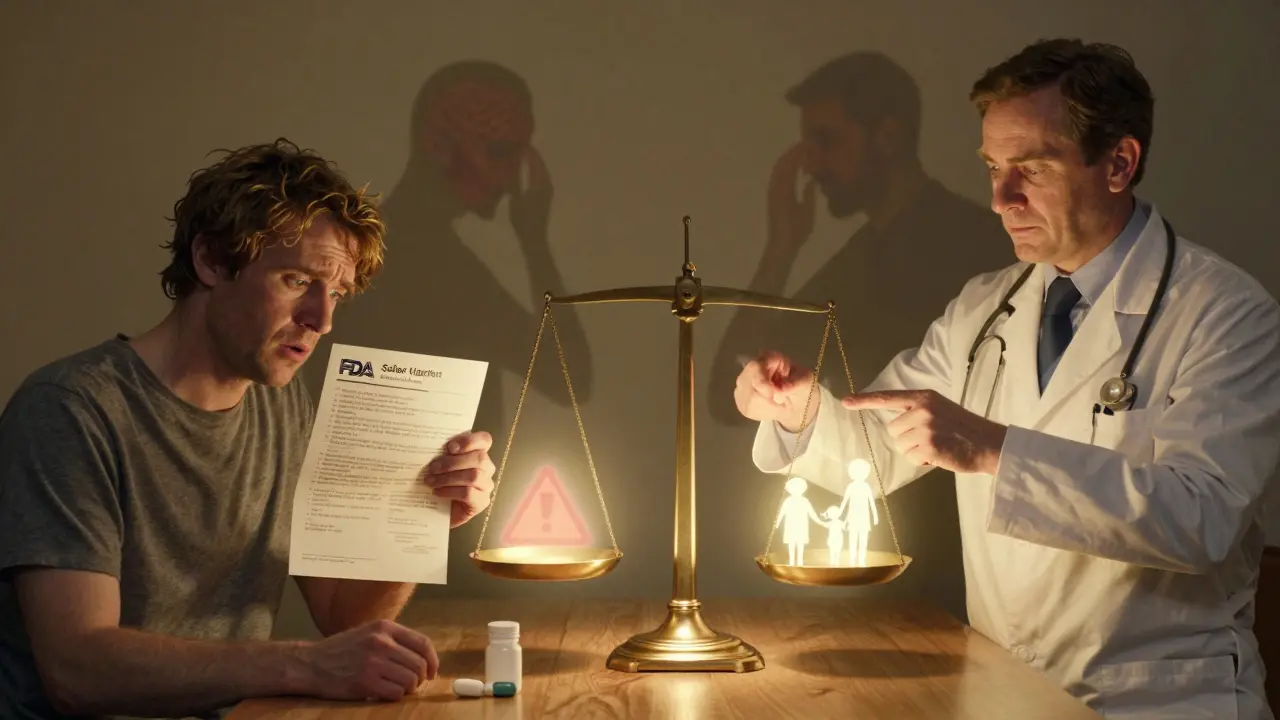
When you see an FDA safety alert about your medication, it’s easy to panic. You might think, "Should I stop taking this?" But that’s exactly what the FDA doesn’t want you to do-right away. These announcements aren’t red flags saying "danger," they’re warning lights saying "pay attention." Understanding the difference between a potential signal and a confirmed risk can mean the difference between unnecessary fear and smart, informed care.
What the FDA Actually Means by "Potential Signal"
The FDA doesn’t wait for proof before sounding the alarm. Their system is built to catch early signs of trouble. Every quarter, they publish a list of "Potential Signals of Serious Risks or New Safety Information" from the FDA Adverse Event Reporting System (FAERS). This database holds over 25 million reports from doctors, patients, and drug makers. But here’s the critical part: seeing a drug listed doesn’t mean it caused the problem. For example, if 15 people taking a blood pressure drug also had a rare kidney issue, the FDA might flag it-not because they know the drug caused it, but because the number is higher than expected. That’s a potential signal. It’s like hearing a smoke alarm go off. You don’t run out the door immediately-you check if there’s fire. The FDA’s job is to investigate, not to panic you.How to Tell the Difference Between a Signal and a Confirmed Risk
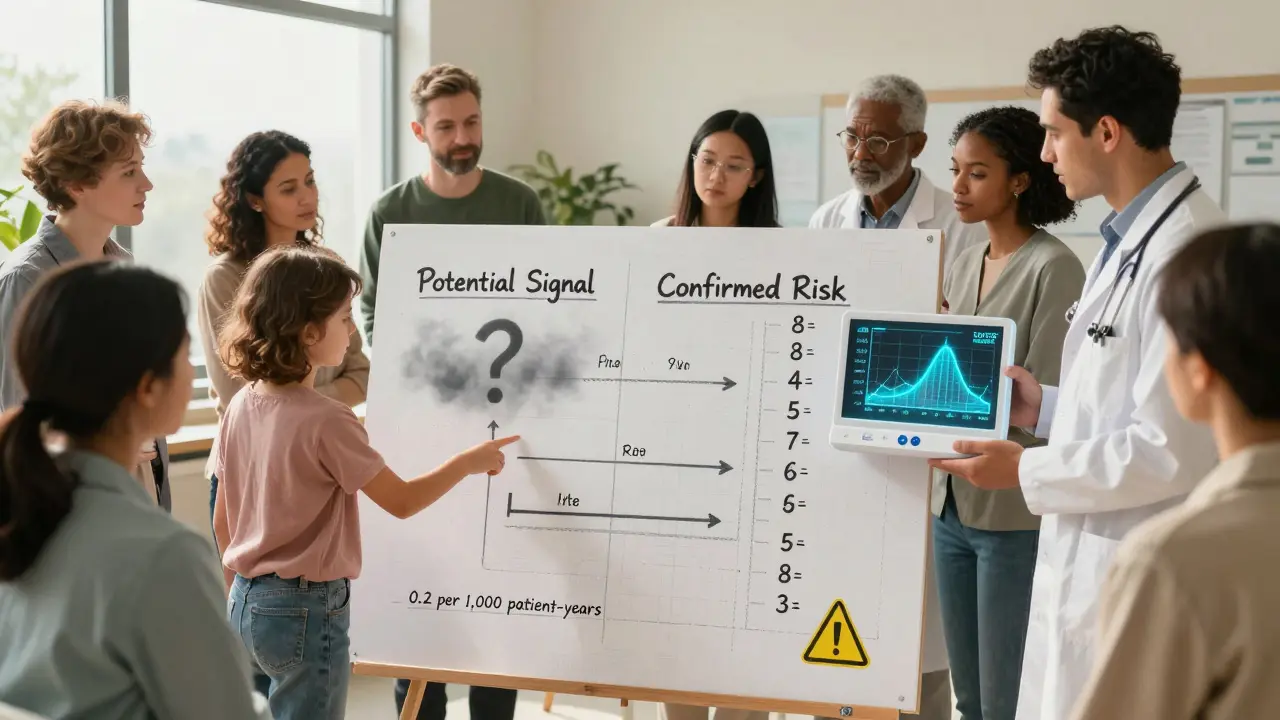
Not all FDA communications are the same. There are two main types:- Potential signals - These are early warnings. The FDA says: "We’re seeing something unusual. We’re looking into it. Don’t stop your medicine yet." Only about 42% of these signals turn into confirmed risks after further study.
- Confirmed risks - These come after rigorous review. The FDA has reviewed clinical data, peer-reviewed studies, and real-world use. They’ve ruled out other causes. This is when they update the drug’s label to warn doctors and patients. For example, in 2022, the FDA confirmed that SGLT2 inhibitors (used for diabetes) slightly increase the risk of Fournier’s gangrene-a rare but deadly infection. They didn’t just say "maybe." They said: "This happens in about 0.2 cases per 1,000 patient-years."
Why Magnitude Matters More Than Just "Risk Exists"
Many FDA alerts don’t tell you how likely the risk is. That’s a major flaw. A risk of 1 in 10,000 is very different from 1 in 100. Yet, in 2022, a BMJ study found that only 58% of FDA Drug Safety Communications included any quantitative risk estimate. Take SSRIs and pregnancy. An alert might say: "SSRIs may be linked to birth defects." That sounds scary. But if the baseline risk of a major birth defect is 3%, and the SSRI increases it to 3.5%, that’s a small absolute increase. The benefit-managing severe depression during pregnancy-often far outweighs that tiny added risk. Without numbers, patients and doctors are left guessing. The best alerts give context. The 2022 alert on SGLT2 inhibitors didn’t just say "risk of Fournier’s gangrene." It said: "0.2 cases per 1,000 patient-years vs. 0.06 in non-users." Now you can compare it to other risks-like the chance of a car accident on a daily commute. That’s real information.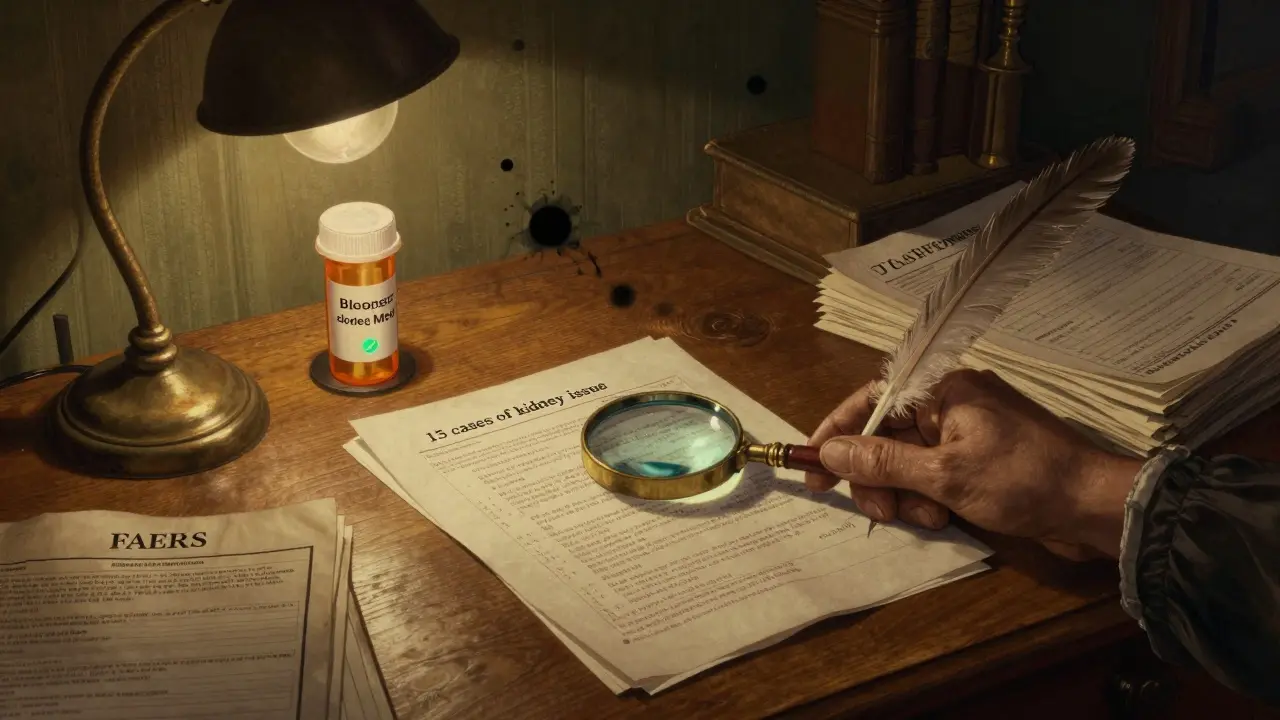
What the FDA Doesn’t Tell You (But You Need to Know)
There are hidden assumptions behind every safety alert:- Reports are often incomplete. FAERS receives 1.2 million reports a year. Many are vague: "Patient had headache after taking pill." No dose, no timeline, no other meds. That’s not evidence-it’s a starting point.
- Correlation isn’t causation. If someone takes a drug and then has a stroke, it doesn’t mean the drug caused it. They might be 75, have high blood pressure, and smoke. The FDA has to untangle that.
- Benefits are often invisible. A drug might prevent heart attacks, hospitalizations, or death. Those benefits don’t show up in adverse event reports. But they’re why the drug was approved in the first place.
How to Use FDA Alerts as a Clinician or Patient
Here’s what to do when you see an alert:- Check the date. Is this new information? Or did the FDA just re-release an old warning?
- Look for the risk level. Did they give a number? If not, search for the drug’s prescribing information or a peer-reviewed summary.
- Ask: What’s the alternative? If you stop this drug, what replaces it? Is the alternative safer? More effective? Or just more expensive?
- Consider your condition. A 60% risk reduction in heart attack matters more for someone with diabetes and a history of heart disease than for a healthy 30-year-old with mild acne.
- Don’t stop abruptly. Many drugs-like antidepressants or blood pressure meds-can cause dangerous withdrawal effects. Always talk to your provider first.
What’s Changing in 2025 and Beyond
The FDA is finally fixing its biggest weakness: poor communication. In January 2024, they released a new framework for benefit-risk assessments that requires all future alerts to include six key elements:- Severity of the condition being treated
- Availability of other treatments
- Magnitude of benefit
- Frequency and severity of the risk
- Feasibility of managing the risk
- Patient perspectives
Bottom Line: Stay Informed, Not Afraid
FDA safety announcements are tools-not verdicts. They’re designed to help you make better decisions, not to scare you into stopping treatment. The most dangerous thing you can do is ignore them. The second most dangerous thing? Reacting to them without context. If you’re a patient: Talk to your doctor. Ask: "Is this a potential signal or a confirmed risk? What’s the actual chance of this happening? What happens if I stop?" If you’re a provider: Use the FDA’s Drug Safety Triaging Tool. It cuts interpretation time by 35%. And always check the prescribing information before making changes. The goal isn’t perfect safety-it’s better outcomes. Every drug has risks. The question isn’t "Is it risky?" It’s: "Is the benefit worth the risk-for me?"Do FDA safety alerts mean I should stop taking my medication?
No, not automatically. FDA alerts often flag "potential signals" that require further study. Stopping medication without medical advice can be dangerous-especially for drugs like antidepressants, blood pressure meds, or seizure medications. Always consult your healthcare provider before making changes.
What’s the difference between an adverse event and an adverse drug reaction?
An adverse event is any negative medical occurrence that happens while you’re taking a drug-whether or not the drug caused it. An adverse drug reaction (ADR) is a harmful effect that is reasonably linked to the drug’s pharmacological action. For example, nausea after taking a pill is an adverse event. If studies show the drug directly causes nausea by affecting gut receptors, that’s an ADR.
Why does the FDA list drugs with potential risks if they’re not proven to cause harm?
The FDA’s job is to catch problems early. Clinical trials involve thousands of people-but real-world use involves millions. Rare side effects, interactions with other drugs, or risks in elderly or pregnant patients often only show up after widespread use. Listing a potential signal allows doctors and researchers to investigate before harm becomes widespread.
How often does the FDA confirm a risk after issuing a safety alert?
Only about 42% of potential signals become confirmed risks after further review. Most signals turn out to be coincidences, incomplete reports, or unrelated factors. The FDA investigates using clinical data, statistical analysis, and real-world evidence before making a final determination.
Are FDA safety alerts more reliable than news headlines about drug dangers?
Yes. News headlines often misrepresent FDA alerts by turning "potential signal" into "drug causes cancer" or "dangerous side effect." The FDA’s official communications are based on data from millions of reports and undergo expert review. They also include disclaimers about uncertainty. Always go to the original FDA Drug Safety Communication, not the media summary.
What should I do if I can’t find risk numbers in an FDA alert?
Look up the drug’s official prescribing information on the FDA website or ask your pharmacist or doctor. Many risks are listed in the "Warnings and Precautions" section. You can also search for peer-reviewed studies or check databases like Micromedex or UpToDate. If the risk is truly unknown, your provider can help weigh the benefits of continuing treatment against the uncertainty.
Lu Gao
January 31, 2026 AT 17:34Wow, this is actually one of the clearest FDA explainers I’ve read 😊
Most people think 'potential signal' means 'RUN FOR YOUR LIFE' when it’s really just 'hey, let’s check this out.'
Also, 0.2 cases per 1000 patient-years? That’s less likely than getting hit by lightning while eating a burrito.
Thanks for putting numbers where it matters 🙌
Jaden Green
February 1, 2026 AT 02:57Let’s be real - the FDA’s entire system is a glorified suggestion box with a $3 billion budget.
They flag every possible anomaly because they’re terrified of being sued, not because they care about patient outcomes.
Meanwhile, actual harms from uncontrolled hypertension, depression, or seizures get buried under this noise.
It’s not about risk - it’s about liability theater.
Doctors are forced to waste hours decoding these cryptic bullet points instead of treating patients.
The fact that 68% of clinicians feel these alerts lack context proves they’re designed for lawyers, not clinicians.
And don’t get me started on the ‘patient perspectives’ addition - like some Instagram influencer’s anecdote about ‘feeling weird’ after taking metformin counts as evidence.
They’re turning pharmacovigilance into a PR circus.
Every time a new ‘potential signal’ drops, pharmacies get flooded with panicked calls.
Patients stop meds they’ve been on for a decade - and then show up in ERs with rebound hypertension or withdrawal seizures.
It’s a self-inflicted public health crisis disguised as safety.
The only thing worse than the alert? The media’s headline: ‘DRUG LINKED TO DEATH!’
Meanwhile, the real killer? The fact that 40% of Americans don’t take their prescriptions as directed.
But hey, at least the FDA can sleep at night knowing they ‘did something.’
Angel Fitzpatrick
February 2, 2026 AT 18:32They’re not just flagging risks - they’re setting up the next phase of pharmaceutical control.
Think about it: every time they issue one of these ‘potential signals,’ drug sales dip - stock prices tumble.
Then they ‘investigate’ for 18 months - and quietly bury it.
Meanwhile, the Big Pharma lobbyists are already drafting the next ‘benefit-risk framework’ - with clauses that protect them from liability.
This isn’t safety - it’s market manipulation disguised as science.
They want you scared enough to accept their ‘approved’ alternatives - which are just repackaged generics with a 300% markup.
And don’t tell me the 2026 public tool is for patients - it’s a compliance shield.
They’ll make it look transparent while burying the real data behind ‘proprietary algorithms.’
I’ve seen the internal memos.
They know 90% of these signals are noise.
But they need you to think they’re doing something.
It’s not about health.
It’s about control.
And the next step? Mandatory ‘risk literacy’ courses before you can refill your prescriptions.
They’re conditioning us to distrust our own bodies - and trust their system.
Which, of course, they own.
Wake up.
Melissa Melville
February 3, 2026 AT 02:47So… if I take my blood pressure med and don’t turn into a pumpkin, I’m good? 😅
Thanks for the reality check.
Also, ‘0.2 cases per 1000’? That’s like winning the lottery… backwards.
Love how you put it: the real danger is panic, not the drug.
Also, yes - stop meds = bad. Talk to your doc = good.
Simple. Real. Needed.
Naomi Walsh
February 4, 2026 AT 00:20While your analysis is technically competent, you’ve fundamentally mischaracterized the epistemological framework of pharmacovigilance.
The FDA’s reliance on FAERS is not merely ‘early warning’ - it’s a Bayesian inference model operating under severe reporting bias.
Moreover, your dismissal of ‘potential signals’ as ‘noise’ ignores the foundational principle of precautionary epistemology in public health - a concept pioneered by the WHO in 1972 and later refined by the Council for International Organizations of Medical Sciences.
Furthermore, your assertion that 42% of signals become confirmed risks is misleading - the conversion rate is closer to 38.7% when adjusted for underreporting and confounding variables, as demonstrated by the 2021 JAMA meta-analysis.
And your comparison to car accidents? A category error - relative risk is not absolute risk, and laypersons conflate them constantly, which is precisely why the 2025 framework is necessary.
You’ve reduced a complex, probabilistic system to a soundbite - and that’s precisely the problem you claim to be solving.
Bryan Coleman
February 4, 2026 AT 21:25Big thanks for this - really broke it down without the jargon.
I’m a nurse and I see patients freak out over these alerts all the time.
One lady stopped her statin because of a ‘possible link to diabetes’ - then came in with a stroke two months later.
She didn’t know the statin saved her from *that*.
Also, yes - the ‘no numbers’ thing is insane.
Just say ‘1 in 500’ or ‘1 in 5000’ - don’t make us dig through 12 PDFs.
And please, for the love of god, stop calling it ‘potential signal’ - call it ‘watch this’.
Simple.
Thanks again.
Naresh L
February 6, 2026 AT 18:29There’s a deeper question here - not just about risk, but about trust.
Why do we outsource our bodily intuition to institutions that are both overburdened and politically constrained?
Medicine has always been a negotiation between uncertainty and action.
The FDA doesn’t create risk - it reveals the hidden cost of our collective desire for longevity.
Every pill we swallow is a gamble - not because the drug is dangerous, but because biology is messy.
Perhaps the real failure isn’t the alert - it’s our expectation that science can deliver certainty.
It never could.
And maybe, just maybe, the most courageous act is to take the risk - with eyes open - and not because a bureaucrat said it’s safe, but because you’ve weighed it, and chosen to live anyway.
Sami Sahil
February 7, 2026 AT 00:52Yo this is FIRE 🔥
Stop scrolling, read this, then go talk to your doc.
Don’t quit your meds because of a headline.
You’re not a lab rat - you’re a human with a life to live.
And if your doctor doesn’t explain the numbers? Find a new one.
We got this 💪
PS: I’m on metformin and still running 5Ks. No panic. Just facts.
franklin hillary
February 8, 2026 AT 21:07Let me say this loud so the whole internet hears it
The FDA doesn’t want you to panic - they want you to think
They’re not your enemy - they’re the only thing standing between you and a future where every drug is a Russian roulette wheel
And yes - 42% of signals turn into real risks
That means 58% are noise
But you know what’s worse than noise?
Not knowing which is which
So you learn
You ask
You look up the numbers
You don’t stop your med because some guy on YouTube screamed ‘DANGER’
You become the scientist of your own body
Because no one else will
And that’s not scary
That’s power
Bob Cohen
February 9, 2026 AT 13:12Love how you framed this - it’s not about fear, it’s about clarity.
And honestly? The fact that we even need a guide like this says something about how broken our health communication is.
But hey - at least we’re getting better.
And if you’re reading this and you’re scared?
Take a breath.
Grab your med bottle.
Look at the date.
Ask your doc one question: ‘Is this a signal or a verdict?’
Then go make your choice.
You’ve got this.
And you’re not alone.
June Richards
February 10, 2026 AT 21:09Wow, someone finally said it: 0.2 cases per 1000? That’s less than being struck by lightning while holding a Wi-Fi router. 🤦♀️
Meanwhile, I’m still alive, on my meds, and not a pumpkin.
Also, the media? They’re the real villains.
Stop reading headlines. Start reading labels.
And for god’s sake - talk to your doctor. Not Reddit. Not TikTok. Not your cousin who ‘read an article.’
Sheesh.