
How to Decide When to Replace Expired OTC First-Aid Medications
 Dec, 20 2025
Most households keep a first-aid kit, but how many of those kits actually work when you need them? If you’ve ever reached for an old bottle of ibuprofen or a bandage that lost its stickiness during an emergency, you’re not alone. A 2023 Consumer Reports survey found that 71% of people think OTC medications stay fully effective for two or more years past their expiration date. The truth? Many don’t. And in some cases, using expired meds can be more dangerous than not using them at all.
Not All Expired Medications Are the Same
Expiration dates aren’t just marketing tactics-they’re based on real science. The FDA requires manufacturers to test how long a drug stays stable, potent, and safe under normal storage conditions. But here’s the key: expiration dates vary wildly by type of medication.Solid pills like ibuprofen, acetaminophen, and aspirin are the most forgiving. A 2019 U.S. Department of Defense study found that 80% of these pills still had at least 90% of their original potency up to 15 years after expiration-if they were kept dry, cool, and in their original bottles. That doesn’t mean you should stockpile them for decades, but if you’re in a pinch and your pain reliever is six months past its date, it’s likely still working.
But liquids? Different story. Eye drops, antibiotic suspensions, and epinephrine auto-injectors (EpiPens) degrade fast. A 2021 study in the Journal of Allergy and Clinical Immunology showed that epinephrine loses 20-30% of its potency within just six months after expiration. In a severe allergic reaction, that drop could mean the difference between life and death. The same goes for nitroglycerin tablets for heart emergencies-once opened, they start breaking down within weeks and must be replaced every 3-6 months, no matter what the bottle says.
What You Should Never Use Past Its Expiration Date
The FDA and major medical groups agree: some medications are too risky to use after expiration. These include:
- Epinephrine auto-injectors (EpiPens)
- Nitroglycerin tablets
- Liquid antibiotics (like amoxicillin suspension)
- Eye drops and ear drops
- Insulin
Why? These aren’t just losing strength-they’re becoming unsafe. A 2023 FDA lab analysis found that 47% of expired hydrocortisone cream samples had bacterial growth. Expired eye drops can cause serious infections. And if you use an expired antibiotic that’s lost potency, you might not kill all the bacteria. That’s how antibiotic resistance starts.
One 2021 report from the Institute for Safe Medication Practices linked expired topical antibiotics to 127 documented cases of skin infections. That’s not a small number. It’s a warning.
Storage Matters More Than You Think
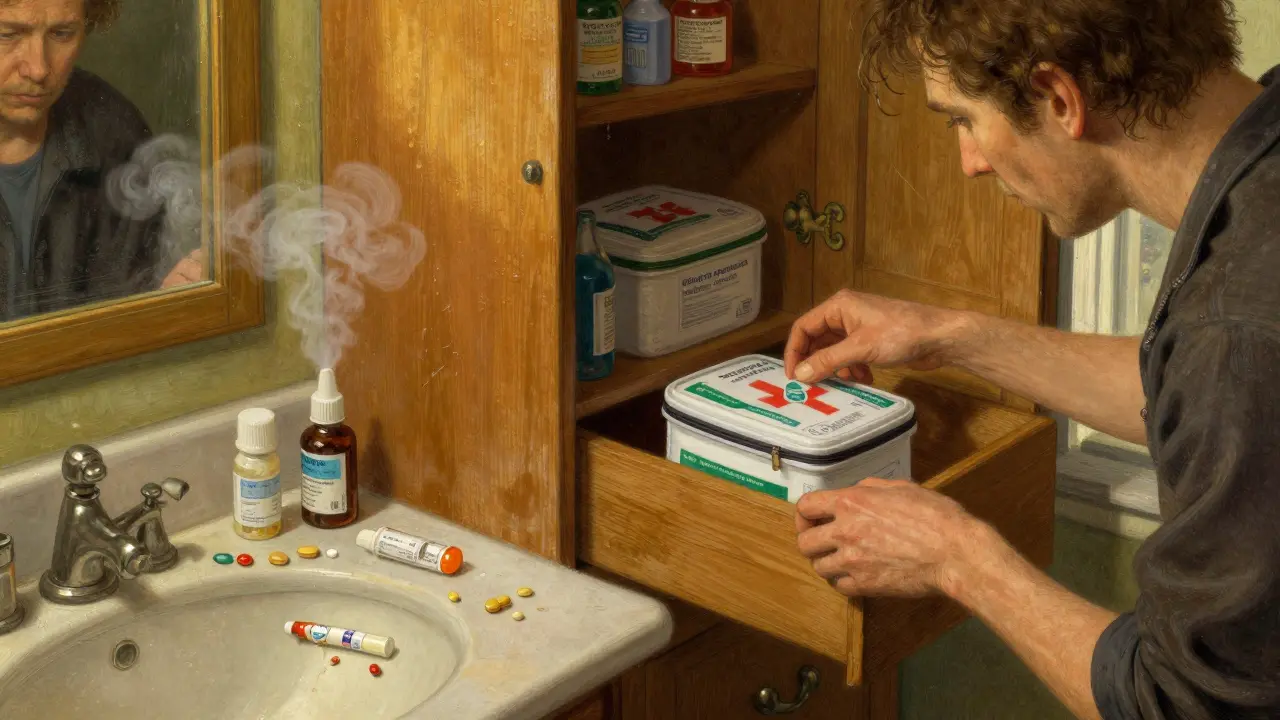
Where you store your first-aid kit can kill its effectiveness faster than the expiration date itself. The bathroom? Bad idea. Humidity, heat, and steam from showers wreck pills and creams. A 2022 Johns Hopkins study showed that medications stored in bathroom cabinets lost potency 40% faster than those kept in a bedroom drawer.
Keep your first-aid kit in a cool, dry place-like a closet or dresser. Avoid direct sunlight. Don’t transfer pills to pill organizers unless you’re using them within a few weeks. Those little plastic compartments expose drugs to air and moisture, cutting their shelf life by 35-50%.
Original packaging? Keep it. The moisture-absorbing packets inside bottles aren’t just for show-they’re critical. Throw them away, and your pills degrade faster.
What About Bandages, Antiseptics, and Other Supplies?
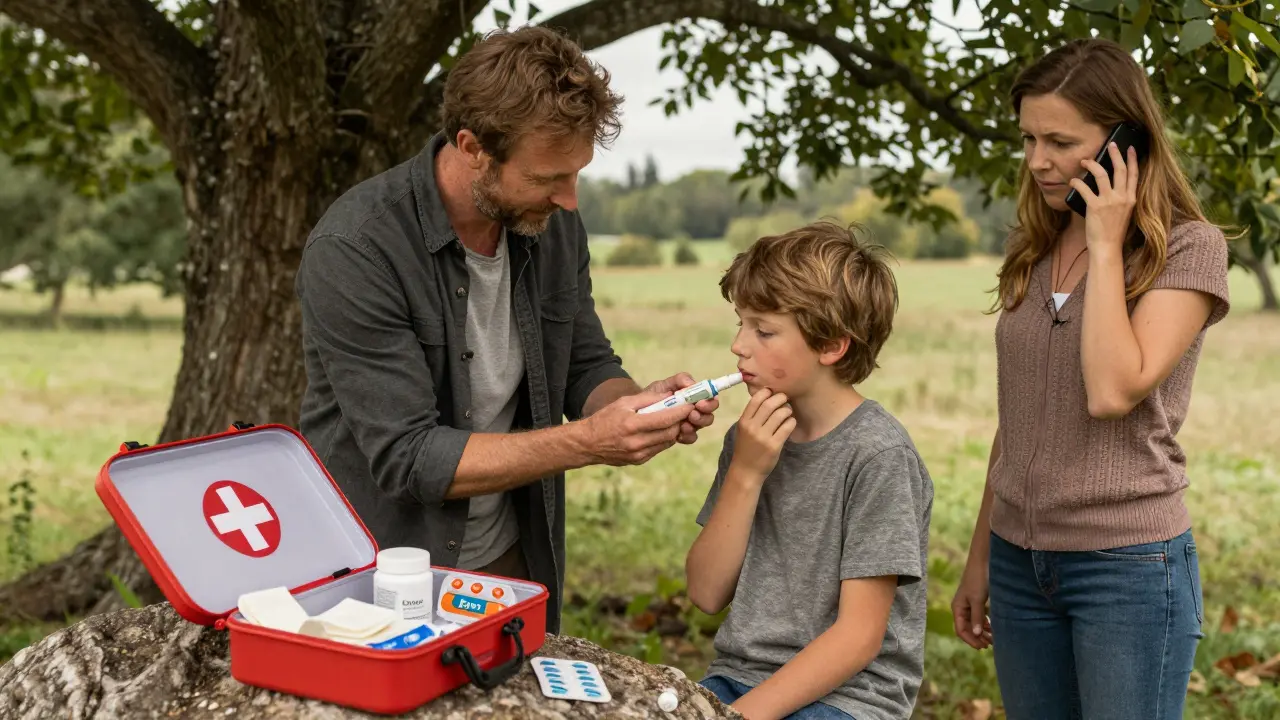
It’s not just medications. Your bandages, gauze, and antiseptics have expiration dates too.
- Hydrogen peroxide: Loses effectiveness within 30 days after opening. If it doesn’t fizz when you pour it on a cut, it’s dead.
- Isopropyl alcohol (70%): Stays good for up to two years if sealed. Once opened, use within 12 months.
- Adhesive bandages: Lose 40% of their stickiness after 18 months. A bandage that won’t stick is useless.
- Sterile gauze: Can become contaminated after 24 months-even if unopened. Bacteria don’t care if the seal is intact.
These aren’t optional. A bandage that falls off mid-bleed or gauze that introduces infection defeats the whole purpose of having a first-aid kit.
How to Check Your Kit-A Simple 4-Step Plan
Don’t wait for an emergency to find out your meds are expired. Set a routine. The American Red Cross recommends this simple process:
- Every 3 months: Look at everything. Are pills discolored? Is cream separated? Does anything smell weird? Toss it.
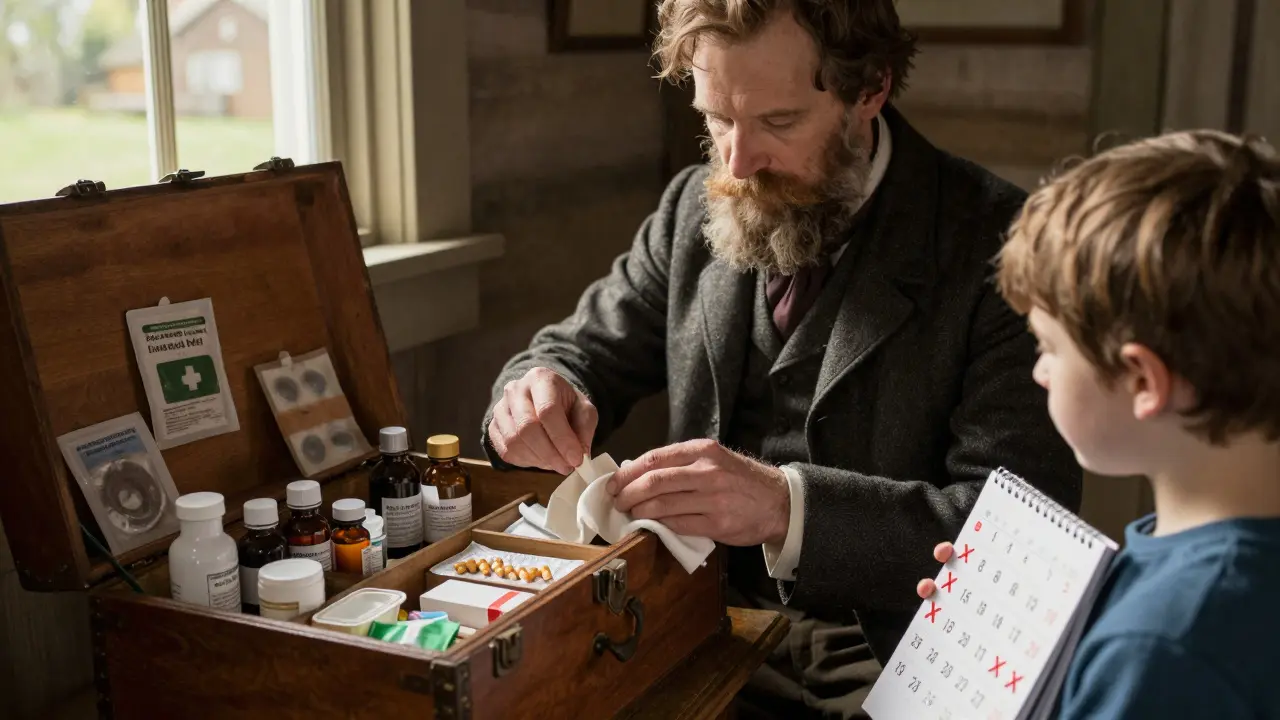
- Every 6 months: Check all expiration dates. Mark them on your calendar. Set a reminder for anything expiring in the next 30 days.
- Emergency meds: Replace epinephrine, nitroglycerin, and rescue inhalers 30 days before they expire. Don’t wait.
- Once a year: Empty the whole kit. Wipe it clean. Restock everything. Throw out the old stuff. Start fresh.
Pro tip: Buy your first-aid supplies in small batches. A $15 kit from the pharmacy is cheaper than a trip to the ER because you used a bad bandage or weak painkiller.
What If You Have No Choice? Using Expired Meds in an Emergency
Let’s say you’re miles from help, your EpiPen is three months past its date, and someone’s having a reaction. Do you use it?
Yes-but with caution.
The FDA and Cleveland Clinic both say: use it if there’s no other option. An expired EpiPen is better than nothing. But don’t assume it’ll work as well. Administer the full dose, and get to a hospital immediately. Same with an expired asthma inhaler-use it, then call for help.
But here’s the line: never use expired antibiotics, eye drops, or insulin. No exceptions. These aren’t “maybe it’ll work” situations. They’re high-risk.
What’s Changing in 2025?
Things are getting better. In 2024, the FDA launched its “Check. Toss. Restock.” campaign to help people understand expiration dates. More companies are adding QR codes to packaging that scan to show real-time potency estimates based on how the product was stored. Some smart first-aid kits now send phone alerts 60 days before meds expire.
And in December 2025, manufacturers will be required to submit full stability data for every OTC product they sell. That means more accurate, science-backed expiration dates-not guesses.
Final Rule: When in Doubt, Toss It
There’s no shame in throwing out an old bottle. The cost of a $5 pain reliever is nothing compared to the cost of an infection, a hospital visit, or worse.
Your first-aid kit is your safety net. If the net has holes, it won’t catch you. Replace expired meds. Check your supplies. Store them right. And don’t let convenience or habit make you careless.
Emergency doesn’t mean “whatever’s lying around.” It means being ready-with tools that work.
Can I still use expired ibuprofen or acetaminophen?
Yes, if they’re solid pills, stored properly (cool, dry, in original bottle), and only a few months past expiration. Studies show many retain 90%+ potency for years. But if they’re discolored, cracked, or smell odd, throw them out. Never use them for serious pain or if you’re unsure.
Is it dangerous to use expired epinephrine?
It’s risky-but not because it becomes toxic. The danger is that it may not work well enough to stop a life-threatening allergic reaction. Epinephrine loses potency quickly after expiration. If you must use an expired EpiPen in an emergency, give the full dose and get to a hospital immediately. Never rely on it long-term.
Why do some medications expire so quickly after opening?
Once you open a bottle-especially liquids like eye drops, antibiotics, or insulin-you expose it to air, moisture, and bacteria. Even if the expiration date is years away, the clock starts ticking the moment you break the seal. That’s why nitroglycerin tablets must be replaced every 3-6 months after opening, even if the bottle says 2027.
Should I throw away expired medications in the trash?
No-not directly. Mix expired pills with coffee grounds or cat litter in a sealed bag before tossing them. This makes them unappealing to kids or pets and prevents them from being dug out. For better safety, use a drug take-back program. In 2023, over a million pounds of expired meds were collected nationwide during National Prescription Drug Take Back Day.
Do smart first-aid kits really help?
Yes, especially for busy households or people with chronic conditions. Kits with Bluetooth reminders can alert you 60 days before meds expire. Some even track usage and suggest restocking. While not essential, they reduce the chance of forgetting. Look for brands like First Aid Only or kits with QR code labeling for real-time info.
Jackie Be
December 21, 2025 AT 23:28OMG I just checked my first aid kit and half this stuff is expired like 2 years ago 😱 I thought ibuprofen was good forever
Jon Paramore
December 23, 2025 AT 17:14Epinephrine degradation kinetics are well-documented: 20-30% potency loss within 6mo post-expiry per JACI 2021. Pharmacokinetic instability in aqueous formulations is non-linear and accelerated by thermal stress. Don't gamble with anaphylaxis.
John Hay
December 24, 2025 AT 20:17I used an expired EpiPen last year. It worked. But I still drove myself to the ER. Better safe than sorry. No excuses.
Dan Adkins
December 25, 2025 AT 00:23It is imperative to note that the FDA's regulatory framework for expiration dating is predicated upon rigorous stability testing under controlled environmental conditions. The notion that ambient storage in a humid bathroom cabinet is equivalent to laboratory-controlled conditions is not only scientifically unsound, but constitutes a gross misinterpretation of pharmaceutical integrity standards. One must exercise due diligence in storage protocol, as degradation is not merely a function of chronological time, but of physicochemical exposure.
Grace Rehman
December 26, 2025 AT 20:54So we're supposed to believe the FDA and big pharma who made us buy new EpiPens every year for $600 when the thing still works? 🤔
Meanwhile my grandpa kept his nitro tabs in his wallet for 12 years and never had a problem
Maybe the real expiration date is when your insurance stops covering it
Orlando Marquez Jr
December 27, 2025 AT 15:14As a public health educator in the U.S., I have observed a pervasive cultural disregard for pharmaceutical expiration dates, particularly in rural and underserved communities. The consequences are not merely anecdotal-they manifest in increased emergency department visits, antimicrobial resistance, and preventable morbidity. Standardized public education campaigns, such as the FDA’s ‘Check. Toss. Restock.’ initiative, must be amplified through community clinics, schools, and faith-based organizations to mitigate systemic risk.
Christina Weber
December 28, 2025 AT 05:31Hydrogen peroxide loses efficacy within 30 days of opening? That’s a fact. Yet I’ve seen people using the same bottle since 2019. This isn’t negligence-it’s stupidity. If you can’t follow basic medical hygiene, you shouldn’t be allowed to own a first-aid kit.
Stacey Smith
December 28, 2025 AT 22:28America’s first-aid kits are trash because people don’t care. We let our kids use expired Tylenol like it’s candy. Other countries don’t have this problem. We’re soft.
Teya Derksen Friesen
December 30, 2025 AT 20:32I keep my kit in a sealed plastic bin under my bed-cool, dry, no light. I rotate meds every 6 months like clockwork. It’s not hard. It’s just discipline. And honestly? It gives me peace of mind.
Swapneel Mehta
December 31, 2025 AT 12:22My dad used to say: 'If it looks weird, smells weird, or feels weird-don't use it.' Simple. Wise. I follow that rule. No need for science when common sense works.
Hannah Taylor
December 31, 2025 AT 15:01did you know the FDA and pharma companies are in cahoots to make you buy new meds? the real shelf life is 10+ years but they hide it so you keep spending
the moisture packets are just to make you think you need to buy new ones
also the qr codes? tracking device. they know when you use your meds
Jay lawch
January 1, 2026 AT 11:40Expiration dates are a capitalist construct designed to maintain artificial scarcity. In India, we have been using Ayurvedic and generic formulations past their printed dates for generations without incident. The Western obsession with sterile, corporate-labeled medicine is a symptom of cultural over-medicalization. Nature does not have expiration dates. Neither should we.
Ben Warren
January 2, 2026 AT 22:35It is a moral failing of contemporary society that individuals treat pharmaceuticals as disposable commodities rather than life-sustaining instruments of clinical intervention. The casual disregard for expiration dates, compounded by the proliferation of misinformation via social media, has engendered a public health crisis of epic proportions. The notion that a $5 pain reliever is 'cheaper' than an ER visit ignores the systemic erosion of medical literacy and personal responsibility. One does not gamble with biological integrity. To do so is not merely imprudent-it is ethically indefensible.
Cara C
January 3, 2026 AT 15:17Just replaced all my meds this week. It felt good. Like spring cleaning but for your safety.
Also bought a new first-aid kit with the reminder app. It’s kinda nice to get a nudge instead of panicking at 2am.
Christina Weber
January 5, 2026 AT 00:40Someone said 'use an expired EpiPen if you have to.' No. You don't. You call 911. You drive to the hospital. You do not risk anaphylactic failure because you were too lazy to replace it. This isn't a movie. Lives are not plot devices.