
Hospital Formulary Economics: How Institutions Choose Generic Drugs
 Jan, 29 2026
When a hospital decides to add a generic drug to its formulary, it’s not just about picking the cheapest option. It’s a complex decision that balances clinical safety, patient outcomes, and financial reality - all while navigating supply chain risks, rebate deals, and regulatory hurdles. The hospital formulary isn’t a static list. It’s a living system, reviewed every month or quarter by a Pharmacy and Therapeutics (P&T) committee, made up of pharmacists, physicians, and nurses who weigh hard data against real-world use.
What Is a Hospital Formulary, Really?
A hospital formulary is a curated list of medications approved for use inside the facility. It’s not a catalog of every drug on the market. It’s a tool for control - designed to ensure patients get safe, effective, and affordable treatments. Unlike retail pharmacies, where patients choose from dozens of options, hospital formularies are often closed or partially closed. That means doctors can’t just prescribe any drug they want. They must pick from what’s on the list, unless they get special approval. This system started in the 1930s, but it became structured in the 1950s when the American Society of Health-System Pharmacists (ASHP) set standards. Today, most hospitals manage between 300 and 1,000 drug products. The goal? Reduce waste, prevent errors, and cut costs without sacrificing care.The Three Rules of Generic Selection
P&T committees don’t pick generics based on price alone. They follow three non-negotiable criteria:- Efficacy - Does it work as well as the brand? The FDA says generics are bioequivalent, but that’s just the starting point. In critical care, even small differences in how a drug is absorbed can matter. A generic anticoagulant might look identical on paper, but if it causes more INR fluctuations in ICU patients, it’s a problem.
- Safety - Are there hidden risks? Complex generics - like inhalers, injectables, or topical products - are harder to replicate. The FDA’s 2022 report showed only 62% of complex generic applications were approved on the first try, compared to 88% for simple pills. That means many generics entering the market lack real-world safety data in hospital settings.
- Cost - Not just the list price. The real cost includes rebates, service fees, and even the cost of extra nursing time. A drug with the lowest sticker price might require more lab monitoring, leading to higher overall expenses.
Tiered Formularies: How Hospitals Organize Drugs
Most hospitals use a tiered system to guide prescribing and cost-sharing. Here’s how it typically breaks down:| Tier | Drug Type | Cost to Patient | Prescribing Restrictions |
|---|---|---|---|
| Tier 1 | Preferred generics | Lowest copay | None - first-line choice |
| Tier 2 | Non-preferred generics or preferred brands | Moderate copay | May require prior authorization |
| Tier 3 | Non-preferred brands | Higher copay | Step therapy often required |
| Tier 4-5 | Specialty drugs | Coinsurance (e.g., 30%) | Strict prior auth, often only for specific conditions |
Tier 1 is where most generics live. These are the drugs the hospital pushes because they’re proven, affordable, and easy to use. But even within Tier 1, not all generics are equal. A 2023 Mayo Clinic case study saved $1.2 million a year by switching to generic cardiovascular drugs - but only after setting up strict monitoring protocols to catch any unexpected side effects.
Why Hospital Formularies Are Different From Retail
Retail pharmacies and Medicare Part D plans have very different goals. Retail formularies focus on outpatient convenience - how easy is it for a patient to pick up a pill? Hospitals care about how a drug behaves in a controlled, high-risk environment. For example:- Hospitals don’t worry about patients storing insulin at home. They worry about it degrading in a hospital fridge.
- Medicare Part D must include at least two drugs in 57 therapeutic categories. Hospitals don’t have that rule. They can pick one - if it’s the best.
- Insurance plans use open formularies to attract members. Hospitals use closed formularies to control costs and reduce errors.
According to the 2022 AMCP Managed Care Pharmacy Compendium, 78% of academic medical centers use closed formularies. Only 42% of commercial health plans do. That’s a big difference. Hospitals prioritize safety and cost control over choice.
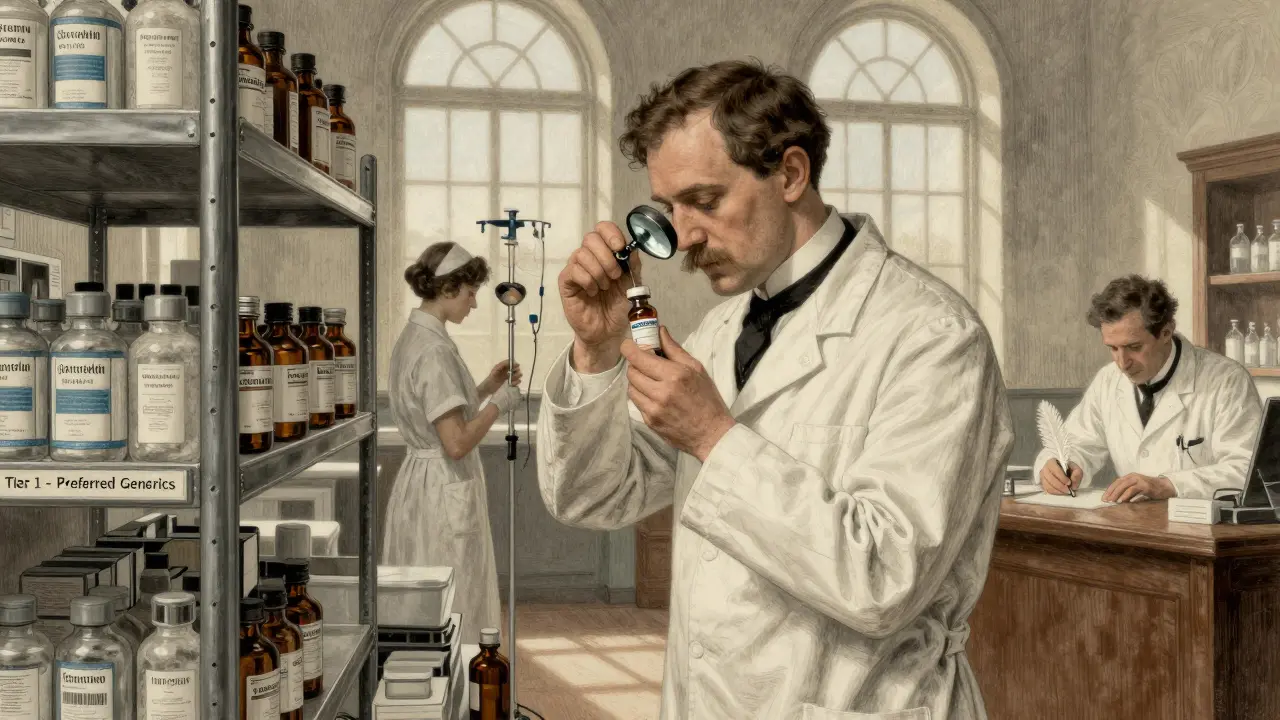
The Hidden Cost of Generic Switching
Switching from brand to generic sounds simple - until it isn’t. Dr. Michael Rodriguez at Johns Hopkins shared a real case: switching to a generic anticoagulant led to more frequent INR checks. Nurses had to spend extra time monitoring patients. The savings on drug cost were wiped out by increased labor. That’s not rare. A 2023 survey of 1,247 hospital pharmacists found that 68% had trouble assessing therapeutic equivalence for complex generics - especially injectables and inhalers. And it’s not just about clinical outcomes. Supply chain issues are a nightmare. In Q3 2023, 84% of hospitals reported at least one critical generic shortage. When a Tier 1 drug disappears, hospitals are forced to buy non-formulary alternatives - sometimes at triple the price. That’s why many institutions now track supplier reliability as part of their formulary evaluation.How Hospitals Actually Evaluate a Generic Drug
Getting a new generic approved isn’t a quick yes-or-no. It’s a multi-step process:- Submission - The manufacturer sends an AMCP dossier: clinical data, pharmacology, economic analysis, and manufacturing details.
- Review - The P&T committee meets monthly. They compare the drug to existing options using comparative effectiveness research (CER).
- Testing - Some hospitals run small pilot programs. For example, a cardiac unit might try a new generic beta-blocker on 50 patients before a full rollout.
- Integration - If approved, the drug is added to the electronic health record (EHR). But here’s the problem: only 37% of hospitals have automated formulary alerts in their EHRs. That means doctors often prescribe off-formulary drugs by accident.
A 2022 University of Michigan study found that 15-20% of prescriptions still violate formulary rules. Why? Because the system isn’t fully connected. Pharmacists are still playing catch-up.
Who Decides? The P&T Committee
The P&T committee is the gatekeeper. But it’s not just doctors voting. The AMCP recommends that at least half the committee be clinical pharmacists. Why? Because pharmacists understand the science behind bioequivalence, stability, and formulation differences. New members need 6-9 months to get up to speed. They have to learn how to read FDA bioequivalence studies, understand rebate structures, and interpret real-world data. Many struggle with the financial side. As Dr. Emily Chen from Massachusetts General said, “The lowest list price doesn’t always mean the lowest net cost.” Rebates, discounts, and service agreements can completely change the math.
Big Trends Changing the Game
Several forces are reshaping how hospitals choose generics:- Value-Based Contracts - 47% of academic hospitals now tie payments to outcomes. If a generic doesn’t reduce readmissions, the manufacturer pays back part of the cost.
- 340B Program - This federal program lets safety-net hospitals buy generics at deep discounts. It’s a huge advantage - but it also creates tension. If a hospital gets a drug at $1, why would it switch to a $3 generic, even if it’s clinically better?
- Pharmacogenomics - 28% of academic hospitals now consider genetic data when choosing generics. For example, a patient with a CYP2C19 mutation might not metabolize clopidogrel well. That changes which generic antiplatelet they get.
- Transparency Laws - Starting January 2025, new federal rules will force manufacturers to reveal hidden rebates. This could shake up formulary decisions. Drugs that looked cheap might suddenly look expensive.
The Future of Generic Selection
The hospital formulary is evolving from a cost-control tool into a precision medicine instrument. The goal isn’t just to save money - it’s to match the right drug to the right patient, at the right time, with the least risk. FDA’s GDUFA III, launched in 2022, is investing $4.3 million to improve complex generic development. By 2026, we’ll see more generics for injectables, inhalers, and other hard-to-replicate drugs. That’s good news - but it also means formularies will need even more expertise to evaluate them. Drug shortages are getting worse. In November 2023, the FDA listed 298 active generic shortages - the highest ever. Hospitals can’t afford to be rigid. The future belongs to institutions that can balance cost, safety, and flexibility.What Works: Real Success Stories
Cleveland Clinic reduced generic acquisition costs by 18.3% without hurting outcomes - by creating a therapeutic interchange committee. This team didn’t just swap drugs. They built protocols: when to switch, how to monitor, who to train. Mayo Clinic saved $1.2 million a year by switching to generics for heart medications - but only after adding daily INR checks and pharmacist-led education. These aren’t luck stories. They’re systems. They require data, discipline, and clinical leadership.Bottom Line
Choosing a generic drug for a hospital isn’t a spreadsheet exercise. It’s a clinical decision wrapped in economics, logistics, and human factors. The cheapest option isn’t always the best. The safest option isn’t always the cheapest. The right choice is the one that’s supported by evidence, backed by monitoring, and aligned with the hospital’s mission - not just its budget.Hospitals that treat formulary decisions as strategic, not transactional, are the ones that thrive - even when supply chains break, rebates shift, and new generics flood the market.
How do hospitals decide which generic drugs to include in their formulary?
Hospitals use a Pharmacy and Therapeutics (P&T) committee to evaluate generics based on three core criteria: clinical efficacy, safety in real-world hospital settings, and total cost - not just the list price. Manufacturers must submit detailed dossiers with bioequivalence data, pharmacology, and economic analysis. The committee compares the drug to existing options, tests it in pilot programs if needed, and only approves it if it meets clinical standards and offers real value.
Why aren’t all generic drugs automatically added to hospital formularies?
Even if a generic is FDA-approved, it may not be suitable for hospital use. Complex generics - like injectables or inhalers - often have subtle differences in delivery or absorption that can affect patient outcomes. Many lack real-world safety data in critical care settings. Hospitals also consider supply reliability, ease of use for nurses, and whether the drug fits into existing treatment protocols.
Is the lowest-priced generic always the best choice for a hospital?
No. The lowest list price doesn’t always mean the lowest net cost. Rebates, service fees, and administrative burdens can change the math. A cheaper generic might require more lab monitoring, extra nursing time, or cause more side effects - all of which increase overall costs. Hospitals now use net cost calculations, not just sticker prices, to make decisions.
How do hospital formularies differ from Medicare Part D or retail pharmacy formularies?
Hospital formularies are usually closed, meaning only approved drugs can be used unless special permission is granted. They focus on inpatient safety, administration by staff, and clinical outcomes - not patient convenience. Medicare Part D must include at least two drugs in 57 therapeutic categories, while hospitals have no such requirement. Retail formularies are often open and incentivized to attract customers; hospitals are designed to control risk and cost.
What role do pharmacists play in hospital formulary decisions?
Pharmacists are critical. At least half of a hospital’s P&T committee should be clinical pharmacists because they understand bioequivalence studies, drug stability, formulation differences, and rebate structures. They’re the ones who spot hidden risks in complex generics and ensure that cost savings don’t come at the cost of patient safety.
Are drug shortages affecting hospital formulary choices?
Yes. In late 2023, there were 298 active generic drug shortages - the highest since tracking began. When a Tier 1 generic runs out, hospitals are forced to buy non-formulary alternatives, sometimes at triple the price. This forces institutions to build flexibility into their formularies, keeping backup options ready and monitoring supplier reliability as part of their selection criteria.
What’s the future of generic drug selection in hospitals?
The future is moving toward precision formularies. Hospitals are starting to use pharmacogenomics to match generics to patients’ genetic profiles. Value-based contracts are tying payments to outcomes. New transparency laws will reveal hidden rebates starting in 2025. And with more complex generics entering the market, hospitals will need deeper expertise - not just to save money, but to deliver safer, smarter care.
Lisa McCluskey
January 29, 2026 AT 16:32Generic selection in hospitals is way more nuanced than people think. It’s not just price. I’ve seen teams spend months testing bioequivalence in ICU settings only to scrap a cheaper option because of INR variability. The real cost isn’t on the invoice-it’s in the extra labs and nursing hours.
owori patrick
January 31, 2026 AT 10:47Love this breakdown. In Nigeria we don’t have the same infrastructure but the same principles apply. Even if a drug is cheap, if it’s unstable in heat or hard to store, it’s useless. Hospitals need to think globally but act locally.
Sarah Blevins
February 1, 2026 AT 00:55The data here is cherry-picked. You cite Mayo and Cleveland Clinic but ignore the 2021 JAMA study showing no significant outcome difference between 92% of generic switches. The narrative of hidden dangers is overstated. Cost savings are real. Stop fearmongering.
Marc Bains
February 1, 2026 AT 03:31As someone who’s sat on a P&T committee for 8 years, I can tell you the real bottleneck isn’t the science-it’s the EHR. 37% of hospitals don’t even have automated alerts? That’s criminal. Doctors prescribe off-formulary not because they’re reckless, but because the system makes it easy to ignore the rules.
Kelly Weinhold
February 2, 2026 AT 02:06This is honestly one of the most important things I’ve read all year. I work in a small community hospital and we just switched our entire anticoagulant lineup last quarter. It wasn’t easy-we had to train 40+ nurses, set up daily INR logs, and convince a bunch of docs who hated change. But our readmissions dropped 22%. It’s not sexy, but it works. Keep sharing this stuff!
Kimberly Reker
February 3, 2026 AT 23:10Formularies are basically the hospital’s version of a diet plan. You can’t just eat the cheapest food and expect to stay healthy. You need the right nutrients, the right timing, and someone watching the pantry. Pharmacists are the nutritionists here. Let them do their job.
Eliana Botelho
February 5, 2026 AT 05:51Wait so you’re saying hospitals are *not* just choosing the cheapest thing because they’re all about patient care? That’s a shocker. I thought this was just corporate cost-cutting dressed up as clinical excellence. The ‘safety’ argument is always the excuse when they want to lock in a deal with a big pharma partner. Rebates are the real driver. Admit it.
calanha nevin
February 6, 2026 AT 04:59The integration of pharmacogenomics into formulary decision-making represents a paradigm shift in therapeutic standardization. While cost containment remains a necessary constraint, the ethical imperative to personalize pharmacotherapy necessitates a recalibration of traditional P&T protocols. The 28% adoption rate is insufficient given the clinical implications of CYP polymorphisms in antiplatelet metabolism.
Claire Wiltshire
February 6, 2026 AT 20:09Such a thoughtful piece! I’m a hospital pharmacist and this nails it. The myth that ‘FDA-approved = hospital-ready’ is so dangerous. I’ve seen generics that look identical but cause more confusion on med reconciliation. We need more transparency-not just on price, but on formulation. Thanks for highlighting the real work behind the scenes.
Darren Gormley
February 8, 2026 AT 03:41LOL so hospitals are ‘complex’? 😂 Meanwhile in the real world, people are paying $400 for insulin because ‘formularies’. This is just pharma’s way of saying ‘we’ll let you have the cheap stuff… if you jump through 17 hoops’. 🤡💸
Mike Rose
February 9, 2026 AT 18:07why do hospitals even bother with all this? just pick the cheapest. who cares if the nurse has to check labs more. its all the same stuff anyway. why make it so hard?
Russ Kelemen
February 11, 2026 AT 13:30There’s a deeper question here: Are we treating medicine like a supply chain problem or a human one? The answer changes everything. If you see a patient as a data point, you optimize for cost. If you see them as a person with a body, a history, a fear-you optimize for safety, even if it costs more. The best formularies don’t just list drugs-they reflect a philosophy.
Diksha Srivastava
February 12, 2026 AT 07:05This is so inspiring! In India, we struggle with shortages and fake meds, but the core idea-clinical first, cost second-is universal. I’ve seen nurses in rural clinics make heroic choices because the formulary didn’t match reality. We need more systems like this, adapted for low-resource settings too.
Marc Bains
February 12, 2026 AT 12:52Exactly what I was thinking. The EHR issue is the silent killer. We added a formulary alert last year and off-formulary prescribing dropped 40% overnight. Simple fix. No new drugs. Just better tech. Why didn’t anyone do this sooner?