
Hatch-Waxman Act: How U.S. Law Makes Generic Drugs Affordable and Accessible
 Dec, 18 2025
The Hatch-Waxman Act is the reason you can buy a generic version of your prescription drug for 80% less than the brand-name version. Passed in 1984, this federal law didn’t just tweak a rule-it rewrote the entire system for how generic drugs reach American patients. Before this law, companies trying to make copies of brand-name drugs had to run full clinical trials from scratch. That meant years of waiting and millions of dollars in costs. As a result, few generics existed. Today, more than 90% of prescriptions in the U.S. are filled with generics. That’s not luck. It’s the Hatch-Waxman Act at work.
What the Hatch-Waxman Act Actually Did
The full name is the Drug Price Competition and Patent Term Restoration Act of 1984. It’s called Hatch-Waxman because two lawmakers-Senator Orrin Hatch and Representative Henry Waxman-worked together to create it. Their goal was simple: keep innovation alive while making drugs cheaper. Before this law, generic manufacturers couldn’t use the safety and effectiveness data from the original drug. They had to prove everything again, even though the brand-name drug had already been approved by the FDA. That was inefficient, expensive, and slow.
The Hatch-Waxman Act fixed that by creating the Abbreviated New Drug Application, or ANDA. This is the fast-track route for generic drugs. Instead of redoing clinical trials, generic makers only need to show their product is the same as the brand-name drug in four key ways: same active ingredient, same strength, same dosage form (like tablet or injection), and same way it’s taken (oral, topical, etc.). The final piece? Bioequivalence. That means the generic drug enters the bloodstream at the same rate and to the same extent as the brand. The FDA requires proof that the levels of the drug in the blood fall within 80% to 125% of the original. That’s not a guess-it’s science, tested with real people.
The Orange Book: The Rulebook for Generic Drugs
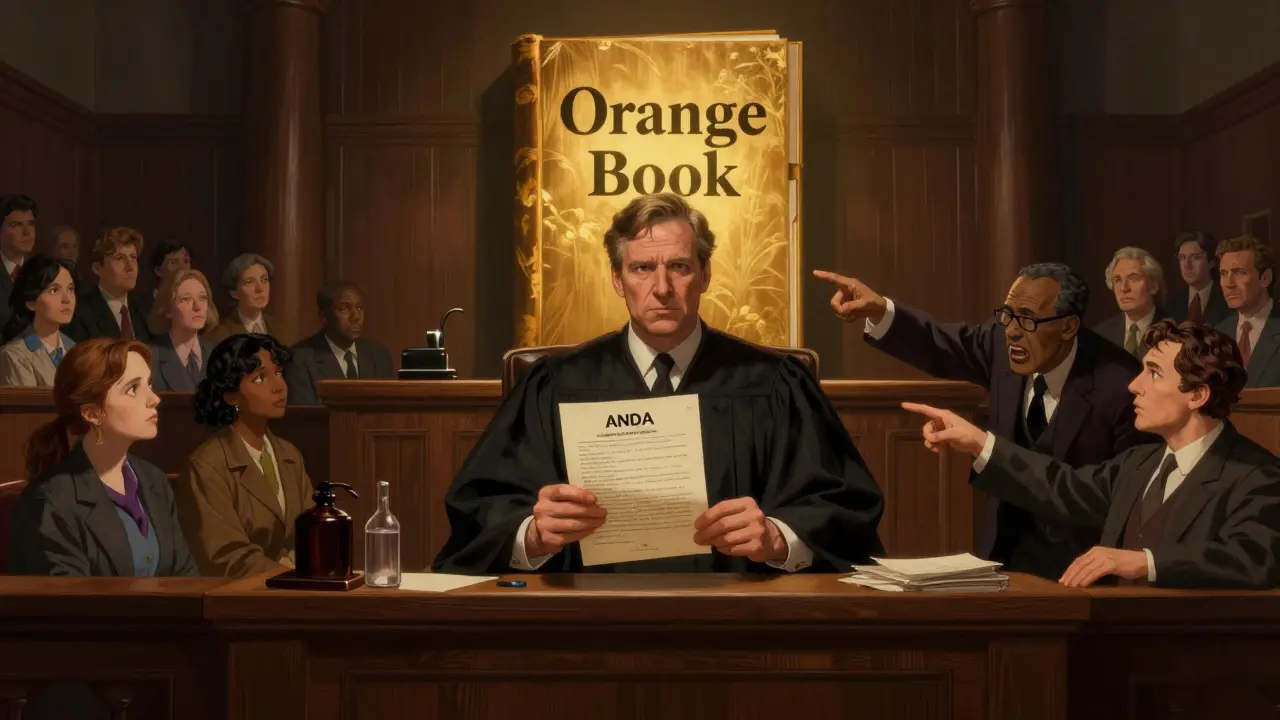
Every drug approved in the U.S. gets listed in a public database called the Orange Book. Officially named Approved Drug Products with Therapeutic Equivalence Evaluations, it’s updated daily. It tells you which drugs are approved, who makes them, and-most importantly-which patents cover them. Generic companies check the Orange Book before they even start developing a copy. If a patent is still active, they can’t launch until it expires… unless they challenge it.
This is where things get strategic. Generic applicants must file one of four patent certifications with their ANDA:
- Paragraph I: No patents listed for this drug.
- Paragraph II: Patents have expired.
- Paragraph III: We’ll wait until the patent expires before selling.
- Paragraph IV: The patent is invalid, or our product won’t infringe it.
Paragraph IV is the big one. It’s a legal challenge. When a generic company files a Paragraph IV certification, they’re basically saying, “We’re going to make this drug now, even if the patent hasn’t expired.” The brand-name company then has 45 days to sue for patent infringement. If they do, the FDA can’t approve the generic for up to 30 months-unless the court rules sooner. This is called the 30-month stay. It’s a legal pause button.
The 180-Day Exclusivity Prize
But here’s the twist: if you’re the first company to file a Paragraph IV certification and you win the legal battle, you get a huge reward-180 days of exclusive market rights. During that time, no other generic can enter the market. That’s not just a bonus-it’s a financial jackpot. With no competition, that first generic can charge close to brand prices and still capture the entire market. That’s why companies race to be first. In the early 2000s, generic manufacturers would camp outside FDA offices to be the first to submit their applications. Today, the FDA has rules to prevent ties: if two companies file on the same day, they share the 180-day period.
This incentive has worked. Over 90% of brand-name drugs face generic competition within one year of patent expiry. The first generic often drops the price by 80-90% almost overnight. That’s why, in 2023, generic drugs saved the U.S. healthcare system $158 billion. Over the last decade, total savings from Hatch-Waxman-driven generics reached $1.7 trillion.
How It Helps Patients-and Why It’s Not Perfect
For patients, the impact is immediate. In 2023, 78% of Medicare Part D prescriptions were filled with generics. That saved the average beneficiary $3,200 per year. For people managing chronic conditions like high blood pressure, diabetes, or asthma, that’s life-changing. Without Hatch-Waxman, many couldn’t afford their meds.
But the system isn’t flawless. One major issue is “pay-for-delay.” Sometimes, the brand-name company pays the generic company to delay its launch. Instead of competing, they strike a deal to split the market and keep prices high. These agreements are under heavy scrutiny from the FTC and Congress. Another problem is “patent thickets”-when a brand files dozens of minor patents on things like pill coatings or packaging, just to delay generics. The FDA has cracked down on this by requiring companies to provide generic makers with drug samples needed for testing. The 2019 CREATES Act made it illegal to block access.
Also, Hatch-Waxman was built for small-molecule drugs. It doesn’t work well for complex biologics like insulin or cancer treatments. That’s why Congress passed the Biologics Price Competition and Innovation Act (BPCIA) in 2010 to create a separate pathway for biosimilars.
Who Uses This System Today?
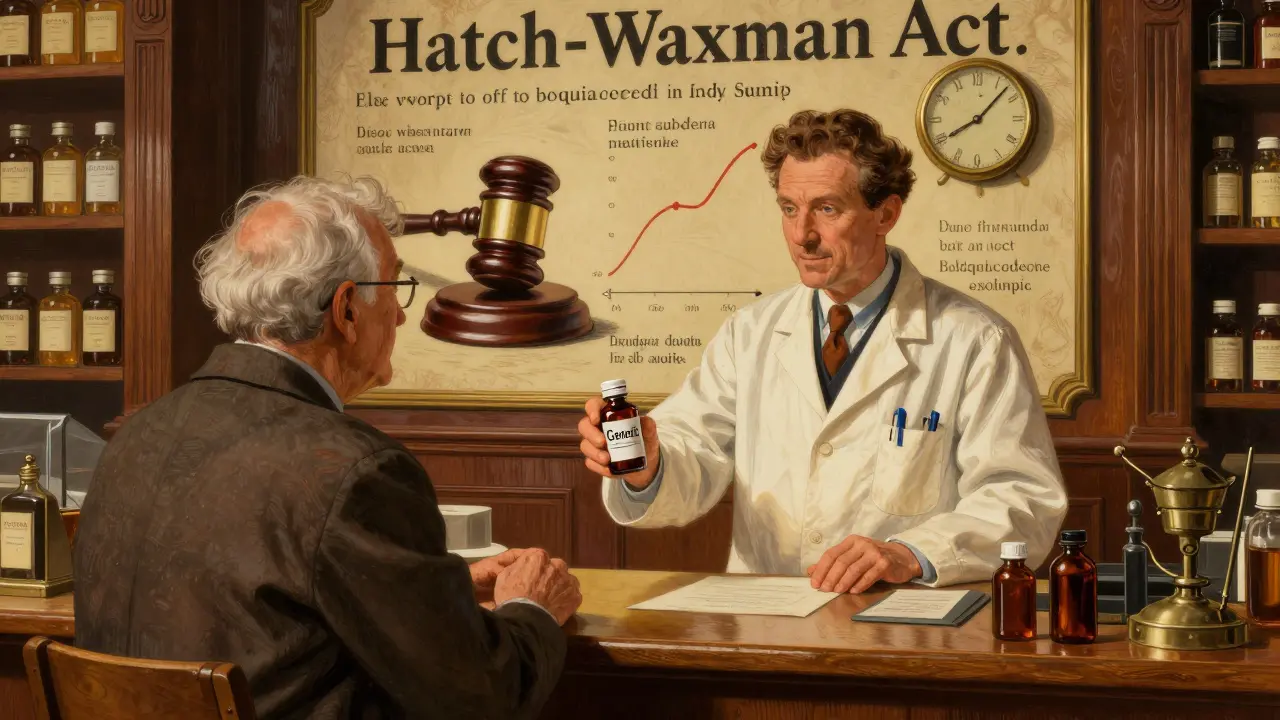
Major generic drugmakers like Teva, Viatris (formerly Mylan), and Sandoz have built entire business models around Hatch-Waxman. They have teams of lawyers, scientists, and regulatory experts just to navigate the ANDA process. The average cost to file an ANDA? $5-10 million. The average time to approval? 3-4 years. But if you’re first to file with a Paragraph IV certification, the payoff can be hundreds of millions in revenue.
The FDA approved 746 ANDAs in fiscal year 2023 alone. That’s up from just 120 in 1990. Thanks to the Generic Drug User Fee Amendments (GDUFA), review times have dropped from 36 months in 2012 to just 18 months today. The FDA now publishes detailed guidance on everything from bioequivalence testing to how to respond to a “refuse-to-receive” letter.
Why This Matters Beyond the U.S.
The Hatch-Waxman Act didn’t just change American healthcare-it became a global model. Countries in Europe, Asia, and Latin America have borrowed its core ideas: abbreviated approval pathways, patent transparency, and incentives for early challengers. But few copied the 180-day exclusivity. That’s because it’s uniquely American-designed to create a race, not just a queue. In Europe, generics enter more slowly, and prices drop more gradually.
Even with its flaws, the Hatch-Waxman Act remains the backbone of generic drug access in the U.S. It’s the reason your insulin, your blood pressure pill, or your antibiotic costs a fraction of what it used to. The system isn’t perfect, but it works. And every day, it helps millions of Americans afford the medicines they need.
What is the ANDA process under the Hatch-Waxman Act?
The Abbreviated New Drug Application (ANDA) is the streamlined pathway created by the Hatch-Waxman Act for generic drug approval. Instead of running full clinical trials, generic manufacturers submit data proving their product is identical in active ingredient, strength, dosage form, and route of administration to the brand-name drug. They must also show bioequivalence-meaning the generic delivers the same amount of drug into the bloodstream at the same rate as the original. This cuts approval time and cost dramatically.
What is the Orange Book and why is it important?
The Orange Book, officially titled Approved Drug Products with Therapeutic Equivalence Evaluations, is a public FDA database that lists all approved drug products and their associated patents. Generic drugmakers use it to identify which patents are still active before filing an application. It also shows therapeutic equivalence ratings, helping pharmacists know which drugs can be substituted. Without the Orange Book, there would be no clear legal path for generic entry.
What does Paragraph IV certification mean?
Paragraph IV certification is a legal statement made by a generic drug applicant claiming that a patent listed in the Orange Book is either invalid or won’t be infringed by their product. Filing this triggers a patent lawsuit from the brand-name company, which can delay approval by up to 30 months. But if the generic wins, it gets 180 days of market exclusivity. This is the main incentive for generic companies to challenge patents early.
Why do generic drugs cost so much less than brand-name drugs?
Generic drugs cost less because they don’t need to repeat expensive clinical trials. The Hatch-Waxman Act lets them rely on the original manufacturer’s safety and effectiveness data. The main costs for generics are developing the formulation, conducting bioequivalence studies, and navigating patent challenges. Without Hatch-Waxman, those costs would be 10 times higher, and generics wouldn’t be affordable.
Has the Hatch-Waxman Act been updated since 1984?
Yes. The most significant updates include the Food and Drug Administration Modernization Act of 1997, which extended patent term restoration to antibiotics, and the CREATES Act of 2019, which prevents brand companies from blocking generic manufacturers from obtaining drug samples needed for testing. The Generic Drug User Fee Amendments (GDUFA), first introduced in 2012 and renewed in 2022, have improved FDA review times and communication with generic companies. These changes keep the system working as drug complexity increases.
Glen Arreglo
December 20, 2025 AT 08:53The Hatch-Waxman Act is one of those quiet heroes of American healthcare. I used to pay $400 for my blood pressure med. Now? $12 at Walmart. No exaggeration-it saved my family’s budget. This law didn’t just make drugs cheaper, it made dignity affordable.
Allison Pannabekcer
December 20, 2025 AT 14:12I work in a community pharmacy and I see this every day. People crying because they can finally afford their insulin. Not because it’s a miracle drug, but because someone in Congress 40 years ago had the guts to say: ‘We’re not going to let patents kill people.’ It’s not perfect, but it’s one of the few things in healthcare that actually works for regular folks.
Chris Clark
December 21, 2025 AT 18:01so like the orange book?? i always thought it was some kind of fruit catalog 😅 but nooo it’s the bible for generic drug folks. and paragraph iv? that’s the wild west of pharma-like declaring war on big pharma with a stack of lab reports. and the 180 day exclusivity?? that’s why companies are literally racing to file. i heard one guy slept in his car outside the fda just to be first. real life drama right here.
Dorine Anthony
December 22, 2025 AT 03:39My dad’s on 7 meds. Five of them are generics. He used to skip doses because he couldn’t afford them. Now he takes them like clockwork. I don’t know the legal stuff, but I know this: if it wasn’t for Hatch-Waxman, he wouldn’t be here. So thanks, whoever made this law. Even if you’re dead now.
William Storrs
December 22, 2025 AT 07:19Look, I’m not a lawyer or a scientist, but I know what I see. People are alive because of this law. That’s the bottom line. If you’re out there working in generics, you’re not some shady discount shop-you’re a lifesaver. Keep fighting the patent battles. Keep filing those ANDAs. The world needs more of you.
James Stearns
December 22, 2025 AT 18:35It is an incontrovertible fact that the legislative framework established by the Hatch-Waxman Act of 1984 constitutes a paradigmatic example of utilitarian regulatory engineering, wherein the commodification of pharmaceutical innovation is deliberately subordinated to the aggregate welfare of the citizenry. One must, however, acknowledge the inherent epistemological limitations of the bioequivalence paradigm, which presumes a homogeneity of pharmacokinetic response across heterogeneous human populations-an assumption not universally substantiated by clinical evidence.
Nina Stacey
December 23, 2025 AT 18:50so i just read this whole thing and honestly i’m crying a little not because i’m emotional but because i realized my grandma probably would’ve died without this law she was on that one diabetes med that cost 500 bucks a month and now she takes the generic for 12 and she’s still alive and making her famous apple pie and i just want to hug whoever wrote this law i don’t even know their name but thank you
Dominic Suyo
December 25, 2025 AT 10:19Let’s be real-this ‘affordable drug’ fairy tale is a corporate shell game. The 180-day exclusivity? That’s just a legalized monopoly with a fancy badge. The ‘first filer’ gets to jack prices up for half a year before the others come in. Meanwhile, the big pharma guys are still milking patents on pill coatings and ink colors. And don’t get me started on pay-for-delay. This isn’t healthcare reform-it’s Wall Street’s favorite card trick.
Kevin Motta Top
December 26, 2025 AT 01:29Generics saved $1.7 trillion. That’s the number that matters.
Carolyn Benson
December 26, 2025 AT 16:06There’s a deeper metaphysical question here: if a drug is chemically identical but legally distinct, is it still the same thing? The body doesn’t care about patents, but the market does. And so we’ve built a system where life is rationed not by biology, but by legal filings and corporate timing. We call it progress. I call it a tragedy dressed in regulatory jargon. The system works-but at what cost to our humanity? We treat medicine like a commodity, and then wonder why people still die.