
GMP for Generics: FDA Requirements for Manufacturing Generic Drugs
 Jan, 24 2026
When you pick up a generic pill at the pharmacy, you expect it to work just like the brand-name version. That’s not luck. It’s because the FDA enforces strict Good Manufacturing Practices - known as CGMP - that every generic drug maker must follow. These rules aren’t suggestions. They’re the law. And they’re the same rules brand-name drug companies have to follow. If a generic drug doesn’t meet CGMP standards, it can’t be sold in the U.S. - no matter how cheap it is.
What Exactly Is CGMP?
CGMP stands for Current Good Manufacturing Practices. The "current" part is key. It means manufacturers can’t just follow old ways of doing things. They have to use modern technology, updated procedures, and real-time quality checks. These rules are written into federal law under 21 CFR Parts 210 and 211. They cover every step of making a drug: from the raw ingredients to the final pill in the bottle.The FDA doesn’t inspect every batch of generic drugs. Instead, they inspect the systems that make those batches. If the system is solid - if the equipment is calibrated, the staff is trained, and the records are complete - then the product will be safe and effective. That’s the core idea behind CGMP: control the process, and you control the quality.
Who Has to Follow These Rules?
Every company that makes generic drugs for the U.S. market - whether they’re based in Ohio, India, or Germany - must comply. There are over 1,800 foreign facilities and 127 domestic ones approved by the FDA to make generics. That means thousands of factories worldwide are under the same set of rules. It doesn’t matter if you’re a small startup or a global giant like Teva or Sandoz. If you want to sell generics in the U.S., you play by FDA rules.The FDA reviews every Abbreviated New Drug Application (ANDA) before approving a generic. That review includes a deep dive into the manufacturer’s CGMP compliance. No CGMP compliance? No approval. Period.
Key Requirements Broken Down
CGMP isn’t one rule - it’s a whole system. Here’s what it actually looks like on the ground:- Personnel: Everyone who touches the drug - from the lab tech to the warehouse worker - must be trained and documented. Training records are checked during inspections. No training? No production.
- Facilities: Clean rooms, air filters, humidity controls - all of it must be designed and maintained to prevent contamination. Even the walls and floors have to be easy to clean. Dust or mold in the wrong place can ruin a whole batch.
- Equipment: Machines used to mix, press, or package drugs must be cleaned, calibrated, and maintained on a schedule. Every calibration is logged. Every repair is recorded. If a machine hasn’t been checked in 90 days, it’s taken offline.
- Raw Materials: Every ingredient - even something as simple as lactose - must be tested before it’s used. The FDA requires manufacturers to verify the identity, strength, and purity of each batch. No shortcuts.
- Production Controls: Every step of manufacturing must be validated. That means proving, with data, that the process consistently produces the same result. For most drugs, this means running three consecutive batches that all meet specs. But it’s not just a one-time thing. You have to keep validating it over time.
- Testing: Finished products are tested for potency, dissolution, and contaminants. Stability testing runs for years to make sure the drug doesn’t break down on the shelf. The FDA also requires specific tests for high-risk ingredients - like checking for toxic contaminants such as diethylene glycol, which caused deaths in 2022.
- Documentation: Everything must be written down. And not just written - it must be signed, dated, and stored for at least one year after the drug expires. Electronic records must have audit trails that can’t be deleted. This is where many companies struggle.
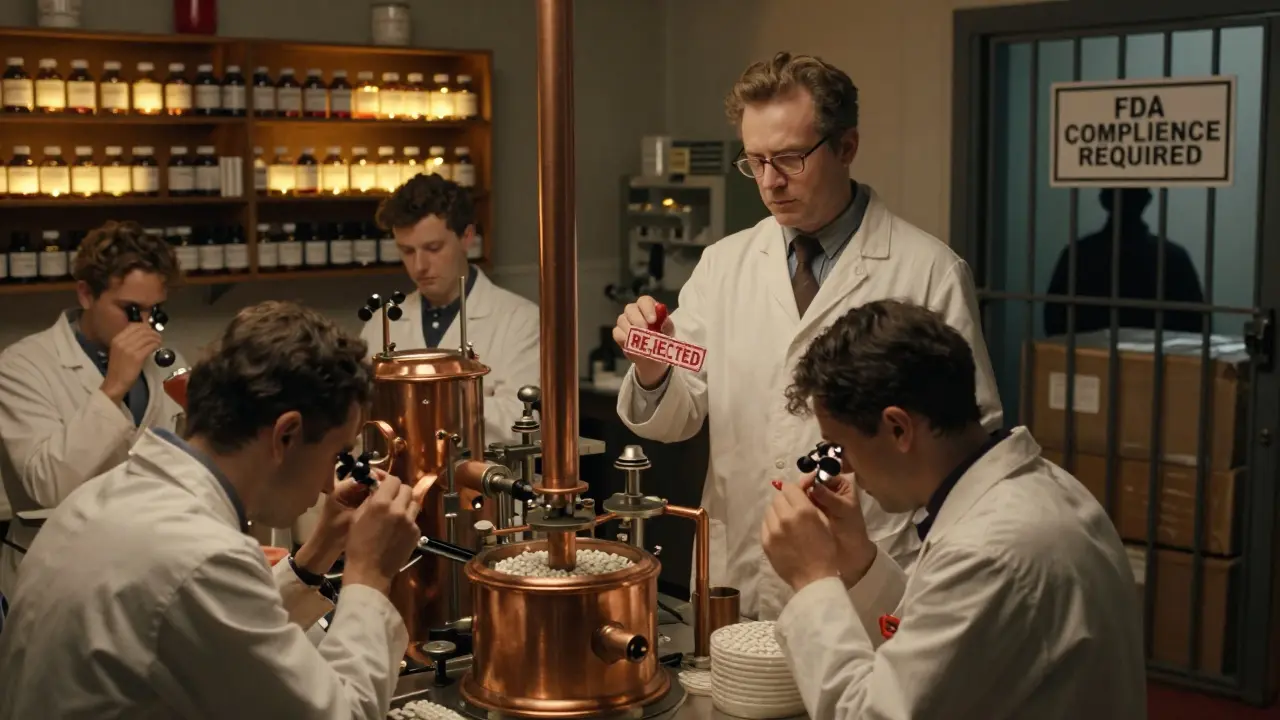
- Quality Unit: This is unique to the FDA system. The Quality Unit has final authority to approve or reject any batch. Even if the production manager says it’s fine, if Quality says no, the batch gets quarantined. No exceptions.
How Is This Different From Other Countries?
The European Medicines Agency (EMA) and other global regulators have similar rules. In fact, about 85% of the requirements line up with the FDA’s. But there are differences. The FDA demands more detailed documentation. Their inspections are more frequent - domestic facilities get inspected about 1.3 times per year on average. Foreign sites get fewer inspections, which has drawn criticism. A 2020-2022 analysis showed foreign facilities received 43% fewer warning letters per inspection than U.S. ones.Some manufacturers say the FDA’s rules are harder to follow. A 2021 study found CGMP compliance costs 18% more in the U.S. than in other regions. But the trade-off is clear: U.S. patients get drugs with a proven, consistent quality track record.
What Happens When Companies Fail?
Failure isn’t just a fine. It’s a shutdown.In 2022, 12 generic metformin products were recalled because of NDMA contamination - a probable carcinogen. The FDA’s warning letter blamed “inadequate process controls and failure to validate cleaning procedures.” That’s a direct CGMP violation.
Other common violations include:
- Missing or falsified lab data (data integrity issues)
- Unvalidated cleaning processes
- Untrained staff
- Improper storage conditions
Foreign facilities account for 63% of all data integrity warning letters. That’s why the FDA is increasing inspections abroad - they’ve allocated 25% more resources to foreign facility checks through 2027.
Real Challenges Manufacturers Face
Implementing CGMP isn’t easy - especially for small companies.A 2022 survey of 317 generic manufacturers found that 68% struggled with documentation. One company on Reddit said switching to electronic batch records cost $1.2 million and took 14 months. Another said their compliance costs hit $2.3 million a year.
Training is another big hurdle. Staff need 80-120 hours of CGMP training every year. New hires often take 12-18 months to become fully proficient. And even then, inspections can feel inconsistent. A 2023 survey showed 57% of manufacturers felt different FDA inspectors interpreted the rules differently.
But there are success stories. Teva used continuous manufacturing for a heart drug and cut batch failures from 4.2% to 0.7% - all while staying fully compliant. That’s the goal: not just to pass inspections, but to build quality into every step.
What’s Changing in 2024 and Beyond?
The FDA isn’t standing still. Here’s what’s coming:- Continuous manufacturing: Traditional batch production is being replaced by systems that make drugs nonstop, like a printing press. The FDA is working on new guidance expected in Q2 2024 to help manufacturers adapt CGMP to this tech.
- Data integrity: Expect tighter enforcement of 21 CFR Part 11. Over 78% of companies still struggle with audit trails and electronic records.
- Supply chain security: The Drug Supply Chain Security Act is pushing for better tracking of ingredients. By 2028, 68% of industry leaders expect stricter rules on sourcing active pharmaceutical ingredients (APIs).
- AI and predictive quality: The FDA is encouraging manufacturers to use AI to predict quality issues before they happen. McKinsey predicts 65% of companies will use predictive systems by 2028.
The bottom line: CGMP isn’t about checking boxes. It’s about building a culture of quality. The FDA doesn’t want you to just meet the minimum - they want you to anticipate problems before they happen.
Why This Matters to You
If you take generic medication - and 90% of U.S. prescriptions are filled with generics - you’re relying on these rules every day. CGMP ensures that the $105 billion generic drug market delivers safe, effective medicine at a fraction of the cost. Without these standards, there’d be no trust in generics. And without trust, patients would pay more, skip doses, or risk side effects from contaminated or ineffective drugs.It’s not glamorous. No one sees the clean rooms, the calibration logs, or the quality audits. But every time you get a generic pill that works just like the brand, that’s CGMP at work.
Are CGMP requirements the same for brand-name and generic drugs?
Yes. The FDA requires that generic drugs be manufactured under the exact same CGMP standards as brand-name drugs. There is no separate or lesser set of rules for generics. This is why generics are considered therapeutically equivalent - they’re made with the same quality controls.
What happens if a generic drug manufacturer violates CGMP?
The FDA can issue a warning letter, block new product approvals, or even halt production. In serious cases, the agency can seize products, sue the company, or ban imports. Recalls are common after major violations - like the 2022 metformin recalls due to contamination from poor process controls.
Do all generic drugs come from foreign countries?
No. While over 80% of generic drug manufacturing happens outside the U.S. - mostly in India and China - there are still more than 120 FDA-approved domestic manufacturing facilities. The location doesn’t matter as long as the facility passes FDA inspections and meets CGMP standards.
How often does the FDA inspect generic drug factories?
Domestic facilities are inspected about every 18 months on average, while foreign facilities are inspected less frequently - typically every 3 to 5 years. However, the FDA is increasing its foreign inspection rate by 25% through 2027, especially for high-risk sites and those with past violations.
Can a generic drug be approved without CGMP compliance?
No. CGMP compliance is mandatory for any Abbreviated New Drug Application (ANDA) to be approved. The FDA will not approve a generic drug if its manufacturing process doesn’t meet these standards - even if the drug is chemically identical to the brand.
What’s the biggest challenge for generic manufacturers today?
The biggest challenge is maintaining data integrity and documentation under increasing scrutiny. Many companies, especially smaller ones, struggle with electronic record systems, audit trails, and real-time monitoring. The cost and complexity of compliance are rising, making it harder for small players to compete.
Next Steps for Manufacturers
If you’re a manufacturer starting out:- Build a Quality Management System (QMS) with documented procedures for every process.
- Qualify your facility (IQ/OQ/PQ) and validate your production processes.
- Train all staff - and keep training records.
- Implement an electronic quality system (eQMS) if possible - it’s now standard for mid-sized and large firms.
- Prepare for FDA inspections by running mock audits and reviewing past warning letters.
The path to compliance is long and expensive. But for any company serious about selling generics in the U.S., it’s the only path.
Ryan W
January 25, 2026 AT 20:24Let’s be real - the FDA’s CGMP rules are a bureaucratic nightmare designed to protect Big Pharma’s profits, not patients. Every time a small manufacturer goes under because they can’t afford $2M in compliance costs, it’s just another monopoly tightening its grip. And don’t get me started on the foreign inspection fraud. They inspect Indian plants once every five years and act like that’s ‘due diligence.’ Meanwhile, we’re paying 5x more for drugs just because some bureaucrat in DC thinks ‘Made in USA’ means ‘safe.’
Dan Nichols
January 27, 2026 AT 05:11CGMP is just corporate theater. You think all those clean rooms and audit trails actually prevent contamination? Nah. It’s about paper trails, not real quality. I’ve seen plants where the inspectors get champagne tours while the actual workers are cutting corners because they’re overworked and underpaid. The FDA doesn’t care about outcomes - they care about checkboxes. And that’s why we still get NDMA in metformin. No one’s testing the damn pills - they’re just checking if the logbook was signed.
Renia Pyles
January 27, 2026 AT 07:30My uncle died from a generic blood pressure med that turned out to be half-strength. The FDA says it’s ‘therapeutically equivalent’ - yeah right. Equivalent to what? A placebo with a price tag? They don’t test enough. They don’t inspect enough. And they sure as hell don’t punish enough. This isn’t science - it’s a casino where the house always wins and patients lose.
Rakesh Kakkad
January 27, 2026 AT 14:56As a pharmaceutical engineer from India, I must emphasize that CGMP compliance is not merely a regulatory obligation but a moral imperative. The infrastructure, training, and documentation systems in Indian facilities are world-class and often exceed FDA expectations. However, geopolitical bias in inspection frequency undermines the credibility of the entire system. We produce over 40% of the world’s generics - yet we are treated as suspects, not partners.
Nicholas Miter
January 27, 2026 AT 17:31Just wanted to say - I work in a small generic lab in Ohio. We got our first FDA inspection last year. It was brutal. Took us 8 months to fix the audit trail on our HPLC logs. But honestly? After it was done, I felt better about the pills we make. Not because we passed - but because we actually fixed the dumb stuff we’d been ignoring for years. The system’s broken, sure. But if you care about what’s in the bottle, you do the work. No magic. Just grind.
Suresh Kumar Govindan
January 27, 2026 AT 23:17Foreign manufacturers are not just non-compliant - they are actively deceptive. The 63% data integrity violation rate is not a statistic. It is evidence of systemic fraud. The FDA allows this because it needs cheap drugs. But cheap drugs made with falsified data are not medicine - they are chemical roulette. And you, the consumer, are the gambler.
TONY ADAMS
January 29, 2026 AT 12:50Man, I just took my generic lisinopril this morning and thought - holy crap, this stuff actually works. Who cares if the paperwork’s messy? As long as it don’t kill me, I’m good. Let the suits fight over the logs.
George Rahn
January 30, 2026 AT 00:55CGMP is the last bastion of American industrial dignity in a world of commodified medicine. It is the silent covenant between science and sovereignty - a covenant written not in ink, but in calibrated instruments, signed in ink, and sealed in the unyielding resolve of quality units who say NO when the factory screams YES. To dismantle CGMP is not to lower costs - it is to surrender the sanctity of healing to the altar of profit. This is not regulation. This is reverence.