
Chronic Hepatitis C: How Modern Antivirals Cure the Virus and Protect the Liver
 Nov, 29 2025
For decades, chronic hepatitis C was a silent killer. Many people carried the virus for years without symptoms, only to discover too late that their liver was damaged beyond repair. Cirrhosis. Liver cancer. Transplant. These weren’t just medical terms-they were life-altering outcomes. But everything changed after 2014. Today, chronic hepatitis C is not just manageable-it’s curable in most cases, with a simple 8- to 12-week course of pills and almost no side effects.
What Changed? The Rise of Direct-Acting Antivirals
Before 2014, treatment for hepatitis C meant weekly injections of interferon and daily ribavirin pills for up to a year. Side effects were brutal: severe fatigue, depression, flu-like symptoms, anemia, and even suicidal thoughts. Cure rates? They hovered between 40% and 80%, depending on your genotype and how advanced your liver damage was. Many patients gave up. Others couldn’t tolerate the treatment at all. Then came direct-acting antivirals (DAAs). These are oral medications that attack the hepatitis C virus directly, blocking the proteins it needs to replicate. No injections. No months of misery. Just one pill a day, often combined into a single tablet. The results? Over 95% of patients achieve a sustained virologic response (SVR)-meaning the virus is undetectable in the blood 12 weeks after treatment ends. That’s the medical definition of a cure. The most common DAA combinations today include:- Sofosbuvir/velpatasvir (Epclusa)
- Glecaprevir/pibrentasvir (Mavyret)
- Sofosbuvir/velpatasvir/voxilaprevir (Vosevi) - used only if prior DAA treatment failed
How Do These Drugs Actually Work?
Hepatitis C is a tricky virus. It copies itself using three key proteins: NS3/4A protease, NS5A, and NS5B polymerase. DAAs target each of these like precision tools.- NS3/4A protease inhibitors (like glecaprevir) stop the virus from cutting its proteins into working pieces.
- NS5A inhibitors (like velpatasvir) prevent the virus from assembling new copies of itself.
- NS5B polymerase inhibitors (like sofosbuvir) jam the virus’s RNA-making machine.
What Happens to Your Liver After Treatment?
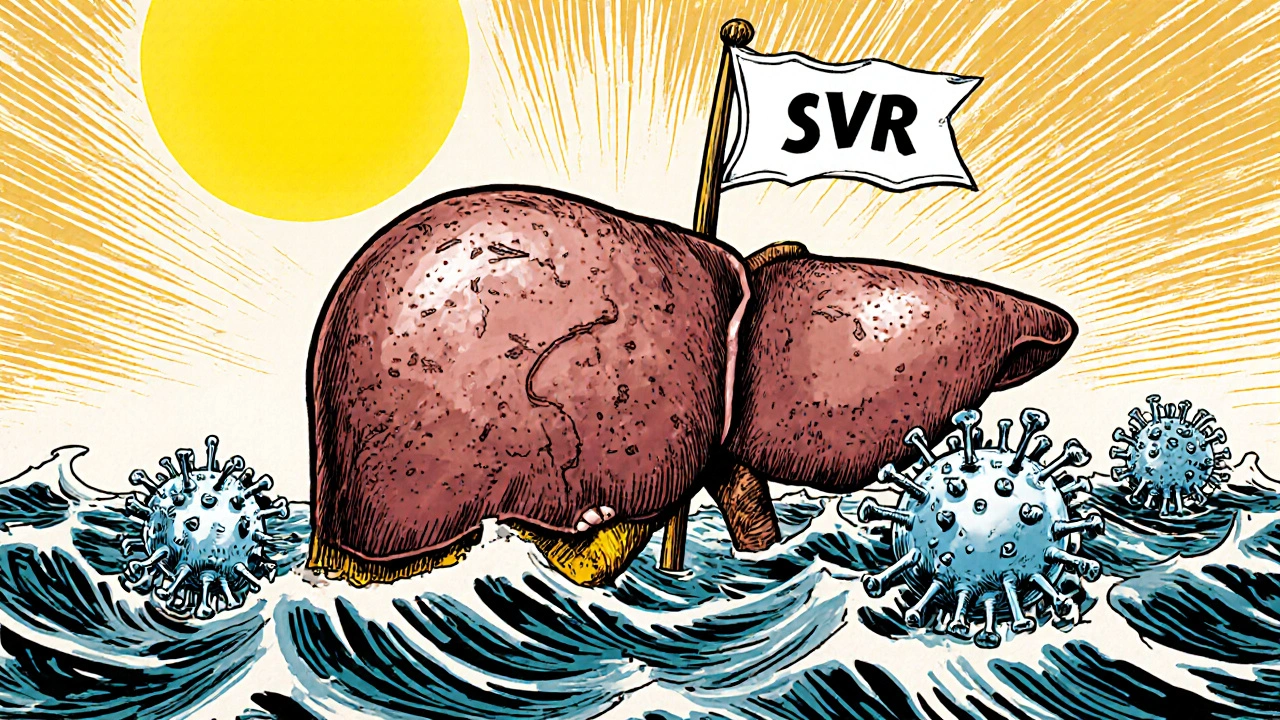
Curing the virus doesn’t just mean you’re no longer infectious. It means your liver starts healing. Studies from the Mayo Clinic show that after successful DAA treatment:- 95% of patients stop fibrosis progression
- 70% see actual regression of liver scarring within five years
- The risk of liver cancer drops by 70-80%
- The risk of liver failure and death plummets
Side Effects? Almost None
The biggest surprise for most patients? How easy the treatment is. The CDC reports that over 90% of people on DAAs experience no side effects beyond mild fatigue or a headache in the first week. That’s it. No nausea. No hair loss. No depression. No hospital visits. Some patients report trouble sleeping or a slight loss of appetite, but these are temporary and rarely severe enough to stop treatment. Compared to the old interferon days, it’s like switching from a sledgehammer to a scalpel. The only real challenge? Getting the medication. In the U.S., the initial price for a 12-week course was over $90,000 in 2013. Today, it’s around $74,700-but insurance usually covers it. Manufacturer assistance programs help 70% of uninsured patients get the drugs for free or at low cost. Many states and community clinics now offer free testing and treatment, especially for people who inject drugs or have Medicaid.Who Can Be Treated Now?
The good news? Almost everyone. The World Health Organization updated its guidelines in 2022 to recommend DAA treatment for children as young as 3 years old. Adults with cirrhosis, HIV, kidney disease, or even liver cancer can now be treated safely. In fact, treating hepatitis C before liver cancer develops is one of the most effective cancer prevention strategies we have. The only exceptions are the 1-5% of patients who have failed multiple DAA regimens. For them, doctors use specialized retreatment plans, often involving newer combinations like Vosevi or experimental drugs still in trials. But even these cases are rare.
Why Isn’t Everyone Cured Yet?
Here’s the hard truth: we have the cure. But we don’t have the diagnosis. Globally, only about 20% of people with hepatitis C know they’re infected. Many are unaware because the virus causes no symptoms for decades. Others avoid testing due to stigma, lack of access, or fear. In low- and middle-income countries, less than 15% of diagnosed patients receive treatment. In the U.S., community clinics treat only about 65% of diagnosed patients, while integrated systems like the Veterans Health Administration hit 95% because they made testing and treatment part of routine care. The biggest barriers aren’t medical-they’re systemic:- Too few screening programs
- Insurance denials and prior authorization delays
- Lack of provider training in primary care
- Reinfection among people who inject drugs (5-10% per year)
What’s Next for Hepatitis C?
The World Health Organization wants to eliminate hepatitis C as a public health threat by 2030. That means a 90% drop in new infections and a 65% drop in deaths. We can hit that goal-if we scale up testing and remove barriers to treatment. Right now, the U.S. treats about 200,000 people a year. To meet the 2030 target, we’d need to treat 400,000 annually. That’s doable. It just requires better screening in ERs, prisons, drug treatment centers, and primary care offices. The science is no longer the problem. The problem is access.What Should You Do If You Think You Might Have Hepatitis C?
If you were born between 1945 and 1965, got a blood transfusion before 1992, used injectable drugs, or have unexplained liver enzyme elevations, get tested. A simple blood test can tell you if you’re infected. If you test positive, don’t panic. Ask your doctor about DAA treatment. You don’t need a liver specialist. Most primary care providers can prescribe it now. And if insurance denies coverage, ask about patient assistance programs-they exist, and they work. This isn’t a chronic disease you live with forever. It’s a curable infection. And if you’ve been living with it, you’re not alone. More than 10 million people worldwide have already been cured since 2013. You can be next.Can chronic hepatitis C be cured completely?
Yes. Direct-acting antivirals (DAAs) cure more than 95% of people with chronic hepatitis C. A sustained virologic response (SVR)-meaning the virus is undetectable 12 weeks after treatment ends-is considered a cure. Liver damage can also improve over time.
How long does hepatitis C treatment take?
Most DAA treatments last 8 to 12 weeks. People without cirrhosis usually take 8 weeks. Those with advanced liver disease or prior treatment failure may need 12 to 24 weeks. Treatment duration is based on liver health, not just the virus.
Are there side effects from modern hepatitis C drugs?
Most people experience no side effects. The most common are mild fatigue or headache during the first week. Unlike older interferon treatments, DAAs don’t cause depression, anemia, or severe flu-like symptoms. Over 90% of patients complete treatment without interruption.
Do I still need to monitor my liver after being cured?
Yes-if you had cirrhosis before treatment. Even after curing the virus, people with advanced scarring remain at higher risk for liver cancer. Doctors recommend ongoing ultrasound screenings every 6 months. If you had no cirrhosis, routine liver monitoring is usually not needed after cure.
Can I get hepatitis C again after being cured?
Yes. Being cured doesn’t give you immunity. If you’re exposed again-through sharing needles, unsterile tattoos, or other blood contact-you can become reinfected. People who inject drugs should use clean equipment and seek harm reduction services to prevent reinfection.
Is hepatitis C treatment covered by insurance?
Most private insurance plans, Medicaid, and Medicare cover DAA treatment. Some require prior authorization or proof of liver damage, but these barriers are decreasing. Manufacturer assistance programs help uninsured patients get treatment for free or at low cost.
Can children be treated for hepatitis C?
Yes. Since 2022, the World Health Organization recommends DAA treatment for children as young as 3 years old. Pediatric formulations are available and have shown the same high cure rates as in adults.
What’s the difference between hepatitis B and hepatitis C?
Hepatitis B is a DNA virus that often becomes chronic, especially if contracted in childhood. It can’t be cured yet, but it can be controlled with lifelong medication. Hepatitis C is an RNA virus that’s curable in nearly all cases with 8-12 weeks of oral antivirals. Vaccines exist for hepatitis B, but not for hepatitis C.
Robert Bashaw
November 30, 2025 AT 17:00This isn't just medicine-it's a goddamn miracle. I remember my uncle on interferon, screaming into the void at 3 a.m., begging for death. Now? A pill. One pill. No needles. No nightmares. My aunt got cured last year and went skydiving on her 65th birthday. The virus didn't stand a chance. We're living in the future, folks. The future is soft, silent, and comes in a blister pack.
Brandy Johnson
December 1, 2025 AT 17:08While the efficacy of DAAs is statistically compelling, the underlying economic and geopolitical implications remain deeply concerning. The concentration of pharmaceutical monopolies, particularly by U.S.-based entities, has created a global treatment disparity that constitutes a form of medical colonialism. The $50 generic pricing in India is not altruism-it is strategic market penetration. The U.S. taxpayer subsidizes R&D, then foreign manufacturers undercut prices to capture emerging markets. This is not progress. It is exploitation dressed in white coats.
Peter Axelberg
December 3, 2025 AT 04:39Look, I’ve known people who’ve been through the old treatment-interferon was like being tortured with a rusty spoon while your brain got rewired by a drunk electrician. And now? You pop a pill, go to work, eat tacos, watch Netflix, and boom-12 weeks later, you’re virus-free. No drama. No drama at all. I’ve got a cousin who was a needle user for years, got diagnosed at 42, started treatment last winter, and now he’s coaching Little League. That’s the real win. Not the science. Not the stats. It’s the guy who gets to hold his kid again without fear. That’s the kind of medicine that matters.
Monica Lindsey
December 4, 2025 AT 21:52It’s not a cure. It’s a Band-Aid on a bullet wound. You’re still a carrier of stigma. And if you’re reinfected? You’re careless. You deserve it.
jamie sigler
December 5, 2025 AT 23:00I mean… I guess it’s nice that some people can afford it. But what about the rest of us? I’ve got a friend who got denied insurance coverage three times. They told him he needed to have ‘advanced fibrosis’ first. So he waited. And now he’s waiting for a liver transplant. Meanwhile, the drug companies are laughing all the way to the bank. I just… I don’t know. It feels wrong. Like we’re being sold a dream that only works if you’re lucky enough to have the right insurance.
Bernie Terrien
December 7, 2025 AT 15:5295% cure rate? Cute. But that 5%? They’re the ones who got screwed by the system. Missed appointments. Ran out of meds. Got reinfected. And now they’re labeled ‘treatment failures.’ No one asks why. No one cares. The system doesn’t treat people. It treats compliance metrics. And if you’re poor, addicted, or homeless? You’re just a footnote in a clinical trial.
Jennifer Wang
December 8, 2025 AT 03:11It is imperative to emphasize that while direct-acting antivirals have revolutionized the management of chronic hepatitis C, post-treatment surveillance remains critical for individuals with pre-existing cirrhosis. The reduction in hepatocellular carcinoma risk is significant but not absolute. Annual ultrasound surveillance, ideally every six months, combined with alpha-fetoprotein monitoring, is recommended by the American Association for the Study of Liver Diseases. Failure to adhere to this protocol may result in delayed diagnosis of malignancy, negating the benefits of viral eradication.
Subhash Singh
December 8, 2025 AT 08:05As someone from India, I can confirm that generic DAAs have transformed public health here. In rural clinics, we now test and treat in the same visit. The cost per course is less than a week’s wages for a laborer. Yet, awareness remains low. Many still believe hepatitis C is contagious through food or touch. We need community health workers-not just doctors-to educate. And we need to stop treating this as a ‘Western problem.’ It’s a human problem. And now, we have the tools. The only question is: do we have the will?
Geoff Heredia
December 9, 2025 AT 07:31Let’s be real-this whole ‘cure’ thing is a distraction. Big Pharma and the CDC are pushing DAAs to make us forget that hepatitis C was spread through contaminated blood products in the 80s. Who was in charge then? Who covered it up? Why did they wait 30 years to fix it? And why are the same companies now selling ‘generic’ versions only after patents expired? This isn’t medicine. It’s a cover-up with a side of profit. They knew. They always knew. And now they’re playing hero.
Tina Dinh
December 11, 2025 AT 05:41YESSSSSS 🙌🏼 I got cured last year and I’m literally crying typing this. No more anxiety. No more hiding my scars. I can hug my niece without feeling like a walking biohazard. This isn’t just science-it’s freedom. 💪🏼❤️
Sullivan Lauer
December 13, 2025 AT 02:04Let me tell you something-this is the single most important medical breakthrough since antibiotics. I’ve worked in ERs for 18 years. I’ve seen the fallout. I’ve held the hands of people who thought they were going to die because they got a blood transfusion in 1987. I’ve watched families break apart because the virus was a secret they couldn’t speak. And now? Now we have a way to erase that shame. One pill. Twelve weeks. Done. No more guilt. No more fear. No more waiting for the other shoe to drop. This isn’t just treatment. It’s redemption. And if your doctor won’t prescribe it? Find another one. If your insurance denies it? Fight them. Call the manufacturer. Go to a community clinic. Don’t let bureaucracy steal your second chance. You’ve survived this long. Now go finish the job. You’re not just getting cured-you’re getting your life back.