
Athlete Anti-Doping Rules: Prescription Medications and Side Effects to Consider
 Mar, 10 2026
Athlete Medication Doping Checker
Check Your Medication
Results
Note: This is a simplified tool based on WADA rules. For official information, always check Global DRO and consult your anti-doping organization.
Every year, thousands of athletes take prescription medications for asthma, ADHD, diabetes, or chronic pain-medications that could accidentally land them in violation of anti-doping rules. It’s not about cheating. It’s about not knowing. A simple inhaler, a common painkiller, or a daily pill for ADHD might contain a substance banned in sport. And if it shows up in a drug test, the athlete is on the hook-even if they didn’t know it was prohibited.
Strict Liability: You’re Responsible, No Matter What
The first thing every athlete needs to understand: strict liability. This isn’t a suggestion. It’s the rule. If a banned substance is found in your body, you’re responsible. It doesn’t matter if you got it from a friend, took it without reading the label, or your doctor prescribed it without knowing the rules. The World Anti-Doping Agency (WADA) makes this crystal clear: athletes must check every medication before using it-even if they’ve used it before.
Think about it: a student-athlete with asthma has been using an albuterol inhaler for years. They never had a problem. Then, during a national competition, they test positive. Why? Because they used a different brand-one with a higher dose. The old inhaler was within the allowed limit. The new one wasn’t. No intent. No malice. Just ignorance. And now they face a suspension.
The Prohibited List: What’s Banned and When
WADA updates its Prohibited List every year. The 2024 version includes over 250 specific substances. But it’s not just about what’s banned-it’s when it’s banned.
- Always banned: Anabolic steroids, growth hormone, EPO, and stimulants like cocaine or methamphetamine are prohibited 24/7, in and out of competition.
- In-competition only: Some substances, like certain beta-2 agonists (e.g., salbutamol), are only banned during competition. Outside competition, they’re fine-within limits.
- Specific routes banned: Inhaled salbutamol is allowed up to 1,600 micrograms over 24 hours. But if you take it intravenously? That’s a violation, no matter when.
Even common corticosteroids like prednisone are banned in competition. They’re allowed out of competition, but athletes must wait 48 to 72 hours after the last dose before competing. Missing that window? That’s an automatic violation.
Therapeutic Use Exemptions (TUEs): The Legal Way to Use Banned Medications
If you need a banned substance for a legitimate medical reason, there’s a path: the Therapeutic Use Exemption (TUE). But it’s not a form you fill out the day before a race. It’s a process.
To get a TUE, you must prove four things:
- You have a diagnosed medical condition that requires the banned substance.
- The medication won’t give you an unfair advantage-it only restores you to normal health.
- There’s no permitted alternative that works as well.
- You applied before you used it-unless it was an emergency.
For example, a diabetic athlete using insulin needs a TUE. So does someone with ADHD taking Adderall. A 2023 case study from USA Swimming showed a 17-year-old swimmer successfully got approved for insulin after working with their endocrinologist and submitting full medical records. But it took months. And 42% of athletes who tested positive said they didn’t know their medication contained a banned ingredient.
Approval rates vary. National-level athletes in the U.S. have a 94.3% approval rate for initial TUEs. But international athletes must apply through their sport’s federation-and 92% of those applications are processed within 21 days. Still, delays happen. One NCAA athlete spent 11 months getting approval for Adderall, submitting three applications and getting referrals from specialists.

Side Effects You Can’t Ignore
Taking banned substances-even with a TUE-comes with risks. Doctors often focus on treating the condition. Athletes need to know the side effects too.
- Corticosteroids: Used for inflammation, but long-term use can suppress adrenal function. That means your body stops making its own cortisol. Suddenly stopping it can cause fatigue, nausea, or even collapse.
- Beta-2 agonists (like albuterol): Great for asthma, but too much can cause heart palpitations, tremors, or dangerous arrhythmias. WADA’s medical director says asthma meds make up 21.3% of all TUEs-and misuse is common.
- Stimulants (like methylphenidate): Used for ADHD, but they raise heart rate and blood pressure. In high doses, they can trigger cardiac events during intense training.
Dr. Larry Bowers from USADA warns: “Different substances take different amounts of time to leave your system.” One athlete tested positive for a stimulant three weeks after their last dose because they didn’t account for slow metabolism. Another thought they were safe because they stopped the medication a week before competition. But the substance lingered in their fat tissue.
Global DRO: Your Best Friend
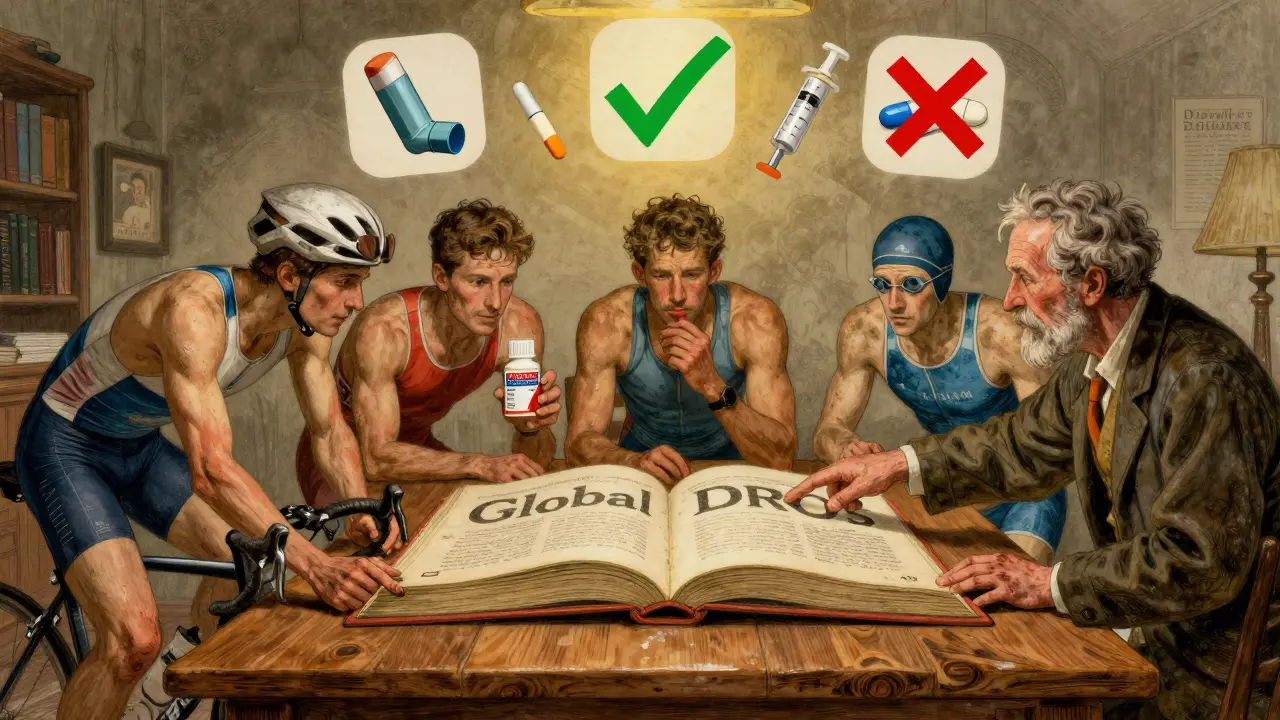
There’s a tool that saves athletes every day: Global DRO. It’s a free, searchable database maintained by USADA, UKAD, and other national agencies. You pick your country, your sport, and the medication name. It tells you if it’s banned, if it’s allowed with limits, or if you need a TUE.
It covers over 1,200 medications across 10 countries. You can check everything from Advil to Zyrtec. But you have to use it correctly. Many athletes search by brand name and get confused. Others don’t realize that the same active ingredient can have different rules depending on the delivery method.
For example: “Ibuprofen” is fine. “Ibuprofen + pseudoephedrine” might not be. Pseudoephedrine is banned in competition above a certain threshold. Global DRO will tell you that. Your pharmacist won’t always know.
Doctors Don’t Always Know the Rules
Here’s the scary part: 68% of athletes say their doctors don’t understand anti-doping rules. A 2022 study found that 89% of physicians treating athletes believe they should check the WADA Prohibited List-but only 63% have ever looked at it.
Doctors prescribe based on medical need. They don’t train for sports regulations. That’s why athletes must take charge. Bring your own checklist. Show your doctor the WADA guidelines. Use the “Check Your Medication” toolkit from WADA. Ask: “Is this banned in my sport? Is there a limit? Do I need a TUE?”
Physicians in British Columbia are now required to consult the Prohibited List before prescribing to athletes. But that’s not universal. You can’t rely on them to know. You have to know.
What Happens If You Get Caught?
Violations range from warnings to four-year bans. The severity depends on the substance, intent, and history. A first-time offense for a low-risk substance might get you a warning. A second offense, or use of a performance-enhancing drug, means a long suspension.
But the real cost isn’t just the ban. It’s the lost training, the missed competitions, the damaged reputation. And for youth athletes? The fear is worse. A 2023 USADA survey found that 28% of young athletes stopped taking necessary medications because they were scared of a positive test. Some developed worse health conditions as a result.
What You Need to Do Right Now
Here’s your action plan:
- Check every medication-prescription, OTC, supplements-on Global DRO before you take it.
- Inform your doctor that you’re an athlete subject to anti-doping rules. Give them the WADA Prohibited List link.
- Plan ahead. If you need a TUE, apply at least 30 days before your next competition. Emergency TUEs exist, but don’t count on them.
- Know clearance times. If a substance is banned in competition, stop taking it early enough to clear your system. Check Global DRO for exact timelines.
- Don’t assume. Just because it worked last time doesn’t mean it’s safe now. Brands change. Doses change. Rules change.
There’s no excuse for not knowing. The tools are free. The information is public. The consequences are real.
Can I use my asthma inhaler if I’m an athlete?
Yes, but only if it’s inhaled and within the allowed dose. Salbutamol (albuterol) is permitted up to 1,600 micrograms over 24 hours. Higher doses or oral/intravenous use are banned. Always check the specific product on Global DRO, as formulations vary by brand. You don’t need a TUE if you stay within limits, but you must declare it on your doping control form.
Do I need a TUE for insulin if I have diabetes?
Yes. Insulin is a prohibited substance under the hormone and metabolic modulators category. Even though it’s essential for managing diabetes, it must be approved through a TUE. You’ll need documentation from your endocrinologist, including blood sugar logs, diagnosis records, and treatment history. Apply well in advance-processing can take weeks.
What if my doctor prescribes a banned medication?
You’re still responsible. Even if your doctor prescribed it, you can’t use it without a TUE. Ask your doctor to check Global DRO or contact your national anti-doping organization. They may be able to suggest an alternative. If not, you must apply for a TUE before taking it. Never assume your doctor knows the rules-always verify yourself.
Can I take over-the-counter cold medicine?
Some can. Many contain pseudoephedrine, phenylephrine, or dextromethorphan-substances that are banned in competition above certain thresholds. Always check Global DRO before taking any OTC product. Even “natural” supplements can contain banned stimulants. When in doubt, don’t take it.
How long does it take for a banned substance to leave my system?
It varies widely. Stimulants like Adderall can clear in 24-48 hours. Corticosteroids may take 48-72 hours. Some substances, like anabolic agents, can stay in your system for months. Global DRO provides clearance timelines for many medications. If it’s not listed, assume it takes longer than you think. When in doubt, stop taking it at least 7-10 days before competition.
Denise Jordan
March 10, 2026 AT 21:19Tom Bolt
March 11, 2026 AT 08:56Kenneth Zieden-Weber
March 11, 2026 AT 10:38Donnie DeMarco
March 13, 2026 AT 03:18LiV Beau
March 14, 2026 AT 01:58Adam Kleinberg
March 14, 2026 AT 22:33Chris Bird
March 15, 2026 AT 04:50David L. Thomas
March 15, 2026 AT 21:42Alexander Erb
March 17, 2026 AT 06:19Mike Winter
March 17, 2026 AT 23:27Shourya Tanay
March 19, 2026 AT 06:30Gene Forte
March 20, 2026 AT 08:03Bridgette Pulliam
March 21, 2026 AT 12:30