
Acid-Reducing Medications and How They Interfere with Other Drugs
 Dec, 19 2025
Drug Absorption pH Calculator
Medication Input
How It Works
Acid-reducing medications raise stomach pH from normal 1.5-3.5 to 4.0-6.0. This affects how weak acids and bases dissolve and get absorbed in the stomach:
Absorption Results
Enter medication details to see absorption calculation
When you take a proton pump inhibitor like omeprazole or an H2 blocker like famotidine for heartburn, you’re not just changing your stomach’s acidity-you’re potentially changing how well your other medications work. It’s not a rumor. It’s not a side effect you can ignore. This is a well-documented, clinically significant issue that affects thousands of people every year. And most of them have no idea it’s happening.
How Acid-Reducing Drugs Actually Work
Proton pump inhibitors (PPIs) and histamine H2-receptor antagonists (H2RAs) reduce stomach acid by targeting different parts of the acid-production system. PPIs like omeprazole, esomeprazole, and lansoprazole shut down the final step-blocking the proton pump in stomach cells. H2RAs like ranitidine and famotidine block histamine signals that tell cells to make acid. Both raise stomach pH from its normal range of 1.0-3.5 up to 4.0-6.0. That sounds harmless, even helpful. But for certain drugs, that small pH shift is enough to stop them from working.
Why pH Changes Break Drug Absorption
Most oral drugs are either weak acids or weak bases. Their ability to dissolve and get absorbed depends heavily on the pH around them. The Henderson-Hasselbalch equation explains this: if a drug is a weak base (pKa >7), it dissolves better in acid. If it’s a weak acid (pKa <7), it dissolves better in alkaline environments. The problem? About 70% of all oral medications are weak bases. That includes HIV drugs, cancer treatments, antifungals, and even some blood pressure meds.
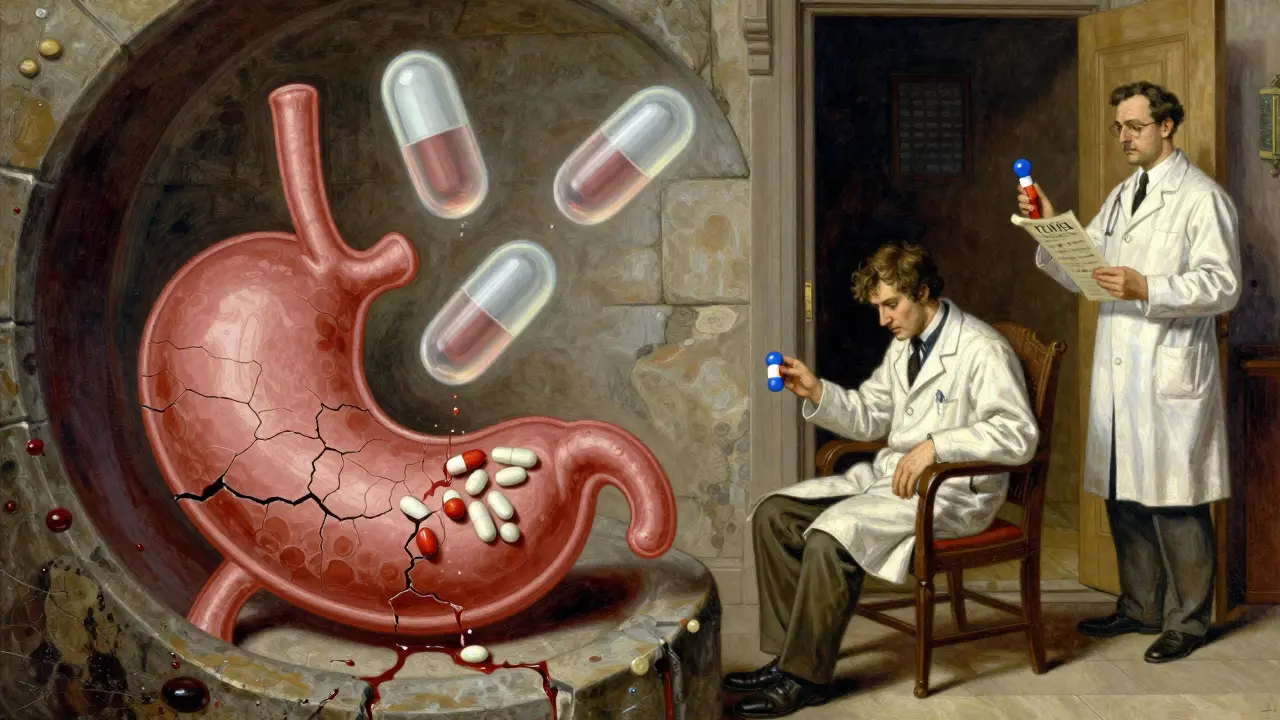
When your stomach pH rises from 2 to 5, these weak bases stop dissolving. They stay in their non-ionized form, which doesn’t mix well with water. Without dissolving, they can’t be absorbed. And even though most absorption happens in the small intestine, the first step-dissolution in the stomach-is critical. If the drug doesn’t break down early, it won’t make it through the system properly.
The Drugs Most Affected
Some interactions are so severe they’re labeled as contraindications. Here are the big ones:
- Atazanavir (HIV treatment): When taken with a PPI, its absorption drops by 74-95%. Patients have seen their viral load jump from undetectable to over 12,000 copies/mL. The FDA says: do not combine.
- Dasatinib (leukemia drug): Absorption falls by about 60%. Studies show patients on PPIs have 37% higher treatment failure rates.
- Ketoconazole (antifungal): Absorption drops 75%. At that level, it’s useless. Many doctors now avoid prescribing it entirely because of this.
- Nilotinib, erlotinib, mycophenolate: All show clinically meaningful drops in blood levels when taken with PPIs.
On the flip side, weak acids like aspirin or esomeprazole itself may absorb slightly better in less acidic environments-but the increase is usually under 25%, and rarely matters clinically.
PPIs vs. H2 Blockers: Not the Same Risk
Not all acid reducers are equal. PPIs are far more dangerous in this context. They suppress acid for 14-18 hours a day. H2RAs only work for 8-12 hours. A 2024 study in JAMA Network Open found PPIs reduce absorption of pH-dependent drugs by 40-80%. H2RAs? Only 20-40%. That’s a big gap.
Also, immediate-release tablets are more vulnerable than extended-release versions. If you’re on dasatinib and your doctor gives you a PPI, ask if there’s an extended-release H2RA option. It might be safer.
Enteric Coatings Don’t Help-They Can Make It Worse
You might think, “My pill is enteric-coated, so it won’t dissolve in my stomach.” That’s true. But here’s the catch: enteric coatings are designed to dissolve at pH 5.5 or higher. When you take a PPI and raise your stomach pH to 6, those pills can dissolve too early-in your stomach, not your intestine. That means the drug gets destroyed by acid before it even gets to the right spot. Or worse, it irritates your stomach lining. The Merck Manual warns this is a hidden risk many clinicians miss.
Real Stories, Real Consequences
Reddit threads are full of people who didn’t know this was possible. One user wrote: “I started Prilosec for heartburn. Two months later, my HIV viral load spiked. My doctor said it was a textbook interaction.” Another said: “My blood pressure meds stopped working. My readings were 20 points higher until my pharmacist caught the Nexium interaction.”
These aren’t rare cases. The FDA’s adverse event database recorded over 1,200 reports of therapeutic failure linked to acid-reducing drugs between 2020 and 2023. Atazanavir, dasatinib, and ketoconazole made up nearly half of those.
What You Can Do
If you’re on an acid-reducing medication and another drug that’s critical to your health, here’s what works:
- Ask your pharmacist. They check for interactions every day. A 2023 study showed pharmacist-led reviews cut inappropriate ARA co-prescribing by 62% in Medicare patients.
- Check the label. The FDA now requires 28 drugs to carry warnings about acid-reducing agents. Look for phrases like “avoid concomitant use” or “reduce dose if used together.”
- Stagger the timing. For weak bases, take the drug at least 2 hours before the PPI or H2RA. It doesn’t fix everything, but it can reduce the interaction by 30-40%.
- Use antacids instead. If you need occasional relief, antacids like Tums or Maalox work fast and don’t last long. Take them 2-4 hours apart from your other meds.
- Ask if you still need the acid reducer. The American College of Gastroenterology says 30-50% of people on long-term PPIs don’t even need them. Stopping could fix more than just your heartburn.
The Bigger Picture
Over 15 million Americans take PPIs long-term. The global market for these drugs hit $18.7 billion in 2023. But for every dollar saved on heartburn meds, there are dollars lost to failed cancer treatments, HIV rebounds, and hospital visits from drug underdosing. The FDA estimates these interactions cost the U.S. healthcare system $1.2 billion a year.
Pharma companies are starting to respond. About 37% of new drugs in development now use pH-independent delivery systems. AI tools are being trained to predict these interactions with 89% accuracy. And electronic health records are finally catching up-Epic Systems reports 78% of doctors now follow clinical alerts warning about dangerous combinations.
But technology alone won’t fix this. It starts with awareness. If you’re on a chronic medication and suddenly feel like it’s not working-or if you’ve been prescribed an acid reducer without a clear reason-ask: Could this be interfering? It might be the missing piece in your treatment plan.
Can acid-reducing medications make my blood pressure pills less effective?
Yes, in rare cases. While most blood pressure medications aren’t strongly affected, some like nilotinib (used for leukemia) and dasiglucagon (for hypoglycemia) show altered absorption. More commonly, patients report higher readings after starting PPIs-not because the BP drug failed, but because they were taking a different drug (like an antifungal or cancer med) that interacted with the acid reducer, leading to secondary complications. Always check with your pharmacist if you’re unsure.
Is it safe to take Tums with my PPI?
Tums and other antacids are generally safer than PPIs or H2RAs for short-term use because they work quickly and don’t last long. But if you’re taking a pH-sensitive drug like atazanavir or ketoconazole, space them out by at least 2-4 hours. Don’t rely on antacids for daily heartburn-they’re not meant for long-term use and can cause electrolyte imbalances if overused.
Why do some people say their PPI stopped working after a few months?
That’s not usually because the PPI lost effectiveness. More often, it’s because the body adapted to the reduced acid, or the original diagnosis was wrong. Many people take PPIs for heartburn that’s actually functional or diet-related. When the underlying cause isn’t treated, symptoms return. Also, long-term PPI use can cause rebound acid hypersecretion-meaning your stomach makes even more acid when you stop. That’s why deprescribing under medical supervision is recommended.
Can I switch from a PPI to an H2 blocker to avoid interactions?
Switching to an H2 blocker like famotidine can reduce interaction risk, but it doesn’t eliminate it. H2 blockers still raise stomach pH enough to affect drugs like dasatinib and atazanavir. They’re a better option than PPIs if you need ongoing acid control, but the safest move is to avoid all acid reducers if possible-especially if you’re on a high-risk medication. Always consult your doctor before switching.
Do over-the-counter acid reducers have the same risks as prescription ones?
Absolutely. Omeprazole (Prilosec OTC), lansoprazole (Prevacid 24HR), and famotidine (Pepcid AC) are chemically identical to their prescription versions. The dose might be lower, but the mechanism is the same. If you’re on a drug that interacts with PPIs, even one daily OTC pill can cause serious problems. Don’t assume OTC means safe to combine.
How do I know if my medication is affected by stomach pH?
Check the drug’s prescribing information. Look for terms like “pH-dependent absorption,” “avoid concomitant use with acid-reducing agents,” or “decreased bioavailability.” Drugs with a narrow therapeutic index-where small changes in blood levels cause big effects-are most at risk. If you’re unsure, ask your pharmacist to run a drug interaction check. They have tools that flag these issues instantly.
Final Thought
Acid-reducing medications are powerful tools-but they’re not harmless. They’re not just for heartburn. They’re pharmacological tools that alter your body’s chemistry in ways that ripple across your entire medication regimen. If you’re taking one, and you’re also on any chronic drug, especially for HIV, cancer, or autoimmune conditions, don’t assume everything’s fine. Talk to your pharmacist. Ask your doctor if you really need it. Sometimes, the simplest fix isn’t a new pill-it’s stopping one you didn’t know was hurting you.
Nancy Kou
December 19, 2025 AT 21:53I never realized how many of my meds could be getting sabotaged by my heartburn pills. I’ve been on omeprazole for years and just assumed it was harmless. This is eye-opening.
Hussien SLeiman
December 20, 2025 AT 20:46Let’s be real - this whole ‘acid is bad’ narrative was pushed by Big Pharma to sell more PPIs. Your stomach needs acid to kill pathogens and absorb nutrients. Raising pH is like turning off your immune system’s first line of defense. And now we’re seeing the consequences: vitamin B12 deficiency, osteoporosis, C. diff infections. They told you it was safe. They were wrong.
Frank Drewery
December 20, 2025 AT 22:28Thanks for breaking this down. I’ve been on famotidine for years and just thought I was being smart about my diet. This makes me want to talk to my doctor about alternatives. Maybe ginger tea, maybe lifestyle changes - something less chemical.
Danielle Stewart
December 20, 2025 AT 22:47As someone who’s been managing GERD for over a decade, I want to say this: yes, these drugs interfere with absorption - but they also prevent esophageal cancer. The risk-benefit calculus is real. I’m not saying don’t question it. I’m saying don’t throw the baby out with the bathwater. Talk to your pharmacist. Get a med review. But don’t stop cold turkey.
mary lizardo
December 22, 2025 AT 20:56It is imperative to note that the assertion presented herein is not merely anecdotal, but is substantiated by peer-reviewed clinical literature, including multiple meta-analyses published in The New England Journal of Medicine and The Lancet. Furthermore, the failure of primary care physicians to counsel patients regarding these pharmacokinetic interactions constitutes a gross negligence in standard of care. Patients are not being informed. This is a systemic failure.
jessica .
December 24, 2025 AT 18:32They’re doing this on purpose. The FDA, Big Pharma, the WHO - they all know. Acid-reducing drugs make you dependent. They make you buy more meds for the side effects. And the government lets it happen because they get kickbacks. I read a whistleblower report. They’re silencing doctors who speak up. Wake up people.
Ryan van Leent
December 26, 2025 AT 01:24I’ve been on PPIs for 8 years and my bloodwork shows low magnesium and iron. My doc said it was fine. I just stopped them cold and now I feel like a new person. Why didn’t anyone tell me this? I’m not some weakling. I’m just someone who trusted the system. Now I’m angry.
Sajith Shams
December 27, 2025 AT 10:36You people are overreacting. In India we’ve been using herbal remedies like amla and licorice root for centuries to manage acidity. No drugs needed. Your body makes acid for a reason. You don’t suppress it - you balance it. Eat less processed food. Stop drinking soda. Walk after meals. Simple. But you Americans want a pill for everything.
Adrienne Dagg
December 29, 2025 AT 08:07OMG I just realized my thyroid med might not be working because of my Prilosec 😱 I’m calling my pharmacy right now. This is wild. Thanks for the heads up!!
Chris Davidson
December 30, 2025 AT 10:16It’s not complicated. If you’re taking a drug that requires gastric acid for absorption - like ketoconazole, atazanavir, or iron supplements - and you’re also taking a PPI you’re probably getting subtherapeutic levels. That’s basic pharmacology. If your doctor doesn’t know this, find a new one.
mark shortus
December 31, 2025 AT 06:17THIS IS A TRAGEDY. I spent YEARS suffering from chronic fatigue and brain fog because my doctor never told me my PPI was blocking my levothyroxine. I thought I was depressed. I thought I was aging. I was just being slowly poisoned by a pill I thought was helping me. I’m crying right now. Someone please tell me I’m not alone.
Emily P
December 31, 2025 AT 21:54Does this apply to all H2 blockers equally? I’ve read conflicting info on whether famotidine has the same impact as PPIs on drug absorption. Any studies comparing them directly?
Jedidiah Massey
January 1, 2026 AT 19:12From a pharmacokinetic standpoint, the pH-dependent solubility of weakly basic compounds like itraconazole and erlotinib is governed by the ionization state dictated by the Henderson-Hasselbalch equation. PPIs elevate gastric pH beyond the pKa threshold of these agents, thereby reducing their non-ionized fraction and compromising passive diffusion across the duodenal mucosa. This is not speculative - it’s quantifiable bioavailability reduction. The clinical implications are non-trivial.
Allison Pannabekcer
January 3, 2026 AT 12:21Thank you for sharing this. I think we all need to remember that medication isn’t just about treating symptoms - it’s about how everything interacts. I’ve started keeping a med log with my pharmacist and asking about interactions before I take anything new. Small steps, but they matter. You’re not alone in learning this.